SolanaNews
Solana’s Validator Network Shrinks, Supporters Call It a Good Thing


Key points
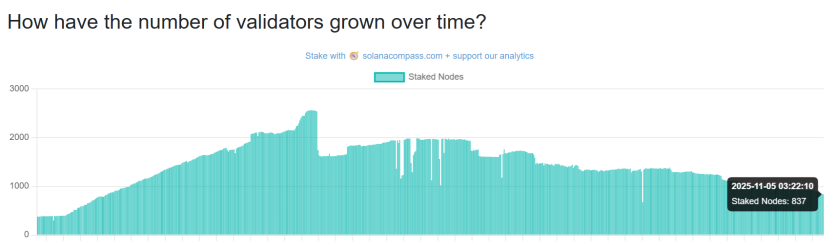
- The number of active validators on Solana has dropped 64% since 2023, falling from around 2,500 to fewer than 900 as part of a network-wide cleanup.
- The Solana Foundation has reduced its SOL loan program for validators to eliminate dependencies and promote a more self-sufficient, efficient network.
- The upcoming “Alpenglow” upgrade aims to lower operational costs and attract new independent validators, reinforcing the system’s stability and diversity.
The number of active validators on Solana has fallen from about 2,500 to fewer than 900 since early 2023 — a 64% reduction.
However, key figures within the ecosystem argue that the network has actually grown stronger. They believe that the nodes leaving the system were inefficient or even harmful to the chain’s stability.
Day open
$155.03
00:00 UTC
Past 7 days
−20.1%
from $194.15
Since the open
−52.2%
$74.06 · 17 Nov, 23:25 UTC
All-time high
−47.1%
$293.31 · Jan 2025
Tomas Eminger, Chief Infrastructure Officer at RockawayX, explained that many of the departing validators were running outdated hardware that couldn’t keep up with Solana’s growth. According to him, their exit removed bottlenecks and improved the system’s overall performance. Among developers, the same argument is repeated: fewer validators doesn’t mean less security — it means a stronger, more optimized foundation.
Solana Is Streamlining and Moving Toward Self-Sufficiency
The shift also stems from an economic adjustment. The Solana Foundation has reduced the amount of SOL tokens it delegates to validators to sustain profitability. The program, originally designed to offset the high operational costs of synchronization and transaction processing, was restructured in April. Since then, for every new validator added, the Foundation has removed three that relied on these subsidies. The goal is to reduce dependence on artificial incentives and strengthen the network’s self-sufficiency.
Alongside inefficient validators, malicious operators have also been eliminated. Dillon Liang, co-founder of Blueprint Finance, noted that many of those who left the network facilitated “sandwich” attacks, where trading bots front-run transactions to gain an advantage over other users. Their removal has reduced the system’s exposure to manipulation and improved infrastructure reliability.

Despite the contraction, the network’s geographic distribution remains balanced. More than 30% of nodes are located in the United States, with the rest spread across dozens of web hosting providers, none holding a dominant share. Some analysts argue that the real metric of resilience is not the number of validators but their distribution and technical quality.
The upcoming “Alpenglow” network upgrade is expected to lower operational costs and attract new independent validators. For Solana developers, the current adjustment is not a setback but a technical purification process aimed at building a more efficient and resilient ecosystem
Notice. For information only; not investment advice.