News
Gnosis Safe Wallet Drained of $6.45M in Suspected Security Breach
A Gnosis Safe wallet suffered a $6.45 million drain following an alleged security breach linked to permissions in the Zodiac Roles module.


Key points
- According to the report by PeckShield and on-chain analyst Specter, unauthorized transfers of approximately $4.3 million in USDC and $1.7 million in syrupUSDC were identified.
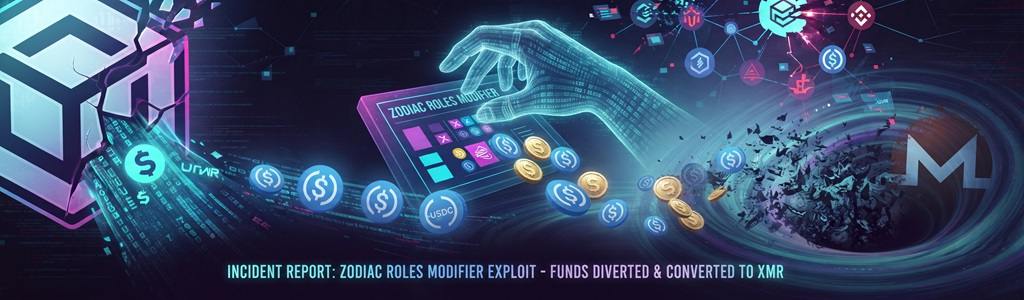
- Investigation data indicate that the stolen assets were partially converted to Monero (XMR) through services such as Hyperliquid and Wagyu.
- Official documentation and reports point out that the attacker exploited existing permissions configured in the Zodiac Roles module to withdraw funds without requiring new signatures.
A new security incident was reported by blockchain firm PeckShield this Monday, November 16. This time, a Gnosis Safe wallet was compromised with estimated losses of $6.45 million. On-chain analyst Specter was the one who detected the attack due to suspicious transfers involving approximately $4.3 million dollars in USDC and $1.7 million dollars in syrupUSDC.
#PeckShieldAlert Specter has reported that a Gnosis Safe may have been compromised, resulting in $6.45M being drained, including $4.3M in $USDC and $1.7M in $syrupUSDC. The hacker has spent ~$813K to buy $XMR on Hyperliquid. pic.twitter.com/BLqlcswoO8
— PeckShieldAlert (@PeckShieldAlert) November 16, 2026
After carrying out the transfers, the funds were moved through exchanges. PeckShield and Specter reported that part of the drained funds were used to purchase XMR, a privacy-focused digital asset. The reports indicate that approximately $813,000 dollars were spent on acquiring XMR on Hyperliquid, while about $1.2 million dollars were converted into Monero via Wagyu. Both estimates correspond to transactions reported through different tracking routes on the network.
The role of permissions in the Zodiac Roles module
According to Specter’s findings, the hackers allegedly used permissions that were already previously configured in the wallet through the Zodiac Roles module. This component is a smart contract tool that allows account owners to assign specific permissions to other addresses within defined parameters.
The Zodiac team explained that administrators can define which contracts an address can interact with, which functions it is allowed to execute, and which are the authorized parameters. Once a role is assigned, the holder can execute approved transactions without the need to obtain new signatures from the Safe owners for each operation.
Initial investigations suggest that this pre-existing permission configuration facilitated the withdrawal of funds without requiring additional approvals at the time of the attack. The two main tokens involved, USDC and syrupUSDC, account for nearly $6 million dollars of the total reported loss.
Fund conversion and background on the Safe
The use of privacy-oriented services, such as Monero, makes it difficult to track funds once they enter its network, due to its technical characteristics that conceal transaction details. Previous investigations into security incidents in the crypto ecosystem reveal similar patterns in the movement of capital derived from thefts or exploits.
The incident adds to other security reported events in Gnosis Safe wallets and third-party modules in recent months. In October, an exploit in the FlashLoopAdapter adapter affected two wallets linked to positions in Aave with losses of $305,000 dollars. Previously, in May, the firm Blockaid identified a $3 million dollar incident related to the SquidRouterModule module, which affected 86 accounts on the Ethereum and Base networks.
Likewise, Gnosis Pay faced a case in June linked to the Zodiac Delay Module, which allowed unauthorized transactions and generated estimated losses of $1.5 million dollars from a vulnerability originating in October 2023. Investigations into these previous incidents included processes of fund recovery and refunds to affected users, according to information disclosed by developers and security firms.