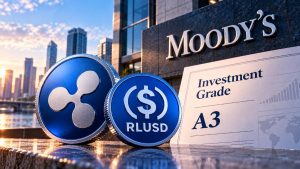
The assignment of an A2 long-term rating and P-1 short-term rating to RLUSD by Moody’s is a verifiable fact and relevant for stablecoin infrastructure. It is also a reading exercise for the sector. The predominant reaction in XRP communities interpreted the announcement as a direct catalyst for the token.
The rating improves the risk profile of RLUSD as a settlement instrument and does not generate any contractual, accounting, or cash-flow channel between the stablecoin and XRP. The economic link exists, but it is second-order, conditional, and has a competitive component that the market tends to omit.
More good news for $RLUSD this week – @moodysratings has assigned RLUSD an A2 long-term rating and P-1 short-term rating, the highest possible short-term rating under its new stablecoin framework.
TL;DR: RLUSD is the first stablecoin to have ever received an investment-grade…
— Jack McDonald (@_JackMcDonald_) October 28, 2026
A2 is investment grade within Moody’s classification, with several categories below Aaa; P-1 is the highest short-term category. The distinction matters because headlines aggregated as “high rating” lose granularity and enable inflated readings. The rated issuer is Standard Custody & Trust, an entity under supervision of the New York State Department of Financial Services (NYDFS). Issuance is native on XRP Ledger and on Ethereum.
The declared collateral consists of short-term U.S. Treasury securities, other short-term sovereign instruments, and cash, with primary custody at BNY, a target coverage of 103%, and redemption at par within two business days for eligible institutional counterparties.
The correct comparison framework is that of money market funds and deposit obligations, not that of utility tokens. The rating assesses credit and liquidity risk of the issuer vis-à-vis the holder: it measures the probability that RLUSD redeems at par under normal and moderate stress conditions.
It does not assess the quality of the XRPL ecosystem, it does not assess the price trajectory of XRP, and it does not establish a value relationship between the two assets. Confusing the scope of a credit rating with an investment thesis in a different token constitutes a category error, and it is the error that dominates a large part of the public conversation about the announcement.
Moody’s documents explicit limits that the market should read with the same attention as the grade. RLUSD is not a bank deposit, Standard Custody is not bankruptcy-remote, and holders do not have a direct ownership interest in the reserves. The entry into force of the GENIUS Act in 2027 should reinforce protection of required reserves in issuer insolvency scenarios.
Until then, credit quality and patrimonial segregation are not equivalent. An institutional holder that interprets the rating as a guarantee of patrimonial isolation is reading more than the document states.

The legal separation between both assets is the central point and usually remains outside the analysis. XRP is not equity in Ripple. An XRP holder does not own shares, does not participate in stablecoin issuance revenue, and has no right to reserve yields.
The rating reduces the perceived risk premium of RLUSD vis-à-vis institutional counterparties and facilitates its adoption in corporate treasuries and settlement desks.
On Ethereum, RLUSD transfers consume gas denominated in ETH. On XRP Ledger, fees are paid in XRP and destroyed through fee burning, with a marginal magnitude relative to circulating supply. Supply distribution adds a relevant datum: around $982 million in RLUSD resided on XRP Ledger versus $1.60 billion on Ethereum, a share close to 38% on the chain associated with XRP.
The majority fraction of supply operates on a rail where XRP does not intervene. RLUSD growth on Ethereum does not generate XRP demand through any direct channel, and available evidence does not show sustained migration toward XRPL.
The historical XRP thesis as a bridge asset in payment corridors rests on the absence of a neutral, stable settlement instrument denominated in dollars. RLUSD partially covers the function with lower volatility and with reserve backing that has been rated.
In dollar-denominated corridors, a stable and regulated instrument competes with the bridge role that the market attributed to XRP. The effect is not speculative: the product logic of a payment stablecoin aims to eliminate exposure to a volatile asset in the settlement leg, and the rating reinforces RLUSD’s competitiveness precisely in the settlement leg.

There is a complementarity path and it is worth delimiting precisely. Shifting settlement volume to XRP Ledger would favor XRP: each operation on XRPL consumes fees in XRP, requires minimum account reserves, and, in aggregate, increases network usage. If institutional adoption of RLUSD were channeled preferentially through XRPL—for example, through settlement agreements with intermediaries operating on XRPL—the network utility of XRP would increase in a measurable way.
Available evidence does not confirm that channeling: XRPL’s share of RLUSD supply remains minority and without a sustained migration trend.
The evolution of XRPL’s share of total RLUSD supply; the settlement volume actually recorded on XRPL; the number and size of bridge transactions involving XRP; the integration of RLUSD into Ripple’s payment products and the proportion of corridors where XRP retains a bridge function; book depth and spreads in XRP/RLUSD pairs; and the use of RLUSD by corporate treasuries as a liquidity management instrument.
An increase in RLUSD supply with flat XRPL share and without growth in XRPL settlement volume does not constitute evidence of benefit for XRP.