News
CFTC Adds Tokenization and Margin to December Agenda
The CFTC announces a December agenda to evaluate tokenization, margins, and the feasibility of the continuous market for cryptocurrencies and derivatives.


TL;DR:
- The Commodity Futures Trading Commission (CFTC) scheduled a public meeting for December to evaluate the integration of tokenization, margins, and continuous trading in derivatives markets.
- The agency’s chairman, Michael Selig, noted that a uniform approach will not be applied to 24/7 trading, analyzing which asset classes are prepared for this modality.
- New industry players, such as Backpack and tZERO, have recently obtained regulatory approvals to operate exchange and clearing infrastructures in the United States.
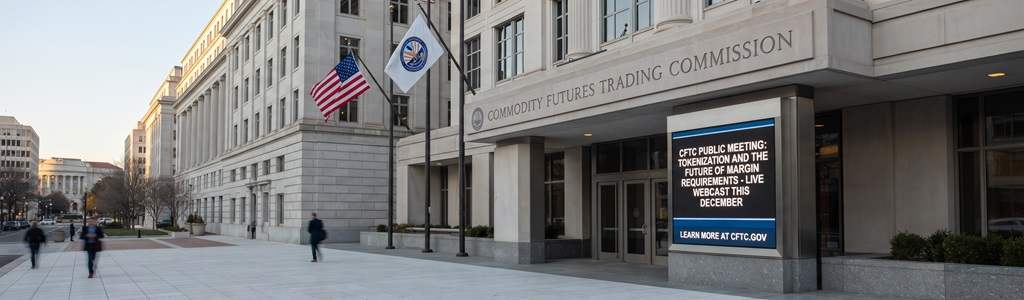
The CFTC set an official meeting for the month of December at its Washington headquarters, which will feature a live stream and public access, for the purpose of examining advances regarding tokenization and margin in financial markets.
According to the agency’s announcement published on Tuesday, November 17, the main event will be held from 1:00 p.m. to 4:00 p.m. EST. The call follows up on a request for public comments issued during the northern summer and seeks to debate innovation, market integrity, and the resilience of U.S. derivatives.
CFTC Chairman Michael Selig previously indicated that the institution will not adopt a generalized or “one-size-fits-all” approach for continuous or 24/7 trading. According to the agency’s communiqués, the main objective is to examine how uninterrupted operations impact different business models to properly adapt the regulatory framework.
In its published agenda, the commission plans to evaluate which asset classes are prepared for continuous negotiation immediately, within a period of one to two years, in the more distant future, or if they definitely do not apply. Among the determining factors are physical delivery, regional differences, and sector-specific commercial needs.
During his statements at the U.S. Treasury Market Conference, Selig had already differentiated between markets. He pointed out that cryptocurrencies and precious metals could adapt to continuous trading, while agricultural products, energy contracts, and some traditional financial products might not be ready for this format. Likewise, he linked blockchain infrastructure to the possibility of achieving almost instantaneous settlement through the use of tokenized collateral in real time.
Tokenization, stablecoins, and clearing in the regulatory crosshairs
The second panel session planned for December will focus on capital access, clearing, the use of guarantees, and margin. Participants will discuss whether tokenization, stablecoins, and blockchain technology can resolve obstacles associated with continuous clearing, in addition to analyzing the risks of pre-funded models and operational sessions during weekends.
For its part, the final panel will address price discovery on weekends, liquidity, manipulation mechanisms, position limits, circuit breakers, cybersecurity, and the operational costs of maintaining permanently active systems.
Various companies in the cryptocurrency ecosystem already implement continuous operation schemes. CME Group initiated continuous cryptocurrency trading at the end of May for futures and options with maintenance pauses, responding to client demand for liquidity. In turn, Coinbase obtained registration for its own clearinghouse at the end of September, projecting plans for settlement in USDC for fully collateralized contracts, while maintaining partnerships with third parties for its leveraged derivatives business.
On the recent regulatory front, Backpack announced on November 16 the obtaining of approvals to operate a designated contract market and a derivatives clearing organization in the U.S. The firm plans to offer 24-hour operable leveraged perpetual futures and the use of collateral in fiat or cryptocurrencies. Company representatives highlighted that these measures seek to transfer price discovery from offshore markets to regulated jurisdictions within the country.
In parallel, tZERO confirmed the approval of its exchange infrastructure in November, complementing its registration as a clearinghouse obtained in October. The entity plans to offer institutional exchange and clearing services that integrate with its existing brokerage, digital securities custody, and transfer agent solutions.
To conclude, current CFTC guidelines establish that exchanges, clearinghouses, and intermediaries must previously discuss their continuous operation plans with regulatory staff. These reviews seek to guarantee strict compliance with the Commodity Exchange Act and the commission’s current regulations.