

News
Fed’s Waller Warns of Tokenization Risks Citing Binance Hack
Federal Reserve Governor Christopher Waller warned about security and liability risks in financial tokenization, citing the Binance hack.


Key points
- Fed Governor Christopher Waller warned about security, fraud, and liability risks in tokenized markets during a conference in New York.
- The October 2026 Binance hack, with estimated losses of $6.3 billion, was directly cited as a case study on the vulnerabilities of the technology.
- The Fed and the Office of the Comptroller of the Currency (OCC) implemented reviews across U.S. banking following the event, with no direct exposures reported.
Christopher Waller, a governor of the Fed, expressed concern over the structural risks associated with tokenized financial markets. Speaking at The Clearing House annual conference in New York, the executive stated that decentralized technologies and smart contracts introduce complex vulnerabilities that escape the traditional control mechanisms of the financial system.
To contextualize these vulnerabilities, Waller made explicit reference to the recent hack against Binance, an event that left estimated losses of $6.3 billion. According to the monetary authority’s report, incidents of this nature demonstrate that purely technical guarantees and automated codes are not enough to shield the ecosystem against potential security failures or large-scale operational breaches.
Liability challenges and the risks of “zombie chains”
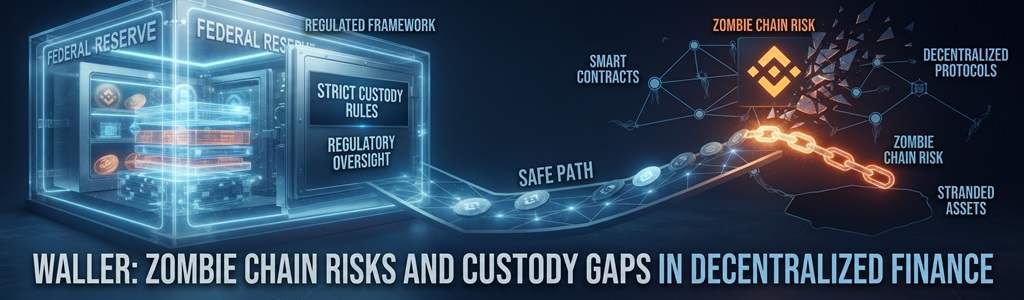
The core of the warning raised by the board of governors member lies in the absence of clear frameworks regarding the assignment of liabilities. According to the arguments presented by Waller, when a failure occurs through the execution of smart contracts, it is complex to determine whether the fault lies with the code developer, the platform hosting the service, or the end user who authorized the transaction.
Likewise, the official introduced the concept of “zombie chains” to describe the risk associated with assets that become trapped or immobilized in blockchain networks that lose activity or collapse. Unlike traditional banking, where the insolvency of an entity is governed by consolidated bankruptcy frameworks and the preservation of accounting records, distributed ledger-based systems can leave funds stranded without a clear path to immediate legal recovery.
The intervention also occurs in a context where U.S. lawmakers have intensified their scrutiny over the custody of tokenized financial assets, questioning regulators’ ability to freeze or recover values transferred outside of strictly regulated platforms. From the Federal Reserve‘s perspective, the expansion of financial tokenization requires the simultaneous development of rigorous legal regulations governing ownership, custody, and settlement.
Banking supervision and technological integration
Following the security incident reported by Binance, financial supervisory agencies in the United States, including the Federal Reserve and the OCC, proceeded to audit the exposure levels of traditional banking institutions to this type of technological architecture. Preliminary reports indicated that federally supervised commercial banking recorded no impacts or vulnerabilities resulting from the event.
However, the need to activate preventative inspections demonstrates the degree of interconnection that digital and tokenized asset flows are generating with conventional financial structures. Market data suggests that while distributed ledger technology offers efficiencies in settlement times, the lack of legal standardization hinders institutional participation on a larger scale.
The analysis presented by the monetary authority concludes that designs oriented toward systemic importance transactions will require more conservative configurations. This could imply sacrificing some of the flexibility and openness characteristic of decentralized public networks in favor of higher levels of privacy, centralized oversight, and institutional control.


