HyperliquidNews
Hyperliquid Policy Center Urges FCA to Target DeFi Rules at Those in Control
The Hyperliquid Policy Center urges the FCA to base its DeFi rules on individual control and the functions of market participants.


Key points
- Submission of observations: The Hyperliquid Policy Center (HPC) submitted its responses to consultation documents CP26/36 and GC26/7 of the United Kingdom’s Financial Conduct Authority (FCA) on November 18, 2026.
- Unilateral control criterion: The group requests that regulatory obligations apply solely to identifiable persons with effective control over regulated functions or direct client services.
- Exclusion of validators and developers: The entity argues that validators and software developers should not be regulated automatically simply for maintaining public networks or receiving compensation.
The Hyperliquid Policy Center (HPC) submitted its observations to the United Kingdom’s Financial Conduct Authority (FCA), requesting that proposed regulations on cryptoassets and decentralized finance (DeFi) be based strictly on the functions performed by individual participants and the degree of control they exert over financial activities.
According to information published on November 18, the HPC’s submission responds to the FCA’s consultation document CP26/36 on the cryptoasset perimeter guidance and guidance consultation GC26/7 on DeFi, directly addressing the regulatory treatment of blockchain infrastructure, market actors, and entities offering digital asset-linked services.
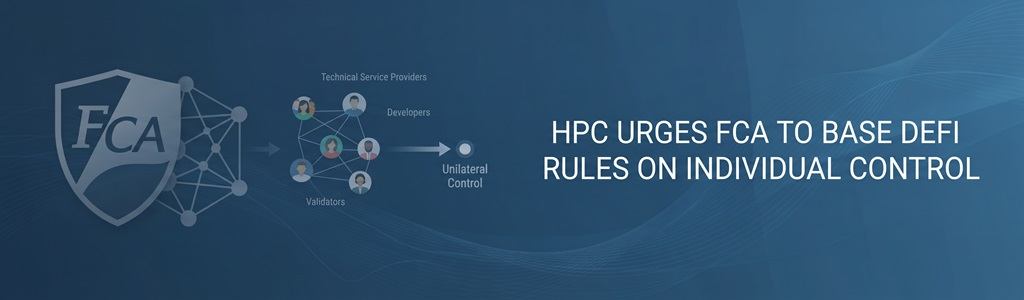
In its proposal, the HPC argues that regulatory obligations should fall exclusively on identifiable persons who maintain unilateral control over regulated functions or who provide financial products and services directly to clients. According to the group’s report, this approach would allow regulated firms to utilize public blockchain infrastructure without losing accountability for their own operations.
The UK’s cryptoasset regulatory framework is scheduled to enter into force on October 25, 2027, as detailed in the political body’s official presentation.
Individual Control Criteria and Developer Exclusion
The HPC noted that the technologically neutral perspective adopted by the FCA is appropriate, though it qualified that the regulator must precisely differentiate participants according to their actual responsibilities and operational authority within decentralized ecosystems.
Data from the report suggest that the British authority should evaluate each actor in an on-chain market independently, rather than treating the entire arrangement as a single regulated entity. The proposed evaluation contemplates analyzing whether an individual possesses the capacity to autonomously modify the functioning of a system after its technical implementation.
Among the indicators of unilateral control mentioned in the document are the authority to pause or revert transactions, settle them at a predetermined price, or alter the economic terms of a protocol without the need for collective approval.
On the other hand, the policy group emphasized that validators and software developers should not be automatically incorporated into the regulatory perimeter simply for contributing to the maintenance of public blockchain networks or for receiving economic compensation for their work. According to the statement, validators operate by processing transactions according to predetermined network rules, apart from exercising independent discretion over users’ finances.
Implications for Liquidity and Order Books
Regarding proprietary trading and order books, the HPC supported the exclusion of dealing on own account activities when an entity does not provide services to third parties. However, the group expressed concern regarding the proposed treatment to identify firms operating with retail clients.
Official documentation advises distinguishing between bilateral contracting and activity executed through centralized multilateral limit order books. In bilateral transactions, an operator interacts directly with a selected counterparty, whereas in a multilateral book, orders are matched through predefined algorithmic rules without operators necessarily knowing the counterparty of the exchange.
The HPC warns that considering each retail operation as evidence of the provision of a regulated service could disincentivize the participation of market makers and proprietary operators on order book platforms, which would lead to reduced liquidity and wider price spreads for end users.
Upcoming regulatory events set the pace for the industry, given that firms interested in operating under transitional provisions must complete their applications during the period between September 30, 2026 and February 28, 2027.