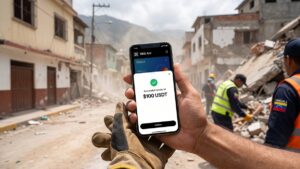
Venezuela is a country that, over the last two decades, has trudged through nearly every conceivable form of crisis. Yet, in the midst of the debacle, a fascinating paradox has emerged: hyperinflation and the collapse of the financial system not only expelled millions of citizens but also turned the country into one of the world’s epicenters of cryptocurrency adoption.
For millions of Venezuelans, Bitcoin and stablecoins no longer represent a high-risk gamble or a tool for tech-savvy speculators. They are, quite simply, the only viable economic escape from an exhausted model. This article argues that, far from being a passing fad, cryptocurrencies have become the silent financial exodus of a nation that lost trust in its own currency, its banks, and its institutions.
To grasp the magnitude of this phenomenon, one must step back and observe the desolate landscape that served as its breeding ground. The bolívar, the national currency, experienced a hyperinflationary spiral that, at its worst moments, surpassed 600% annualized inflation, pulverizing lifelong salaries and savings in a matter of weeks. Monetary policy became an unstoppable machine for printing unbacked bills, leading to scenes that defied belief: a coffee cost thousands of bolívars in the morning and tens of thousands by the afternoon.
In that context, trying to save in the local currency was a guaranteed sentence to impoverishment. The population’s instinctive response was to dollarize, but access to physical dollars was restricted by exchange controls and a chronic shortage of foreign currency. Bank accounts abroad were an unattainable privilege for the majority. It was in that perfect storm of financial repression and the destruction of purchasing power that Bitcoin began to shine brightly, not as a luxury asset, but as a lifesaver.
The first function that cryptocurrencies fulfilled in Venezuela was precisely that of a refuge of value. Unable to safeguard their income in bolívars, citizens began converting any surplus, no matter how small, into Bitcoin or, more commonly, into stablecoins like USDT, pegged to the U.S. dollar. This practice, which started in very small circles of tech enthusiasts, spread rapidly through word of mouth, YouTube tutorials, and shared desperation.

Today, the average Venezuelan who has any type of savings does not think about bank savings accounts; they think about their digital wallet on Binance, Airtm, or Reserve. Trust has shifted from the concrete buildings of banks to a decentralized blockchain. It is the digital embodiment of a total vote of no confidence in the traditional financial system, a system that failed miserably in its most basic duty: preserving the value of the currency.
In parallel, cryptocurrencies sparked a silent revolution in the realm of family remittances. Venezuela has a diaspora of more than seven million people, and the flow of money they send to their loved ones is a fundamental pillar for survival. Traditional remittance channels were riddled with exorbitant fees, delays of several days, and the constant threat of government controls.
Cryptocurrencies transformed that process: a Venezuelan worker in Lima, Santiago, or Miami can send funds to their family in Caracas almost instantly, paying negligible fractions in fees. It is estimated that 40% of remittances entering Venezuela already move through crypto assets. This figure is not trivial: it reveals that cryptocurrencies have rebuilt the bridge of family solidarity that the banking system collapse had demolished. It is a direct connection, from phone to phone, without intermediaries capturing a portion of the scarce income.
But the impact goes far beyond savings and remittances
Cryptocurrencies have permeated daily commerce in a way that surprises any visitor. It is not just about specialized stores; from a small family business selling empanadas to national pharmacy chains, they accept payments in stablecoins via QR codes. It is common to see signs reading, with a certain irony, “Crypto accepted.” This hybrid economy has allowed hundreds of thousands of independent workers, freelancers, and entrepreneurs to collect payment for services rendered abroad, bypassing blockades and disconnection from the international financial system. Programmers, designers, virtual assistants, and even consultants have found in cryptocurrencies the key to integrating into the global labor market when local banks simply could not process international payments.
The response of the Venezuelan State to this financial exodus has been, like almost everything in its recent history, erratic and contradictory. First, it tried to demonize cryptocurrencies, and then, with a pragmatic turn, decided to ride the wave. It launched the Petro, a cryptocurrency supposedly backed by oil reserves, which failed spectacularly due to its lack of transparency, opaque implementation, and the zero trust it generated among the population. The Petro became a symbol of how not to create a digital currency.
Subsequent raids on Bitcoin miners, accusing them of excessive energy consumption, generated legal uncertainty. Nevertheless, reality imposes itself: the government has shifted towards a hybrid economy model. By creating the National Superintendency of Crypto Assets (SUNACRIP) and integrating crypto payment gateways into public and private banking through systems like Conexus, it seeks to regulate and even capture taxes from this immense capital flow, which, according to estimates, moved over 44 billion dollars in the last year, placing Venezuela 18th in Chainalysis’s global crypto adoption index.

Against this backdrop, one must ask: is Bitcoin a definitive economic exit or merely a palliative patch? My opinion leans toward the former, albeit with crucial nuances. Bitcoin is not going to solve the structural causes of poverty: it does not replace the lack of a diversified productive apparatus, it does not repair the collapsed electrical infrastructure, nor does it solve legal insecurity. However, cryptocurrencies have played a role that no public policy has achieved: giving individuals back control over their money.
In a country where the State has historically been the main predator of private savings, the self-custody provided by crypto wallets is an act of peaceful civil resistance, a way of saying, “my effort will not be confiscated.” This financial empowerment is revolutionary in a context where inflation was a mechanism of massive expropriation disguised as monetary policy.
That said, we cannot idealize this process. The mass adoption of cryptocurrencies in Venezuela also carries risks that deserve attention. Bitcoin’s volatility, although less than the bolívar’s, can be a problem for those who do not manage timing well. The proliferation of pyramid schemes disguised as crypto investments has wreaked havoc on a population eager for quick gains.
Likewise, the digital divide and the erratic quality of internet connections remain real barriers for the most vulnerable sectors and for those living in rural areas. The technology is an exit, but it is not universal; and without financial education, there is a risk that the most disadvantaged will fall into the hands of new exploiters.
For this reason, I am among those who believe the Venezuelan example urgently demands massive digital literacy and financial literacy programs in crypto assets, both from civil society and, paradoxically, from the public institutions that today try to regulate what they previously banned.
Another aspect shaping the future of this economic escape is Bitcoin mining
Despite intermittent bans and power outages, Venezuela has underutilized energy potential, especially in regions with flared gas and hydroelectricity that could be channeled into regulated mining, generating clean foreign currency for the State and employment for communities. In fact, intelligently articulated, mining could become an engine of regional development, transforming the burden of underused infrastructure into a competitive advantage. Of course, this requires institutional capacity that does not currently exist and a legal framework guaranteeing stable rules of the game for decades—something difficult to imagine in the short term.
Bitcoin represents much more than a financial technology for Venezuela: it is a sociological phenomenon that reveals society’s capacity to adapt and survive when the monetary social contract has been completely violated. Venezuelans, driven by necessity, have taken a quantum leap toward the future of money, skipping the intermediate phases that other societies are still debating. They have demonstrated, in practice, that when the State fails in the most basic matters, decentralization can be a lifesaver.
Bitcoin is the lifeboat in the shipwreck, and although navigating it requires skill and is not without dangers, it has allowed millions of people to avoid sinking into absolute misery. The economic exit is not a single path, but the trail blazed by cryptocurrencies is now irreversible.
Let us not stare at the skeptic’s pointing finger; let us contemplate the moon of financial freedom at which the Venezuelan has aimed with desperate determination. And that moon, though still distant for some, already illuminates the daily economy of an entire country.