MarketsNews
Gemini Faces Fresh Legal Challenge Over Predictions Platform
A New York bettor sued Gemini and the Winklevoss twins on November 25 for operating an unlicensed sports betting platform.


Key points
- Class action lawsuit in New York: Rayath Chowdhury filed a legal action on November 25, 2026, against Gemini and its founders, Cameron and Tyler Winklevoss, in the U.S. District Court for the Southern District of New York.
- Unlicensed betting allegation: The court filing contends that Gemini Predictions operates as a sportsbook without state authorization and allows access to users aged 18 to 20.
- Volume and background: The platform surpassed 329 million traded contracts through October 21, 2026, as the firm faces declining revenues and prior actions from state regulators.
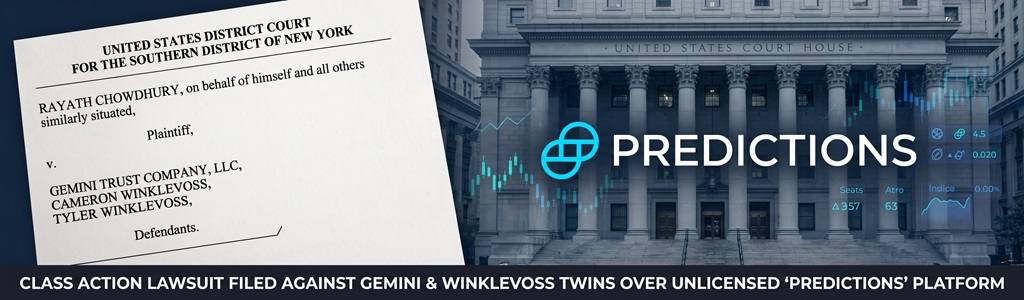
Cryptocurrency exchange Gemini and its co-founders, Cameron and Tyler Winklevoss, are facing a new class action lawsuit in the United States over the operation of their prediction markets platform. The legal action was filed on November 25 by New York resident Rayath Chowdhury in the U.S. District Court for the Southern District of New York, alleging that the service operates as an unlicensed sportsbook.
The plaintiff claims to have begun placing bets and incurring losses on the platform’s sports event contracts around May 19. Through this proposed class action, Chowdhury seeks to recover funds wagered by users across the United States, in addition to requesting a jury trial, an accounting of bets, restitution, injunctive relief, and treble damages.
The lawsuit names six entities and individuals as defendants: Gemini Space Station Inc., Gemini Titan LLC, Gemini Olympus LLC, Winklevoss Capital Fund LLC, and brothers Cameron and Tyler Winklevoss. The court document brings five counts under New York state law. Two of these claims fall under Sections 5-419 and 5-421 of the General Obligations Law, statutes that empower bettors to sue to recover money lost on illegal wagers.
Two other counts cite Sections 349 and 350 of the New York General Business Law, which prohibit deceptive acts and false advertising, while the fifth count corresponds to unjust enrichment. The court filing proposes establishing a specific class for New York, a nationwide class, and subclasses across 29 other states and the District of Columbia. The allegations contained in the complaint have not yet been examined or proven in court.
Allegations Over Access for Under-21 Users and Corporate Structure
Gemini‘s headquarters are located in New York, a jurisdiction that requires a specific state license to operate sportsbooks. According to the text of the lawsuit, no entity affiliated with Gemini has ever received a license from the New York State Gaming Commission in any capacity.
The filing notes that the company has labeled sports bets as “event contracts” since at least January 8, 2026, in order to operate in jurisdictions where online sports betting is prohibited. In the plaintiff’s words cited in the court filing, the company attempts to disguise its operation using financial terms such as “trading,” “predictions,” or “combos” to prevent consumers from identifying the activity as gambling.
Furthermore, the complaint contends that the platform is open to anyone over 18 years of age across all 50 states. According to the plaintiff’s arguments, Gemini directs social media advertising campaigns, cash promotions, and endorsements from its founders toward young adults aged 18 to 20, a demographic generally prohibited from participating in legal sports betting in New York and other states.
Public reports cited in the lawsuit estimate that Gemini‘s prediction market traded more than 329 million contracts from its launch in December 2025 through October 21, 2026. The cumulative tally stood at 100 million contracts in May and 225 million by mid-August 2026. Available options include point-spread wagers on college baseball and basketball teams, as well as NFL parlay bets termed “combos” introduced in September.
Regarding corporate structure, the complaint asserts that the Winklevoss brothers run Gemini‘s entities as a single enterprise by jointly owning, funding, and overseeing them. The lawsuit alleges that by hosting the service on Gemini while keeping the equity and guarantees in Winklevoss Capital Fund, the founders structured the business so that revenues flow to them. In May 2026, that fund purchased $100 million in new Gemini shares paid for with approximately 1,258 bitcoins, a transaction that raised the twins’ beneficial ownership to roughly 65.1% of the firm’s Class A shares.
This litigation marks the second gambling-related case the company has faced in New York during 2026. Previously, on April 21, State Attorney General Letitia James sued Gemini Titan, alleging it operated an unlicensed wagering business. These actions come alongside cease-and-desist orders issued by Connecticut‘s consumer protection regulator in September and Ohio‘s casino control commission in October.
The legal backdrop coincides with a financial downturn for the firm, whose third-quarter 2026 revenue fell 19% year-over-year to $40.9 million, compounded by asset manager VanEck‘s decision to discontinue custody and settlement agreements with Gemini for three exchange-traded funds (ETFs). As the next procedural step, the Southern District of New York court will evaluate the admissibility of the complaint and the motion for class certification filed by Chowdhury‘s counsel.