TL;DR
- AI agents need autonomous payment systems, which only crypto networks can provide.
- Coinbase launches AI wallets, and Circle offers ultra-small micropayments for automated systems.
- SpaceX holds Bitcoin, and xAI hires blockchain specialists to build payment systems.
Wei Zhao, one of the highest-volume operators in crypto asset markets, delivered a projection that rattled crypto analysis circles this week: Bitcoin could trade at $500,000 before the year ends. With the asset currently hovering around $71,000, the call implies an upside run exceeding 600% from current levels — a scale that strikes many analysts as aggressive. For Zhao, however, the convergence of macrostructural forces already in motion justifies the target.
Zhao’s central argument does not rest on classical technical analysis. Instead, he points to a variable that most valuation models have yet to price in: demand generated by artificial intelligence agents. His thesis holds that next-generation AI systems major tech companies are building today require autonomous payment infrastructure. Traditional banking channels — accounts, cards, interbank clearing networks — do not natively support machine-to-machine payments. Crypto networks do.
BITCOIN IS GOING TO $500,000 THIS YEAR AND AI IS THE REASON NOBODY IS TALKING ABOUT
BTC is sitting at $72K right now.
The last time this many signals lined up, Bitcoin went 10x.
Here is what changed.
Coinbase just launched wallets built for AI agents.
Not humans. Agents.…
— 🇨🇳 Wei Zhao 赵伟 (@antmillionsbot) March 6, 2026
The Payment Infrastructure for AI Is Already Taking Shape
Two recent market developments validate the direction Zhao identifies. Coinbase deployed wallets designed specifically for AI agents, decoupling the human user experience from the signing and execution protocol. Meanwhile, Circle introduced micropayments as low as $0.000001, enabling value transfers that no conventional payment processor can execute at that level of granularity. Both products target the same market: automated transactions between software systems.
Zhao adds another heavyweight data point: SpaceX holds Bitcoin positions valued at hundreds of millions of dollars, and xAI — the artificial intelligence division tied to Elon Musk — has been actively bringing in blockchain specialists. For Zhao, major corporate players do not build Bitcoin treasury exposure out of inertia; they construct financial infrastructure for the cycle ahead.
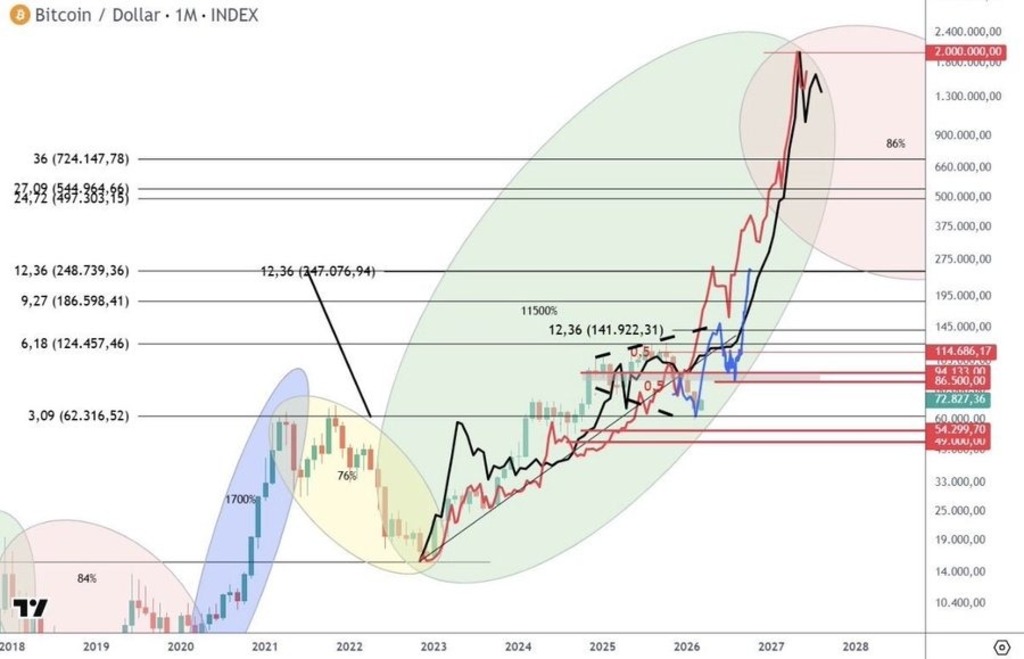
On the price roadmap, Zhao outlines a three-phase sequence. First, Bitcoin clears $100,000 as AI wallet infrastructure reaches operational adoption. From there, rising AI-to-AI transaction volumes pull large institutional funds into systematic BTC accumulation. In that scenario, with the protocol’s fixed supply absorbing a structurally new source of demand, the price could reach $500,000 before December.
Bitcoin’s long-term chart also supports the reading. The asset trades inside a multi-year ascending channel that, in prior cycles, preceded price moves of comparable magnitude. Current accumulation patterns closely resemble the pre-breakout phases that led into the major rallies of 2017 and 2020.
Zhao acknowledges the uncertainty embedded in any projection at this scale, yet argues that the present market structure carries no historical parallel: for the first time, a new class of market participants — AI agents — could enter Bitcoin’s order book without any direct human intervention.