

ZcashNews
Zodl Adds CrossPay QR Payments and Fixes Zcash Voting Bug
The Zodl wallet updates its software on November 18 to integrate CrossPay QR payments and fix a voting issue in Tor.


Key points
- The November 18 Zodl update incorporates the Send Max feature into its sending, exchange, and CrossPay options, in addition to optimizing Tor connectivity.
- QR code scanning support in CrossPay covers payment requests in Bitcoin, Litecoin, Ether, and Solana, allowing the use of Zcash shielded balances.
- The fix for the NU7.1 voting bug allows users to cast their ballots without needing to activate Tor before the December 1 deadline.
This Wednesday, November 18, cryptocurrency wallet Zodl reported that they updated their software to expand its payment capabilities and correct a technical bug related to governance processes on the Zcash network. According to the developers’ report, the new version introduces the Send Max feature in the sending, exchange, and CrossPay tools, while optimizing the stability of connectivity through Tor.
Zodl 3.21.0 is live on iOS and Android.
• Send Max for Send, Swap, and CrossPay
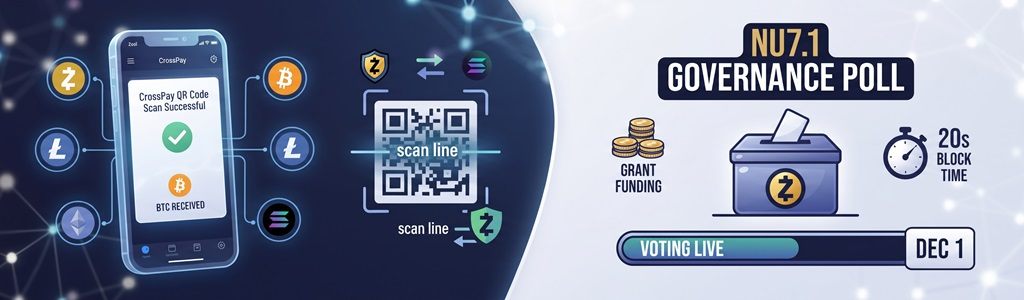
• CrossPay QR scanning for BTC, LTC, ETH, and SOL
• Improved Tor connectivityWe've also fixed the issue affecting voting with Tor disabled in the NU7.1 poll. pic.twitter.com/DIcSoq7DMQ
— Zodl | Zcash Wallet (@zodl_app) November 18, 2026
Official information details that the main feature of the update is the incorporation of QR code scanning for four types of requests in CrossPay. With this function, the wallet interface automatically fills in the recipient’s address, the requested asset, and the required amount. According to the project’s documentation, a merchant issuing an invoice in Bitcoin can receive funds in BTC while the customer makes the payment from their shielded balance in ZEC.
CrossPay’s technical infrastructure relies on NEAR Intents to find optimal exchange routes through independent market makers. According to the protocol guidelines published by Zodl, the sender’s shielded balance covers both the main transaction and the associated fees. The QR scanning tool operates directly with payment requests denominated in Bitcoin, Litecoin, Ether, and Solana, adding to compatibility with dozens of digital assets supported by the platform.
Once the application processes the payment data, the interface presents a review screen for the user to confirm the parameters. The wallet creators recommend verifying the asset, the network, and the destination address before authorizing the transfer, especially when depositing into centralized exchange accounts that do not support recoveries for transfers on unsupported networks. The evolution of each operation can be monitored in the application’s activity history.
Fix for the Voting Bug in NU7.1
The update released by the development team comes preceded by a technical incident reported two days before the official announcement. During the opening of the voting period on November 16, Zodl users experienced restrictions that required them to enable Tor to cast their votes on the Zcash network. With the new software package, eligible coinholders can participate from the app’s voting menu without needing to keep that privacy network active.
According to information disclosed by the developers, the voting uses the snapshot recorded at Zcash block 3,578,540 as a reference to determine balances with voting rights. Votes remain encrypted until the official count concludes, scheduled for December 1 at 02:59 UTC. The consultative process covers five fundamental questions regarding the economic and operational future of the cryptocurrency.
Four of the survey questions analyze the allocation of funds for Zcash Community Grants, a program that receives 8% of block rewards. The options range from the gradual phase-out of new grants to the redirection of capital flows toward development reserves and the maintenance of the current scheme under the name Zcash Adoption Pool.
The fifth question evaluates the possibility of adjusting the block generation time to 20 seconds under optimal security conditions. The consultation guidelines indicate that the decisions adopted will serve as a consultative indicator for participants to evaluate the adoption of future software updates on the network.


