The cryptocurrency market operates under structural conditions that do not favor an altcoin season. The available data from June and July 2026 provides a defined picture. Capital rotation from Bitcoin to the rest of the ecosystem does not manifest as a broad movement.
Altcoins experience selective movements but lack the liquidity support required for a sustained and widespread appreciation. The opinion of experienced traders aligns with quantitative metrics. A generalized altseason will not occur in the short term.
The Altcoin Season Index registers 58 points. The historical threshold of 75 defines the start of an altcoin season. A reading below that level indicates an absence of generalized rotation. The index has improved from its lows at the start of the year, but the distance to the confirmation zone remains wide.
In parallel, Bitcoin dominance consolidates around 58%. A decline below 55% would constitute the first technical indication of a regime change. Currently, neither metric confirms a capital rotation. The market displays fragmentation, not unification.
Liquidity serves as the fuel for the altcoin market
The stablecoin market capitalization contracted by 7.7 billion dollars during June. This contraction represents the largest monthly decline since 2022. The supply of digital dollars available for purchasing risky assets is decreasing.
The contraction of USDT and USDC, the two main issuers, reinforces the trend. The macroeconomic context deepens the restriction. Restrictive monetary policies maintain interest rates at elevated levels.
Significant rate cuts are not projected until 2027. Without money printing and without rates near zero, speculative capital finds no incentive to migrate massively toward higher-risk assets. Experienced traders, such as Crypto Kid, point to 2028 or 2029 as a realistic window for the next period of abundant liquidity.
Market history supports that thesis. The major altseasons of 2017 and 2021 coincided with expansionary monetary policies. The current environment lacks that stimulus.
Spot Bitcoin ETFs in the United States recorded outflows of 4.3 billion dollars in June. Institutional capital is leaving the primary cryptocurrency. However, that capital does not redistribute equitably among altcoins. ETFs for Solana, XRP, and Hyperliquid (HYPE) captured selective inflows.
The rotation is directional and limited. Capital seeks refuge or exposure in concrete narratives, not in the sector as a whole. A healthy market for altcoins requires inflows into the majority of assets.
The current situation shows concentrated entries in a few exceptions and outflows from Bitcoin. That generates localized rallies but does not produce a tide effect that lifts all prices.
Approximately 84% of altcoins listed on Binance trade below their 200-day moving average. Forty percent of all altcoins remain below their all-time highs. Cumulative selling pressure in the spot market reaches -209 billion dollars. This accumulation represents fifteen consecutive months of net sales. That figure constitutes an extreme level not observed in years.
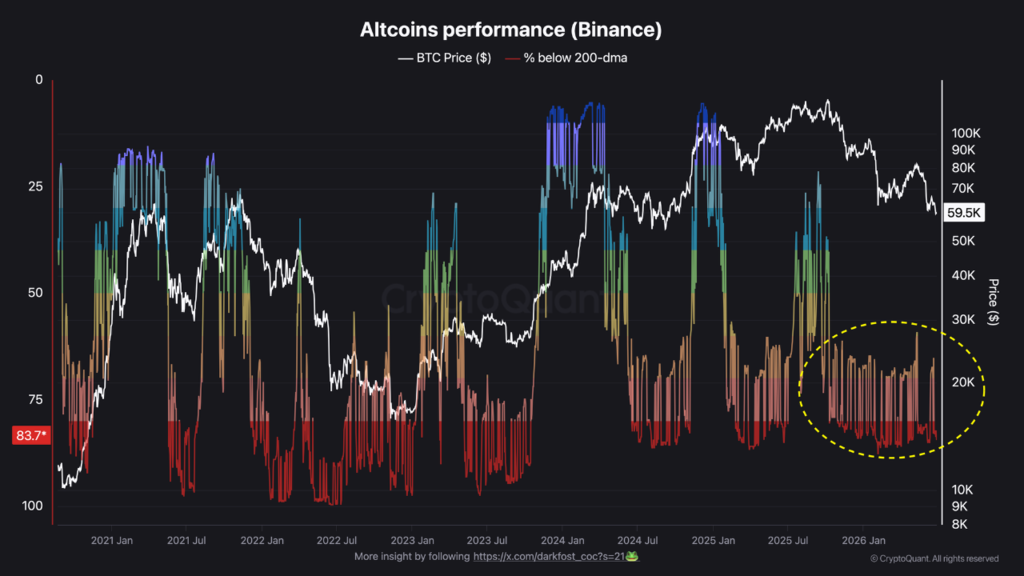
Ethereum and Solana, the two main alternatives to Bitcoin, present declines exceeding 60% and 70% from their peak prices. The market structure does not show the necessary strength for a general rebound. The majority of digital assets are in a long-term downtrend against Bitcoin.
An asset trading well below its 200-day moving average does not generate confidence among institutional investors. The accumulation of selling pressure erodes the sector’s recovery capacity.
Player1Taco acknowledges the potential of specific narratives, including decentralized artificial intelligence, real-world assets (RWA), and decentralized physical infrastructure networks (DePIN). Those areas can generate positive returns. The Venice token (VVV) and Morpheus serve as examples of projects within decentralized AI. However, the performance of a few projects does not define an altcoin season.
An altcoin season implies a simultaneous and sustained appreciation of the majority of assets. The current market is characterized by capital concentration in defined niches. Investors must differentiate between a sectoral movement and a regime change in the market cycle.
Altcoins act as trophy assets, according to Crypto Kid’s description. They attract capital only during periods of excess liquidity, not in a credit-restricted environment.
The combination of on-chain indicators, institutional flows, and macroeconomic conditions points to a clear conclusion. The market does not meet the conditions for a generalized altseason in the short term. Liquidity is insufficient, Bitcoin dominance is elevated, and the technical performance of altcoins is fragile.
Expectations of a cycle similar to 2020-2021 ignore the reality of current monetary policy. An altcoin season, as a broad market phenomenon, requires an expansion of the money supply and a significant decline in interest rates.
Selective movements in AI, RWA, or DePIN offer opportunities, but they do not constitute an altcoin season. The market operates under a logic of limited rotation, not generalized euphoria.
The absence of an altcoin season does not imply the absence of opportunities
Experienced traders can identify narratives with growth potential. However, the strategy of purchasing any altcoin in expectation of a generalized rally proves ineffective in the current context.
The cryptocurrency market matures and becomes more selective over time. The altcoin season, as a concept, depends on external factors to the ecosystem. Federal Reserve monetary policy and global liquidity determine the cycle.
The data from June and July 2026 are explicit. The contraction of stablecoins, outflows from Bitcoin ETFs, and the high dominance of Bitcoin draw a clear scenario.
A generalized altseason will not occur during the remainder of the year. Investors must adjust their expectations and their portfolios to that reality.