TL;DR:
- Regulatory Standard: The Digital Asset Exchange Alliance (DAXA) approved a mandatory regulation requiring the invalidation of API credentials under suspicion of illegal sharing.
- Trading Metrics: According to official data from the Financial Supervisory Service (FSS), automated bot trading currently accounts for 30% of the total volume in the South Korean market.
- Collateral Impact: The implementation coincides with a global pullback over the last 24 hours that reduced the total capitalization of the crypto sector to $2.46 trillion.
The Digital Asset Exchange Alliance (DAXA) implemented a new compliance standard in South Korea to mandatorily revoke API cripto credentials that show signs of being improperly shared among users. The measure introduces an additional layer of oversight in one of the regions with the highest digital asset transaction volumes in the world.
This intervention comes at a time when the Financial Supervisory Service (FSS) is intensifying its scrutiny of automated trading within local exchanges.
Tiered Surveillance Against Manipulation on Exchanges
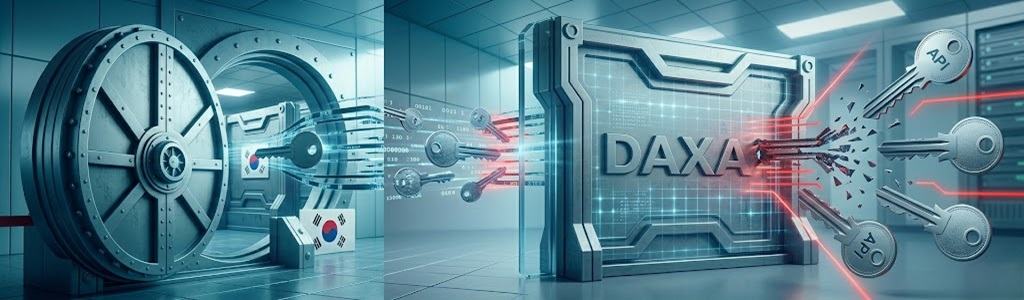
This Thursday, DAXA reported through an official statement that the new regulatory framework aims to neutralize market manipulation activities and fake orders (spoofing) coordinated through multiple accounts. Information from the FSS suggests that certain traders used these programmatic accesses to repeatedly place and cancel large buy orders, simulating fictitious demand to drive up prices before executing sell orders. The regulatory body, however, did not specify the exact number of accounts currently under administrative investigation.
Application programming interfaces, commonly known as API keys, allow external automated systems to connect directly to exchange servers. Through this technical access, software tools can gather real-time market data, place trade orders, and manage financial transactions such as deposits or withdrawals.
The guidelines designed by the alliance stipulate that regulated exchanges in the country must execute restrictive and tiered responses to suspicious behavior.
The organization added that its integrated members—Upbit, Bithumb, Coinone, Korbit, and Gopax—will apply continuous audits including warning notices to users, mandatory identity verification, and, ultimately, the forced expiration of technical access.
In addition, the firms will implement IP address whitelists to ensure that commands originate solely from networks previously authorized by the account holder. Up to the date of this announcement, DAXA has not revealed the internal technical methodology that will be used for the automated detection of irregular patterns.
Security Background and Infrastructure
Vulnerability in the custody of API credentials presents itself as a recurring challenge within the global infrastructure of the digital financial ecosystem. Historical reports recall that in 2022, the 3Commas trading service was hit by a massive exposure of access tokens, resulting in the leak of approximately 100,000 API keys belonging to institutional and retail clients on global platforms.
Although international firms like Binance, Coinbase, OKX, and Kraken have for years incorporated optional IP whitelisting policies and granular permission management, the South Korean guidelines move toward mandatory application under specific risk criteria determined by the consortium.
Recently, security analysts from the crypto firm Sodot indicated that incidents stemming from the misuse of programmatic access are often misclassified in public reports as general hacks, hiding structural vulnerabilities in password management by commercial operators.
The effective deployment of the new technical controls and multi-factor authentication systems by South Korea’s big five exchanges will begin to be continuously evaluated starting next month.