TL;DR:
- Solana advances SIMD-0553, a proposal that raises fees on resource-intensive transactions and lowers costs for simple operations.
- The new model would increase daily SOL burning from 648 to between 7,500 and 9,000 tokens — a 12 to 14 times increase over current levels.
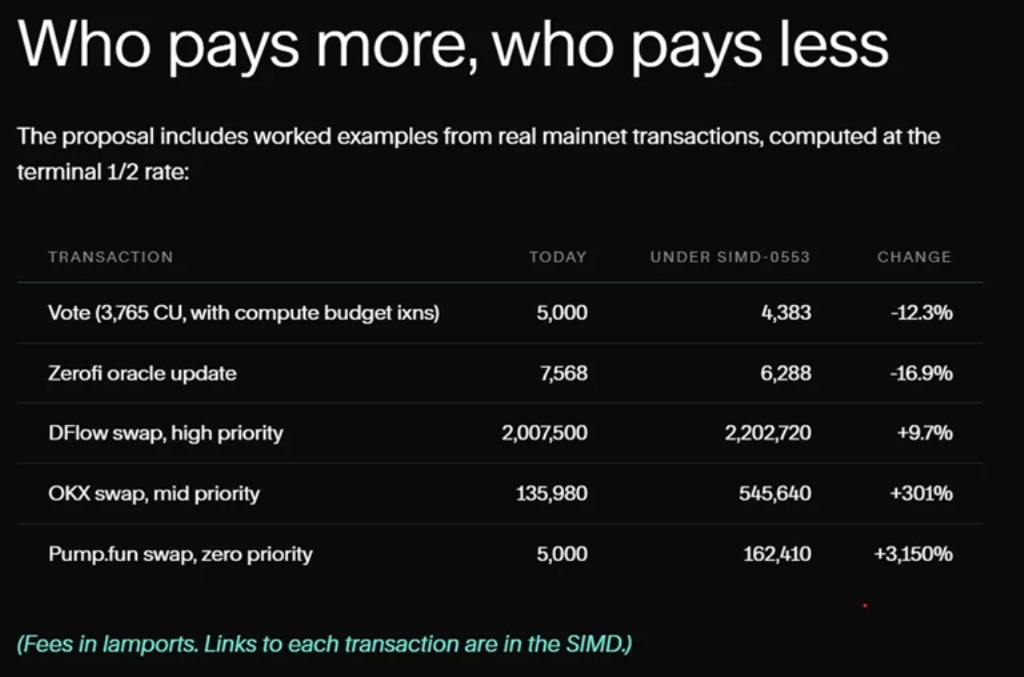
- Some high-frequency swaps could become up to 3,150% more expensive, though the absolute cost would still remain below $0.05 per transaction.
The Solana network is moving forward with a structural reform of its fee model through the proposal SIMD-0553, an improvement document that would modify the way the protocol charges for computational resource usage.
The initiative was presented by Cavey, a researcher at Temporal, a Solana network infrastructure firm, and entered the new onchain governance process in early August, clearing its initial support phase on the 4th of that month. It is currently in the support and discussion stage, which lasts approximately two weeks.
The baseline diagnosis is stark: today, a transaction that does nothing costs the same as one that consumes 200 million CPU cycles. That distortion discourages efficiency and benefits those who waste resources without bearing their real cost.
Solana: Waste Has a Price
Under the proposed scheme, fees would be calculated based on the resources each transaction requests, rather than a uniform fixed amount. Revenue from that concept would not go to validators but would instead be burned, removing SOL from circulation. The model targets especially computationally inefficient arbitrage: over the past 30 days, the five traders with the highest failure rates sent 11.5 million transactions, consumed 929 million compute units across 2,477 operations that generated $16,091 in profits, and paid just 78 SOL in fees.
Stablecoin and token transfers could become around 20% cheaper. Vote transactions would drop 12.3% and oracle updates 16.9%, according to Temporal’s modeling. However, some high-frequency swaps would face considerable increases: a medium-priority swap on OKX would cost 301% more, and a no-priority swap on pump.fun 3,150% more. Even so, Cavey argues that even the most resource-intensive transactions would hover around $0.05, compared to the $2 or $5 a $100 swap can cost on a centralized exchange.

The Debate Over Validators
The most controversial point is the reduction in income for Solana validators, who would initially see their base revenue fall by around 4%. One contributor questioned whether the additional burn is a valid objective and argued that validator income should not be reduced arbitrarily.
On the burning side, the proposal projects that the daily figure would scale from 648 SOL to between 7,500 and 9,000 SOL. Given that the network emits approximately 60,000 SOL per day, that level would still not make Solana deflationary on its own, although a parallel proposal, SIMD-0550, seeks to reduce inflation faster than previously planned. For Cavey, the central objective is not deflation but rather aligning core, application, and infrastructure developers around more efficient use of the network.