TL;DR:
- The SEC submitted to the OIRA a formal interpretation on how federal securities laws apply to crypto assets.
- Unlike staff guidance, the document comes from the full Commission, which gives it significantly greater regulatory weight.
- After the interagency review, the agency’s three commissioners will vote on whether to adopt the interpretation as official reference.
The SEC submitted to the Office of Information and Regulatory Affairs (OIRA) a formal interpretation seeking to clarify how United States federal securities laws apply to certain crypto assets and related transactions. The document could mark an inflection point in the way the regulator approaches the crypto market.
The filing is structured as an interpretive release, which means it introduces no new legal requirements but clarifies how the agency understands existing rules should apply to the crypto space. Its relevance should not be underestimated, however: unlike standard statements from the SEC’s technical staff, this interpretation comes from the full Commission, which gives it considerably greater institutional weight.
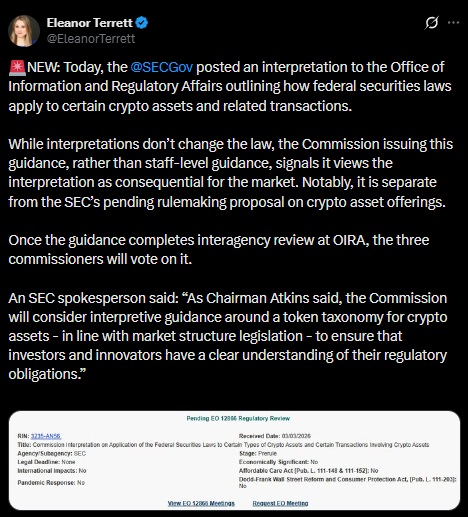
According to an agency spokesperson, the regulator is evaluating interpretive guidance aimed at establishing a clearer taxonomy for digital tokens. The stated objective is to provide investors, developers, and market participants with a more defined understanding of their regulatory obligations, a flashpoint that has fueled years of legal disputes and enforcement actions across the industry.
Three SEC Commissioners Will Have the Final Vote
Before the interpretation can be formally adopted, it must complete the interagency review process conducted by the OIRA, a division of the White House Office of Management and Budget. This body examines the broader implications of proposed federal rules, particularly those with potential impact on financial markets.

Once that stage is complete, the three commissioners of the SEC will vote on whether to approve the guidance. If adopted, the interpretation could become a central reference for determining which digital assets fall under U.S. securities regulation, a question that has sat at the core of countless legal disputes. The outcome of that vote will have direct consequences for the regulatory framework governing cryptocurrencies in the United States in the years ahead.