TL;DR
- Aztec launched its v5 update in alpha, reducing proof times for private transactions by more than 2x and cutting costs by 50%.
- Version v5 enables ZK proof generation directly on users’ devices, such as phones and laptops, without relying on centralized data centers.
- Vitalik Buterin, who financially backed the project, confirmed the network reached “Stage 2” of decentralization by his own standards.
Aztec launched its v5 update in alpha, a crucial milestone toward offering fully private transactions and establishing them as “the default standard” within the Ethereum ecosystem. The launch was confirmed by co-founder Zac Williamson. The upgrade was approved by token holder governance and executed onchain today.
The core change in v5 is what the team calls “client-side proving“: the ability to generate zero-knowledge proofs directly on the user’s device, without relying on centralized infrastructure. This contrasts with the dominant approach in the ZK ecosystem, where the most demanding computations are delegated to data centers. According to Williamson, the team’s bet has always been clear: “We need this to work on phones, on consumer laptops, on some $500 Lenovo, if this technology is going to have a real impact.”
Aztec Alpha V5 is live.
The fastest private transactions we've ever shipped, now on mainnet. Read more on https://t.co/KmYZppMZce.
Apps roll out over the coming week, starting with @nyxmoney.
Nyx is invite-only, but for the next 24 hours it's open to everyone. Code below 👇 pic.twitter.com/VaD05xxr9h
— Aztec (@aztecnetwork) July 21, 2026
Aztec V5: Speed, Privacy and Lower Costs
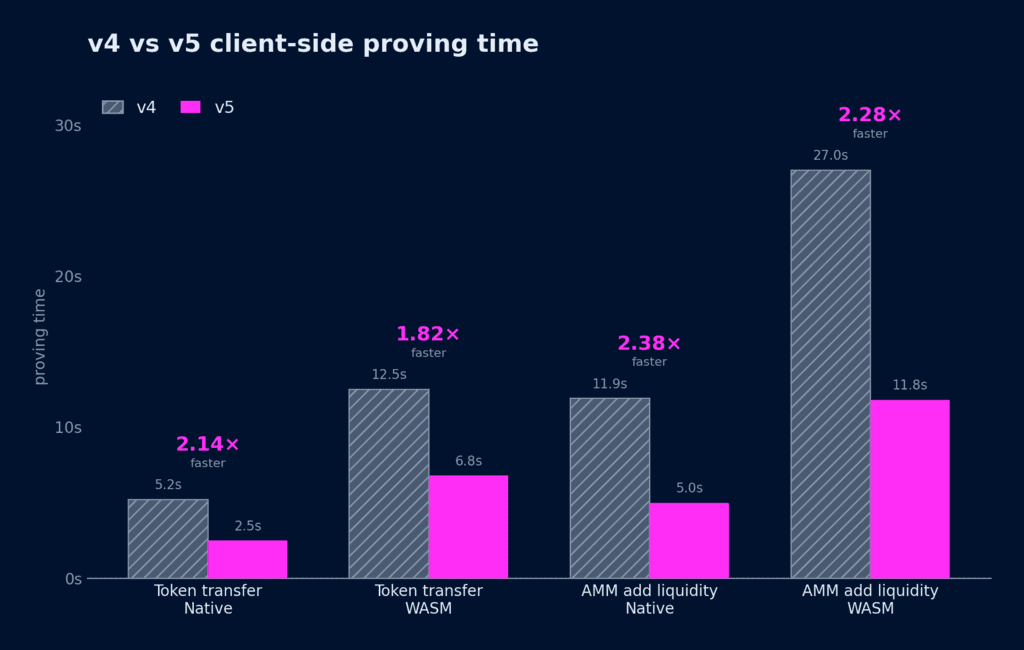
V5 reduces proof times by more than 2x, cuts the average cost of a private transaction by approximately 50%, and shortens block production time from 14 seconds to 6. It also lowers the verification cost of rollup proofs on Ethereum by around 40%, bringing the average fee for a private token transfer to under $0.05.
Several use cases were identified, including the ability to earn private yields on Aave through the wallet projects Nyx. Shield and TRAIN, in turn, provide bridges to Ethereum.
The Vulnerabilities in V4
The v5 launch comes months after Aztec recommended that users abandon the previous version. In March, active vulnerabilities were discovered in v4, leading to its deprecation. Williamson attributed part of the problem to the disruptive acceleration of artificial intelligence, which affected the network during its first lifecycle. For v5, the team dedicated significant resources to security: 234 researchers participated in the bug bounty program, and the team is working on formal mathematical verification methods.

Additionally, Vitalik Buterin launched a demo of an anonymous message board on Aztec and confirmed that the network reached “Stage 2″ of decentralization according to his own standards for Layer 2s. Buterin financially backed the project, which has accumulated more than $119 million in total funding. The team behind Aztec also created PLONK in 2019, the ZK proof system that gave rise to frameworks such as Plonky2 and Plonky3, currently used by Polygon.