PolygonNews
Reental’s Polygon Contracts Drained of $454K After Admin Upgrade
Real estate platform Reental suffers a $454,000 exploit on Polygon following an administrative update to its aToken contracts.


Key points
- Million-dollar losses: Real estate investment platform Reental suffered a theft of approximately $454,000 in Tether (USDT) and USD Coin (USDC) on the Polygon network.
- Vulnerability due to update: According to a report by Blockaid, the attack originated following an administrator update to the aToken proxy contracts that allowed unrestricted withdrawals.
- Attacks in the sector: The incident adds to recent security breaches reported in Paytaca, Curve Finance, and K3 Capital during the same period.
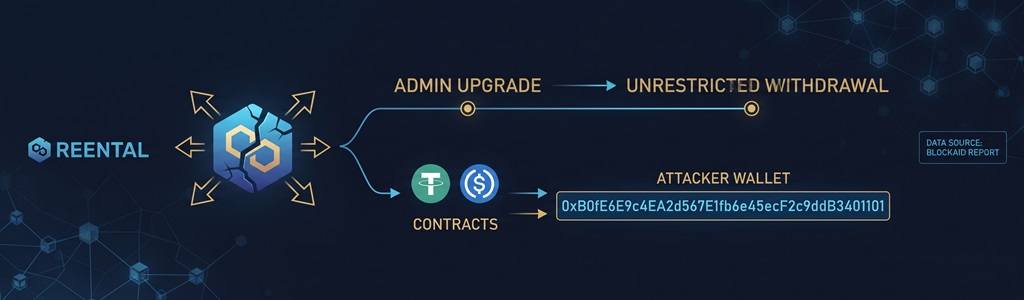
According to a report by security firm Blockaid, this Wednesday the real estate investment platform Reental suffered a security exploit on the Polygon blockchain, with an estimated $454,000 in Tether (USDT) and USD Coin (USDC) drained from its contracts. The hacking involved an administrator update in the affected token contracts, which enabled any user to withdraw the stored funds.
Blockaid posted on its X account that the attacker drained the stablecoins through two consecutive transactions. Likewise, the security firm identified a digital wallet directly linked to the incident with the address 0xB0fE6E9c4EA2d567E1fb6e45ecF2c9ddB3401101. At the time of the report’s issuance, the exploit remained active and the affected platform had not issued an official public acknowledgment of the event.
🚨 Blockaid detected an ongoing exploit on @Reental_co on Polygon.
An admin upgraded the USDT and USDC aToken proxies to a contract that lets anyone drain the underlying tokens, then swept the remaining stables.
~$454k drained from the aTokens so far across 2 txs.🧵— Blockaid (@blockaid_) November 18, 2026
How the Attacker Drained Reental’s Funds
According to Blockaid’s information, the attack began after an administrator updated Reental’s USDT and USDC aToken proxy contracts to a new contract. This modification introduced a vulnerability that triggered the emptying of the stablecoins held in the corresponding contracts.
The malicious actor took advantage of this flaw to extract the available liquidity. The security firm detailed that the attacker initially withdrew nearly $454,000 from the aToken contracts in two independent operations, before sweeping the remainder of the stable assets. A proxy contract allows a blockchain application to modify operating code without altering its main address, facilitating technical updates without needing to deploy contracts from scratch; however, the detected update configured unrestricted withdrawals.
The security firm avoided speculating on how such administrative modification was approved or whether the administrator’s account was compromised, nor did it identify those responsible behind the wallet address.
A Landscape of Growing Incidents in the Ecosystem
Reental’s incident integrates into a series of security breaches reported in the cryptocurrency industry. Previously, Bitcoin Cash wallet Paytaca revealed that attackers breached its backend systems for two consecutive days, creating fake peer-to-peer trading orders and sending unwanted payment requests to users, although the community’s private keys remained secured on personal devices.
On the other hand, Curve Finance reported that an attacker stole approximately $38,200 in fees from its CowSwapBurner contract on Ethereum, employing a flaw in trade order approval. In parallel, Blockaid detected another exploit in K3 Capital‘s sBOLD vault on Ethereum, where attackers stole nearly $3.43 million through multiple transactions.
Reental operates as a tokenized real estate investment platform that allows users to allocate capital to international projects and receive monthly returns, in addition to trading their tokens on secondary peer-to-peer (P2P) exchange platforms. The information available so far does not clarify whether the stolen funds belonged directly to private investors or to the company’s operational reserves.