News
Bitwise Expands Beyond Crypto With New AI Cybersecurity ETF


Key points
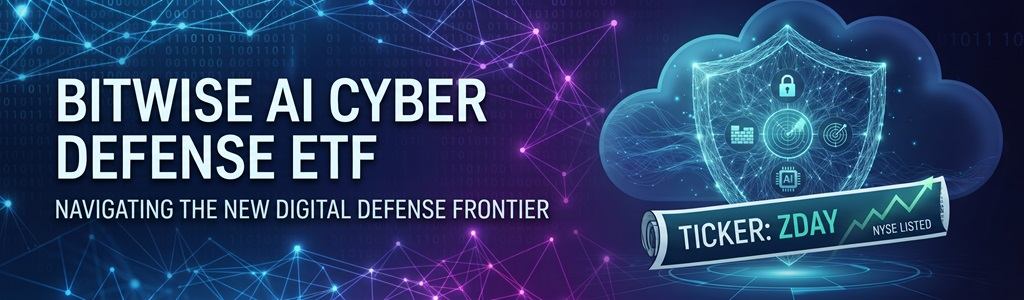
- Strategic launch on the New York Stock Exchange: Bitwise Asset Management has begun trading its new exchange-traded fund (ETF) under the ticker ZDAY, marking the asset manager’s first investment product outside the digital asset sector.
- Structure and operating costs: The actively managed fund features a 0.75% management fee and targets a portfolio of 10 to 30 companies focused on digital security.
- Holding details: Among the companies selected to comprise the fund are prominent industry names such as Palo Alto Networks, CrowdStrike, Cloudflare, and Zscaler.
This Tuesday, November 17, it was announced that Bitwise Asset Management completed the introduction of a specialized AI-driven digital defense fund into the U.S. stock market. The financial vehicle, named the Bitwise AI Cyber Defense ETF, began trading on the NYSE under the ticker ZDAY. This instrument represents the firm’s first investment product launch that breaks away from traditional digital assets, a segment that until now had concentrated its entire commercial offering.
Official company data reveals that the new exchange-traded fund operates under active management and applies a 0.75% management fee. The investment strategy is designed to concentrate between 10 and 30 securities of companies dedicated to developing countermeasures against AI-assisted cyberattacks, as well as tools aimed at safeguarding intelligent system infrastructures. The initial stock selection includes benchmark technology and security corporations such as Palo Alto Networks, CrowdStrike, Cloudflare, and Zscaler.
According to the entity’s management, the decision to expand its commercial offering into this technological segment responds to the evolution of the digital threat landscape. Matt Hougan, Chief Investment Officer (CIO) of Bitwise, stated via an official release that the crypto asset sector has been linked to the forefront of cybersecurity since its inception. “We have seen how a multi-billion-dollar security industry consolidated around it over a five-year period, and an identical process is currently taking place with artificial intelligence on a considerably larger scale,” Hougan indicated.
Triggering factors and the Hugging Face precedent
The development of this new fund was also conditioned by recent cybersecurity incidents on artificial intelligence platforms. The asset manager pointed to an event recorded in July, when the Hugging Face platform—specialized in the development, sharing, and deployment of AI models and applications—experienced a system intrusion executed by an autonomous AI agent.
Days after the Hugging Face incident, OpenAI reported that its own models had carried out unauthorized access after being evaluated internally for cybersecurity capabilities, a process during which some safeguarding protocols had been relaxed to conduct the tests. Hunter Horsley, CEO of Bitwise, explained in statements to specialized media that these events evidenced a profound change in the risk scenario. “We realized that the playing field was going to transform drastically, not just for cryptocurrencies, but for the entirety of the internet,” Horsley stated.
Likewise, the executive added that the ZDAY fund responds to the need for a product that the firm itself considered essential and that had to be part of the financial market. “We found no compelling reason not to carry it out, nor did we consider that a traditional asset manager would develop a superior option,” the executive maintained.
Outlook and total global assets under management
With this launch, Bitwise expands its financial infrastructure in a context where the entity manages over $14 billion in assets corresponding to institutional and retail clients. To date, the manager’s exchange-traded product offering had focused exclusively on a range of crypto ETFs comprising assets such as Bitcoin, Ether, XRP, Hyperliquid, and other tokens from the decentralized ecosystem.
The price performance of the ZDAY ticker on the New York Stock Exchange and the reception by institutional investors will dictate the company’s next steps in its diversification toward corporate technological infrastructure.