The Bitget incident on 24 September 2026 produced a measurable shift in incident response. Chainalysis reported 387 million dollars stolen and dispersed across four blockchains.
The firm documented use of artificial intelligence to reduce cross-chain bridge reconciliation from more than 20 hours to less than 10 minutes.
Chainalysis Attributes Bitget’s $387M Hack to DPRK Actors, Traces Funds Across Four Chains
Chainalysis said the $387 million Bitget hack was carried out by DPRK-linked threat actors. Within the first three hours, the stolen funds moved across Ethereum, XRP, Zcash and Tron… pic.twitter.com/ljWHOgX5qB
— Wu Blockchain (@WuBlockchain) October 2, 2026
Opinion: AI does not replace human judgment, but AI changes the baseline for incident response. The crypto sector must integrate automated forensics, human validation, and data governance to make on-chain traceability effective.
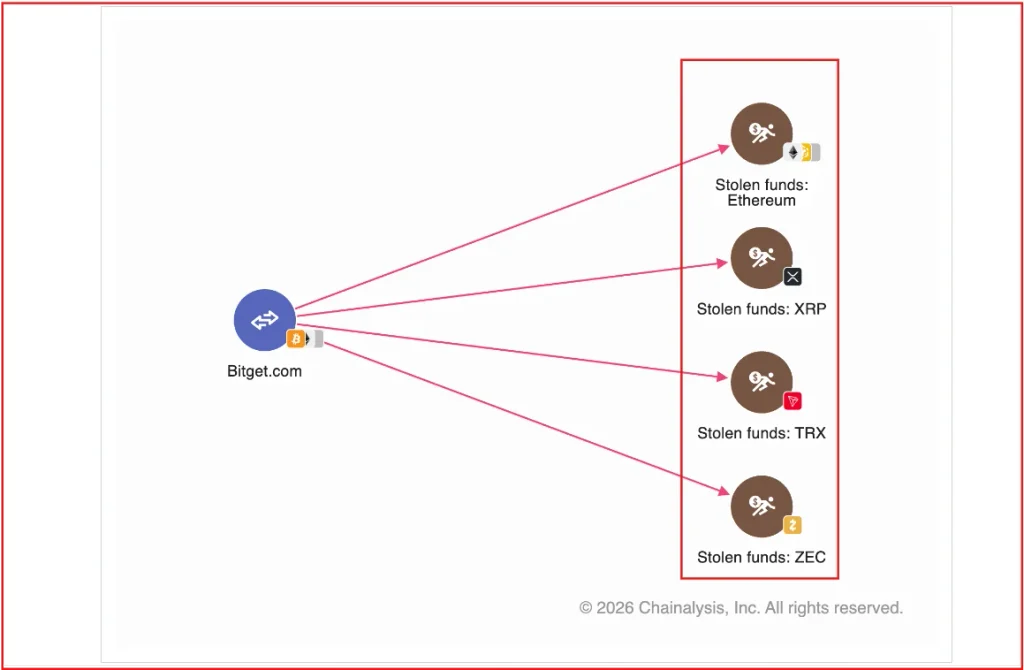
Investigation of Bitget showed initial dispersion across Ethereum, XRP, Zcash, and Tron. Attackers used cross-chain liquidity protocols, messaging protocols, instant swaps, and laundering services. Attribution to North Korea raised total crypto stolen by actors linked to North Korea in 2026 above 1 billion dollars.
The relevant point is not only magnitude. The relevant point is velocity of movement. Artificial intelligence enabled fund labeling minutes after identification, which supported compliance response in near real time. Automation did not solve the underlying problem: cross-chain fragmentation remains a vector of opacity.
Actual Capacity of AI in Blockchain Forensics
Artificial intelligence applied to blockchain forensics operates on transaction graphs, address clustering, entity resolution, and anomaly detection. Models reduce manual work of reconciliation across bridges, decentralized exchanges, and messaging protocols. In Bitget case, automation matched deposits with corresponding payments across different networks.
Capacity is valuable because attackers divide funds into multiple transfers to complicate tracking. Artificial intelligence processes patterns which a human analyst would take hours to correlate. Result quality depends on labeled data, updated heuristics, and logic defined by experts. Without human validation, risk of false positives and attribution errors increases.
The industry must understand: artificial intelligence is not an oracle. AI is a productivity layer over imperfect data. Cross-chain bridges do not always expose homogeneous information. Mixers and privacy coins introduce noise. Instant swaps break continuity of trace.
Artificial intelligence can infer relationships, but AI does not guarantee legal certainty. For regulatory compliance, difference between suspicion and evidence is critical. An AI model can flag an address as linked to stolen funds; a court requires chain of custody, methodological traceability, and human review. Model governance becomes operational requirement.
Data Quality and Labeling Constraints
Blockchain forensics depends on entity labeling. Labels map addresses to exchanges, mixers, sanctioned entities, bridges, and smart contracts. Artificial intelligence can propagate labels through graph neural networks, heuristic clustering, and probabilistic inference.
Propagation introduces uncertainty. A label with low confidence can mislead compliance systems. Precision and recall trade-offs matter. High recall catches more illicit flows; low precision creates false positives. Human analysts must set thresholds based on risk appetite, jurisdiction, and asset class.
Model drift occurs when attacker behavior changes. Continuous retraining is necessary. Retraining requires fresh labels, verified incidents, and feedback loops from investigations. Without feedback loops, AI models degrade.
Malicious actors adapt tactics to defensive automation
Actors can use single-use addresses, intermediate contracts, non-KYC protocols, and fragmented liquidity routes. Artificial intelligence trained on historical data can lose efficacy against new adversarial patterns. Data poisoning and label manipulation are documented risks in machine learning. In blockchain forensics, explainability is as important as precision. A model which cannot justify a label generates distrust among compliance teams, regulators, and law enforcement.
On-chain traceability requires data interoperability
Chainalysis, TRM Labs, Elliptic, and other firms maintain proprietary label sets. Artificial intelligence can expand coverage, but provider fragmentation limits a single view. Exchanges and VASPs need standardized APIs, real-time alerts, and risk scores integrated into AML workflows. Automation without standards produces information silos. Response to Bitget demonstrated speed is possible; the question is whether the sector can sustain speed without shared infrastructure.
Cross-Chain Bridge Design and Traceability
Cross-chain bridges vary in message format, settlement finality, and event logging. Some bridges emit deposit events on source chain and withdrawal events on destination chain. Others use lock-and-mint, burn-and-release, or liquidity pools. Artificial intelligence must reconcile asynchronous events across chains. Time gaps and reorg risk complicate matching.
Standardized event schemas would reduce integration cost. Bridge operators can publish cryptographic proofs, sequence numbers, and correlation IDs. Correlation IDs allow forensic tools to link source and destination transactions without manual reconciliation. Privacy concerns exist, but pseudonymous identifiers can preserve user privacy while supporting audit trails. Regulators can encourage voluntary standards through safe harbor provisions.
Operational Metrics for Incident Response
Exchanges and VASPs should measure mean time to detect, mean time to label, mean time to freeze, and mean time to report. Bitget case suggests AI can reduce mean time to label to minutes. Mean time to freeze depends on legal review, counterparty cooperation, and jurisdictional reach. Runbooks must define escalation paths, evidence preservation, and communication protocols.
Tabletop exercises with AI-assisted scenarios can test response capability. Post-incident reviews should document model performance, false positives, false negatives, and human interventions. Metrics should be shared with regulators under confidentiality agreements. Benchmarking across industry consortia can identify best practices without exposing sensitive data.
Implications for Exchanges, VASPs, and Regulators
Centralized exchanges face pressure to freeze funds in minutes. Bitget only froze 1.1 million dollars of nearly 388 million dollars stolen. Artificial intelligence can improve detection of deposits linked to hacks, but freezing action depends on legal processes, jurisdictions, and international cooperation.
Regulators must require response capability, not only incident reporting. Model governance implies audits, versioning, bias testing, and heuristic documentation. Artificial intelligence in AML cannot be a black box.
VASPs must integrate human validation in decisions to block accounts. A false positive can affect legitimate users. Artificial intelligence helps prioritize, but final decision requires analysts. Attribution to North Korea combines on-chain analysis, open-source intelligence, financial intelligence, and geopolitical context. No model substitutes human intelligence. Public-private cooperation is necessary for indicator sharing and cross-border alerts.
Legal and Evidentiary Standards
Court admissibility of AI-generated attribution remains unsettled in many jurisdictions. Expert witnesses must explain model architecture, training data, validation methods, and error rates. Chain of custody for on-chain data requires hash verification, timestamping, and secure storage. Automated reports can support investigations, but affidavits from human analysts carry weight.
Regulators should issue guidance on AI use in AML and sanctions compliance. Guidance should address explainability, auditability, and accountability. Liability for AI errors must be allocated among software vendors, data providers, and financial institutions. Insurance products for AI-related compliance failures may emerge. Legal certainty will encourage adoption.
Public Policy and International Coordination
North Korea-linked thefts exceed 1 billion dollars in 2026. Cross-border crime requires cross-border response. Financial Action Task Force standards apply to VASPs, but enforcement varies. Information sharing between law enforcement, exchanges, and analytics firms is fragmented. Interpol, Europol, and national cyber commands need real-time access to labeled blockchain intelligence.

Privacy laws constrain data transfers. Public-private partnerships can use trusted intermediaries and privacy-enhancing technologies. AI forensics should be part of national cybersecurity strategies. Crypto sector should support international conventions on asset recovery and mutual legal assistance. Speed matters because funds move in minutes, while legal processes move in months.
Recommendations for the Crypto Sector
- First, invest in cross-chain data standards. Bridges must expose verifiable events and consistent metadata.
- Second, adopt explainable artificial intelligence in regulatory compliance. Compliance teams need to understand why a model flags a transaction.
- Third, maintain human validation in attribution and freezing.
- Fourth, develop real-time response capability with clear runbooks.
- Fifth, participate in labeling consortia to expand coverage.
- Sixth, require model audits and adversarial testing. Seventh, train hybrid analysts with knowledge of blockchain, AI, and financial law.
Artificial intelligence reduces investigation times, but AI does not eliminate operational risk. Bitget case shows automated forensics can be decisive. Bitget case also shows cross-chain fragmentation and lack of cooperation limit results.
Crypto sector must treat AI forensics as critical infrastructure, not as marketing product. On-chain traceability requires data, people, and processes. Technology alone does not solve attribution, jurisdiction, or fund recovery.