TL;DR
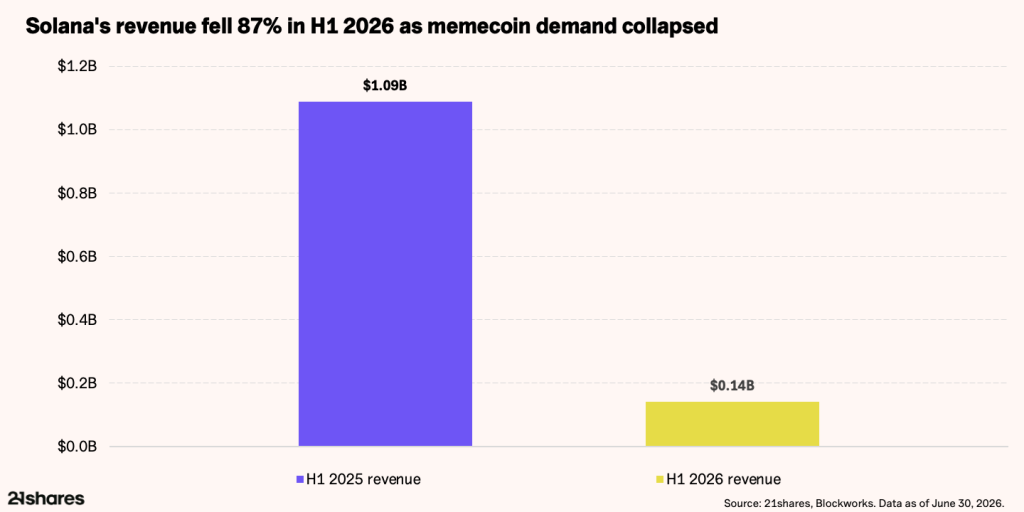
- 21Shares published a report revealing that Solana’s gross revenues fell 87.1% year-over-year, from $1.09 billion in H1 2025 to $141 million in H1 2026.
- Memecoin fees, which represented 95% of revenues in H1 2025, collapsed along with speculative demand, dragging the annualized rate down to $282 million.
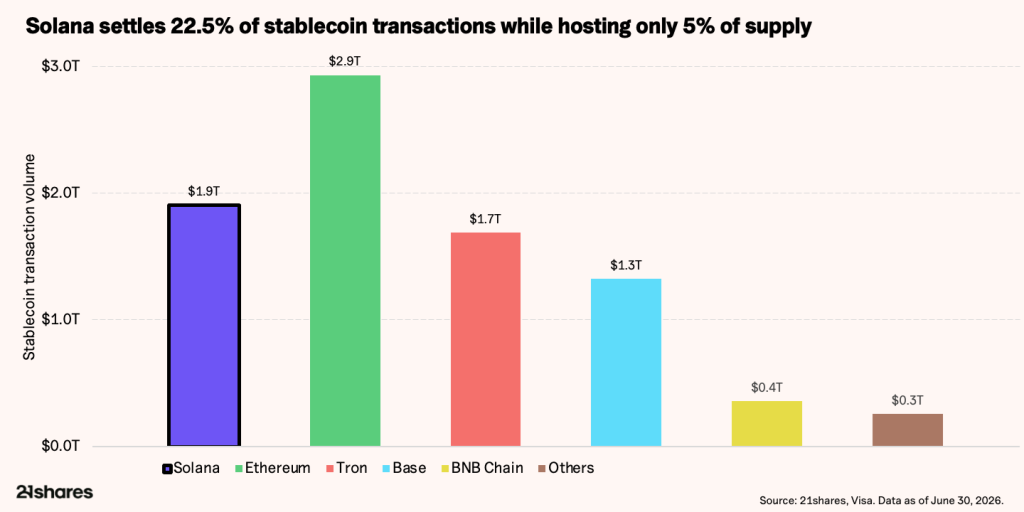
- Stablecoins and real-world assets grew: Solana processed more than 22.5% of all global stablecoin transactions in H1 2026.
The Solana network’s revenues plummeted 87.1% year-over-year during the first half of 2026, dropping from $1.09 billion to $141 million, according to a report published by 21Shares, the crypto asset investment products firm. Analyst Matt Mena, author of the report, notes that the decline does not reflect a loss of genuine activity, but rather the end of the speculative cycle driven by memecoins that dominated the network during the first half of 2025.
During that period, priority fees and Jito tips concentrated 95% of the network’s revenues — 40% and 55% respectively — according to Blockworks data as of June 30, 2026. Memecoin traders competed for early block access through tips and front-running, generating artificial demand for block space that inflated revenue metrics to levels that were hardly sustainable.
21Shares: A Transition That Solana’s Surface Numbers Don’t Show
The 21Shares report focuses on the shift in the composition of activity on the network. Memecoins went from representing 40% of spot volume in H1 2025 to 16% in H1 2026, while stablecoins climbed from 6% to 19% and general Solana trading grew from 41% to 53%. At the same time, the network captured 97% of spot DEX volume in tokenized real-world assets during the first half of 2026, compared to 7% recorded a year earlier.
In the stablecoin market, the network holds approximately 5% of total supply, but processed more than 22.5% of all global transactions during that period, with over $1.9 trillion in settled value. Assets under management in stablecoins on Solana grew 51% year-over-year, from $10.4 billion to $15.7 billion.
Leadership in DEX volume also holds: with just 9.5% of the total market capitalization of smart contract blockchains, Solana recorded more than 36% of global spot DEX volume, nearly double the share of Ethereum.
Real Risks to Consider
21Shares identifies four specific risk factors. Fee revenues are inherently cyclical and compress in bear markets. Competition grew in key verticals: Canton for real-world assets, Hyperliquid and Robinhood Chain for trading, and Tempo for stablecoins.
Adding to that, non-speculative assets generate lower fees per transaction. And in August 2026, a routing failure took approximately 29% of staked SOL offline, approaching the threshold below which the network cannot achieve finality.
As positive factors, 21Shares highlights the Alpenglow upgrade, which would reduce finality to around 150 milliseconds, and the growth of Solana (SOL) ETFs, which accumulated around $1.3 billion in assets since their launch in October 2025, with Goldman Sachs as the largest individual holder according to Q2 13F filings.