TL;DR
- Market Range: Unitas UP shows wide yearly trading channels from 2026 to 2032, with forecasts spanning conservative lows near $0.10 and ambitious highs above $2.20 depending on liquidity, sentiment, and adoption strength.
- Analyst Outlook: Predictions remain divided across all years, with some models expecting steady growth while others highlight volatility, macro pressure, and uneven participation that could limit Unitas UP’s upward momentum.
- Long‑Term Trend: Across the full 2026–2032 window, Unitas UP’s trajectory reflects cautious stability mixed with high‑end speculative scenarios, showing how utility expansion, market confidence, and broader crypto cycles will shape its future valuation.
Unitas has positioned itself as a protocol built to streamline value movement across borders, offering a structure that blends fiat‑denominated stability with crypto‑native flexibility. Instead of acting like a traditional payment network, Unitas focuses on creating predictable conversion units that allow users to transact without worrying about sudden price swings. This approach has helped Unitas gain traction among traders and developers who want the efficiency of blockchain systems but still rely on stable pricing for everyday operations. By anchoring transactions to unitized values, the protocol aims to make global transfers smoother, more transparent, and easier to adopt across different markets.
The Role of the UP Token in the Ecosystem
At the center of this framework is the UP token, which supports the protocol’s internal mechanics and ensures that conversions remain fluid across the network. The token acts as a stabilizing asset, helping maintain liquidity and enabling seamless transitions between various unitized assets. As Unitas expands and more participants use its conversion model, the UP token’s utility becomes increasingly tied to the protocol’s overall performance. This connection makes UP a meaningful asset to analyze, especially as demand for predictable settlement tools grows within the broader crypto landscape.
Why UP’s Price Outlook Matters for 2026–2032
With the crypto market entering a new cycle shaped by regulatory changes, liquidity rotations, and renewed interest in utility‑driven tokens, UP’s long‑term trajectory stands out. This article focuses on how adoption trends, market conditions, and technical indicators could influence UP’s price from 2026 through 2032, offering a clear window into its potential evolution.
Unitas (UP) 2026 to 2032 Price Prediction
Unitas 2026 Outlook: Early Signals and Market Positioning
Forecast data from CoinDataFlow outlines a trading range that places UP between $0.109 on the lower end and $0.313 on the upper boundary in 2026. When compared to today’s average value, this projection suggests a slight decline of around ‑2.32% if the market gravitates toward the higher target. The estimate reflects a cautious stance shaped by current liquidity conditions.
A separate set of forecasts presents a more divided outlook for the same period. Some analysts expect an upward move toward $0.38, with additional projections echoing a potential climb to roughly $0.41 by year’s end. These higher targets assume stronger market confidence and a more favorable environment for utility‑focused tokens.
Unitas 2027 Projection: Adoption Trends and Shifting Liquidity
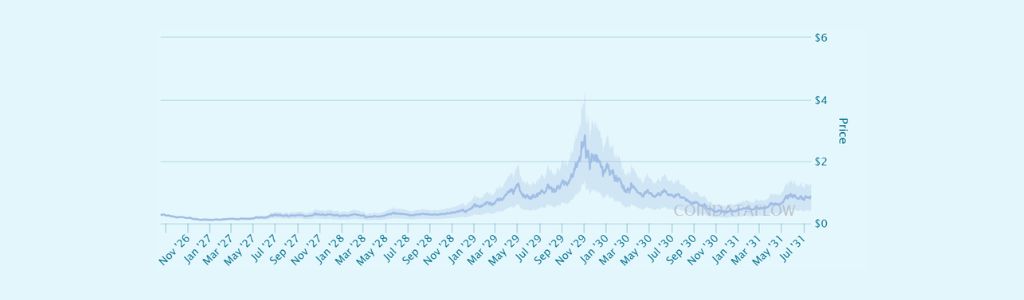
Predictions for 2027 from CoinCodex indicate that UP could trade within a broad channel stretching from $0.2508 to $0.8663, producing an estimated annual average near $0.4873. If the market aligns with this midpoint, the projected return on investment could reach 170.40%, reflecting a scenario where stronger liquidity, healthier sentiment, and increased protocol activity help lift the asset’s performance.
Other analysts present a more divided outlook for the same period. Some models anticipate a downward move toward $0.30 by December, suggesting that market pressure and uneven participation could weigh on UP’s momentum. Additional forecasts echo this cautious stance, pointing to values near $0.27 by year’s end.
Unitas 2028 Forecast: Mid‑Cycle Growth and Sector Expansion
Analysts at DigitalCoinPrice outline a notably stronger outlook for UP heading into 2028. Their projections suggest the asset could begin the year near $0.53 and trade around $0.94, marking a substantial jump compared to the previous cycle. This upward shift reflects expectations of healthier liquidity conditions, improved sentiment, and a more mature crypto environment.
Not all forecasts share this optimistic tone, however. Several analysts continue to present a more cautious view, placing UP within a lower band between $0.23 and $0.30 for 2028. These models highlight concerns around volatility, uneven adoption, and broader macro pressure that could limit UP’s ability to maintain higher valuations. A different perspective points to a potential December value near $0.33.
Unitas 2029 Scenario: Volatility Patterns and Investor Sentiment
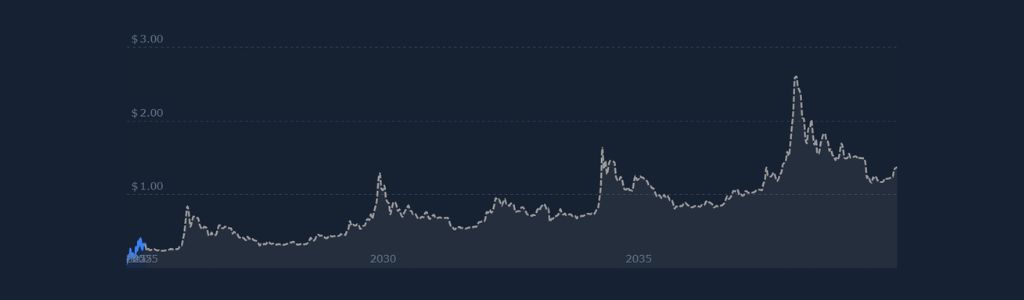
Experimental forecasting models outline a highly optimistic scenario for UP in 2029, projecting a potential surge of 789.03% under ideal market conditions. These models place the token’s upper target near $2.85, with a broader predicted range extending down to $0.52. Such a wide spread reflects the uncertainty surrounding long‑term liquidity cycles.
Other analysts present a more moderate outlook for the same year. Several projections anticipate UP trading near $0.41 and $0.42 by the end of 2029, suggesting steady but measured growth rather than an explosive rally. Additional forecasts support this middle‑ground perspective, pointing to a potential December value around $0.42.
Unitas 2030 View: Long‑Term Utility and Network Evolution
Forecasts for 2030 outline a trading channel that places UP between $0.4066 and $0.9253, with an estimated annual average near $0.5465. If the market aligns with this midpoint, the projected return on investment could reach 188.92%, signaling a year where stronger liquidity, improved sentiment, and broader adoption help support a more confident price structure.
Long‑term projections for 2030 remain divided, with analysts presenting sharply different views on UP’s potential trajectory. Some models anticipate continued growth, pointing to values near $0.33 by the end of the decade, while additional forecasts echo an upward trend toward $0.42. These perspectives assume a supportive market backdrop and sustained interest in conversion‑driven assets.
Unitas 2031 Estimate: Macro Influence and Market Resilience
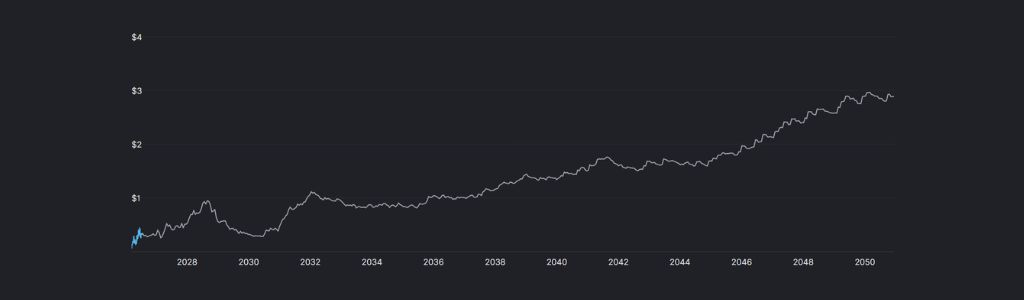
Experimental simulations indicate a potentially strong year for UP in 2031, projecting growth of 233.39% under ideal market conditions. These models place the upper target near $1.07, with a broader range of fluctuations extending down to $0.42. This spread reflects the uncertainty surrounding long‑term liquidity cycles and the evolving role of conversion‑driven assets.
Market analysts present a more measured outlook, suggesting that UP could cross the $0.79 level during 2031 based on technical indicators and broader trend analysis. Their projections outline a minimum value near $0.46, while the maximum could reach $1.05, offering a balanced view of both upside potential and market pressure.
Unitas 2032 Horizon: Maturity Phase and Future Valuation
Forecasts for 2032 suggest a year shaped by steady growth and expanding utility for UP. Technical models indicate the asset could begin the year near $1.00 and potentially close at the same level, reflecting a stable outlook supported by gradual market maturation. Additional projections place UP’s value around $0.93.
Experimental price simulations present a more ambitious perspective for the same year. Under optimal conditions, UP could climb by 603.38%, reaching a potential high near $2.26. These models outline a trading range between $2.26 and $0.62, highlighting both the upside potential and the volatility that may accompany extended market cycles.
Conclusion
UP’s long‑term outlook from 2026 to 2032 reflects a mix of cautious forecasts and ambitious upside scenarios. Analysts highlight shifting liquidity, evolving adoption, and widening trading ranges, showing how UP’s performance will depend on market confidence, utility growth, and broader sentiment across each year of the cycle.
The Price Predictions published in this article are based on estimates made by industry professionals; they are not investment recommendations, and it should be understood that these predictions may not occur as described.
The content of this article should only be taken as a guide, and you should always carry out your own analysis before making any investment.