The cryptocurrency market is once again going through one of its most frustrating phases for retail investors. Despite a wave of positive regulatory developments in Washington and historic changes within the United States financial structure, major digital assets have responded with apathy. For the XRP community, which has spent years waiting for a definitive catalyst, the current price weakness once again highlights one of the oldest rules in financial markets: “buy the rumor, sell the news.”
In one of his latest analyses, YouTuber and financial educator Oscar Ramos directly addressed this collective frustration dominating social media and crypto forums. From a pragmatic perspective, Ramos argues that the current correction does not necessarily invalidate the long-term bullish scenario, but instead represents a technical phase that often precedes a much larger move. According to his interpretation, the lack of immediate market reaction to seemingly bullish news has more to do with institutional dynamics and macroeconomic conditions than with any structural weakness in the crypto ecosystem itself.
Regulatory Progress and the Market’s Paradox
On paper, recent developments appeared to create the perfect conditions for a massive rally across the digital asset market. The U.S. Senate Banking Committee advanced discussions surrounding the CLARITY Act, legislation designed to establish clearer definitions regarding which digital assets should operate under banking supervision and which qualify as utility tokens. This legislative process follows the earlier approval of the GENIUS Act in the House of Representatives, which passed with overwhelming bipartisan support by 294 votes to 134.
The urgency behind these regulatory efforts is far from accidental. During the first half of 2026, tokenized Real-World Assets (RWAs) surpassed $26 billion distributed across blockchain networks, nearly quadrupling the figures recorded a year earlier. This explosive growth explains why Washington is increasingly focused on creating a legal framework capable of integrating digital assets into the traditional financial system. Academic research published by King’s College London argues that the main regulatory challenge is no longer about stopping crypto expansion, but rather about determining how traditional finance and blockchain infrastructure will coexist within the same legal architecture.
Despite these seemingly bullish developments, markets reacted in the opposite direction. Bitcoin temporarily lost the $82,000 level, while XRP pulled back after briefly reaching local highs near $1.56. According to Oscar Ramos, this contradiction has a relatively simple explanation: large institutions and hedge funds usually position themselves long before positive news becomes official. By the time retail investors enter the market driven by excitement, major players often use that incoming liquidity to take profits.
The Silent Accumulation Behind XRP’s Consolidation
XRP’s price action has remained trapped within a sideways range for several months, a consolidation pattern that began forming at the end of January. For many retail investors, this lack of direction has created psychological exhaustion and growing frustration. However, Ramos insists that the real market activity is happening far away from the charts observed by retail traders.
According to the analyst, much of the institutional accumulation is taking place through OTC (Over-The-Counter) transactions, meaning private deals that do not immediately impact public order books. This mechanism allows large funds and market makers to acquire millions of tokens without triggering sharp price movements visible to the broader market. As a result, the market may appear “dead” on the surface while a major accumulation phase quietly unfolds underneath.
This dynamic also aligns with the broader evolution of the global financial infrastructure. Technical studies published by MDPI estimate that the migration toward blockchain-based real-time settlement systems could generate more than $12 billion in annual savings for the U.S. financial system compared to traditional ACH networks. At the same time, financial giants such as JPMorgan Chase continue expanding hybrid institutional digital money solutions, reinforcing the idea that public and private blockchains will eventually coexist within a unified financial ecosystem.
For Ramos, this context helps explain why XRP continues attracting institutional attention despite its temporary price weakness. Rather than signaling a lack of interest, the prolonged consolidation phase could actually represent the final stage before a far more aggressive expansion move.

Kevin Warsh, the Federal Reserve, and Macroeconomic Pressure
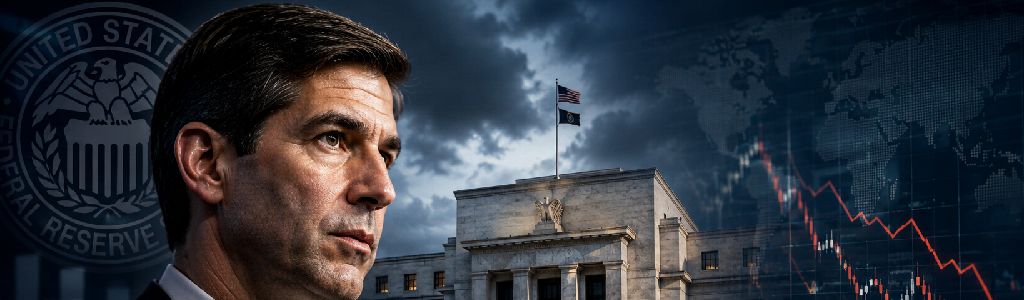
Another major factor behind the recent volatility is the leadership transition at the Federal Reserve. The departure of Jerome Powell and the arrival of Kevin Warsh have introduced a completely new macroeconomic backdrop for global markets.
Warsh, historically known as a monetary “hawk” due to his criticism of large-scale quantitative easing policies, recently surprised Wall Street with a thesis centered around technological productivity. His argument suggests that the expansion of technologies such as artificial intelligence could boost economic growth without generating equivalent inflationary pressures, potentially allowing the Federal Reserve to aggressively reduce its balance sheet.
The debate has already gained traction within institutions such as London School of Economics, where economists warn that a rapid balance sheet reduction could significantly alter global liquidity conditions. For risk assets, including cryptocurrencies, this creates an environment of heightened sensitivity and volatility.
The recent correction in XRP and Bitcoin cannot be viewed in isolation. It coincided with a sharp selloff in Wall Street that erased more than $1 trillion in market capitalization across indices such as the S&P 500 and the NASDAQ Composite. Part of this downward pressure also came from a reassessment of expectations surrounding the artificial intelligence sector, as institutional investors increasingly questioned whether the massive investments made over recent years can translate into sustainable near-term revenues.
Final Reflection
Despite the visible frustration among retail investors, Oscar Ramos believes XRP’s structural outlook remains strong. From his perspective, the consolidation phase observed since the beginning of the year does not signal collapse, but rather a transition period within a market still heavily influenced by macroeconomic forces, institutional positioning, and global liquidity adjustments.
Financial history repeatedly shows that periods of market apathy often precede the most explosive moves. While retail traders focus on daily price fluctuations, institutions typically operate with much longer investment horizons and quieter accumulation strategies. In that context, XRP’s current consolidation may not represent structural weakness at all, but instead the calm before a new expansion cycle driven by regulatory clarity, institutional adoption, and the modernization of the global financial system.
Disclaimer: This article has been written for informational purposes only. It should not be taken as investment advice under any circumstances. Before making any investment in the crypto market, do your own research.