Vitalik Buterin reaffirms his authority over the Ethereum Foundation and rejects calls for a leadership change.
The Ethereum community is pushing to promote Danny Ryan, a key figure in the transition to Proof of Stake, as a leader within the foundation.
Buterin condemns attacks and threats against Aya Miyaguchi, the current executive director of the foundation, highlighting the toxicity in the community.
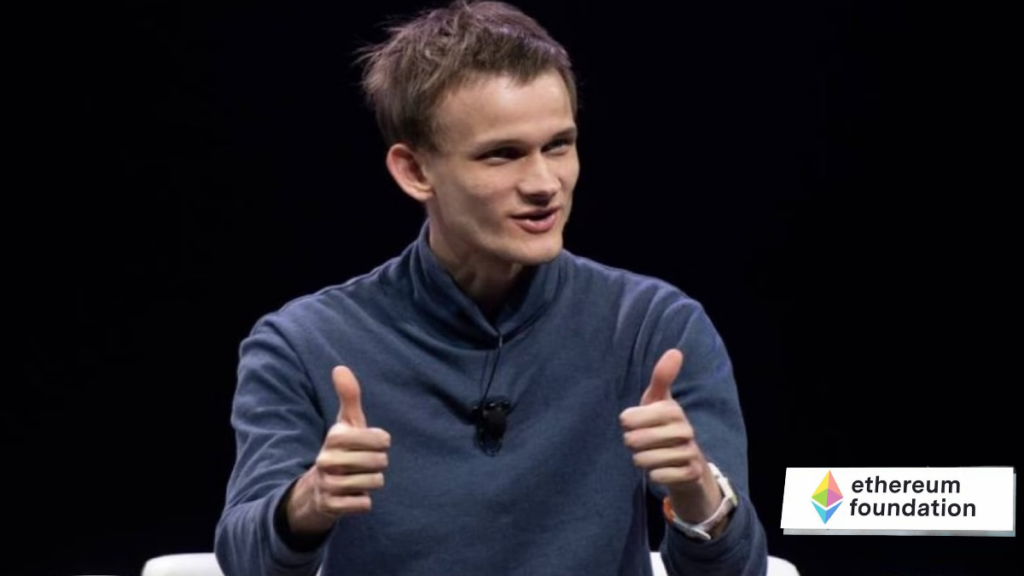
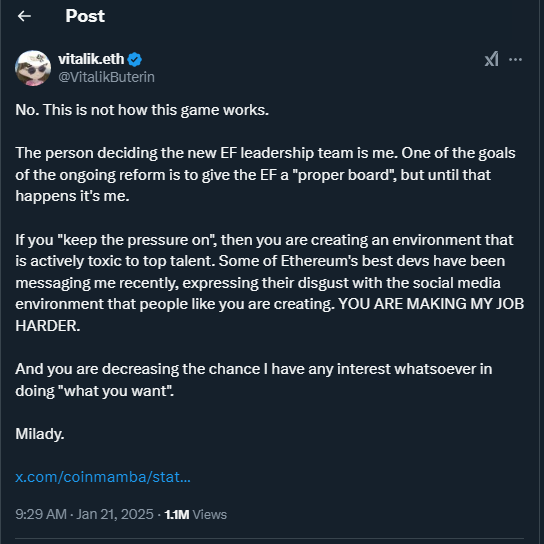
Ethereum co-founder Vitalik Buterinresponded to rumors of a potential leadership change within the Ethereum Foundation and reaffirmed his position of authority in a post on X on January 21. Buterin made it clear that decisions regarding leadership remain his sole responsibility until reforms are implemented, which include the creation of a “proper board”. Additionally, he criticized certain members of the crypto community for their “actively toxic” attitude towards top talent, stating that such behavior undermines the foundation’s progress.
This statement comes amid growing pressure from the community to promote Danny Ryan, a key researcher and developer in the Ethereum ecosystem, to a leadership role within the foundation. Ryan is known for his critical role in transitioning Ethereum from Proof of Work (PoW) to Proof of Stake (PoS). His supporters argue that his experience and long-term vision position him as a suitable leader, although Buterin has emphasized that leadership decisions remain his alone.
Toxicity and Harassment in the Ethereum Community
A significant concern related to the Ethereum Foundation’s leadership has been the harassment of Aya Miyaguchi, the current executive director. Miyaguchi, who has led the foundation since 2018, has been subjected to personal attacks and death threats from certain members of the community. Buterin strongly condemned these actions, calling them “pure evil”. He also expressed concern about the impact this toxic behavior is having on the community, warning that it could drive away Ethereum’s top developers, hindering the ecosystem’s overall growth.
“Some of Ethereum’s best developers have recently written to me, expressing their disgust with the social media environment people like you are creating. YOU ARE MAKING MY JOB HARDER,”
Buterin wrote, noting that this kind of pressure only makes it more difficult for the desired changes to occur.
Regarding the future of the Ethereum Foundation, Buterin announced significant changes on January 18 aimed at improving communication between the foundation and developers within the ecosystem. These changes aim to support decentralized application (DApp) developers, promote censorship resistance, and strengthen privacy. However, Buterin made it clear that the foundation will not adopt a more centralized approach or engage in ideological shifts or political lobbying.
TL;DR: Vitalik Buterin stated on October 29, 2026, that artificial intelligence models lack the wisdom to interpret the deeper substance of unpublished texts. The Ethereum
TL;DR: The governance vote in Lido DAO aims to roll back specific fork-related contracts on Hoodi after the October 26, 2026 upgrade was postponed. The
TL;DR Changpeng Zhao warned that artificial intelligence could facilitate attacks against Bitcoin users without needing to break its cryptography. Vitalik Buterin also expressed confidence in
The DeFi sector recorded a solid recovery during Q3 2026 driven by tokenized equities and lending deposits, according to ARK Invest’s quarterly report. However, the
Postquant Labs introduced the Quip Virtual Machine (QVM) to the industry on its Aglais testnet, integrating quantum and classical hardware under a single programming layer.
TL;DR: Polygon integrated support for Hyperledger Besu into its Chain Development Kit (CDK) to connect institutional chains with Agglayer. The architecture allows banks and institutions
We use cookies to ensure that we give you the best experience on our website. If you continue to use this site we will assume that you are happy with it.