TL;DR:
- The European banking consortium Qivalis brings together 37 financial institutions across 15 countries to issue a digital currency backed 1:1 by the euro.
- The chosen infrastructure for technical deployment is the public Ethereum blockchain under the European Union’s MiCA regulatory framework.
- The initiative’s application for an Electronic Money Institution (EMI) license is currently under review by the central bank of the Netherlands (DNB).
Ethereum Institutional confirmed this Tuesday, September 8, that a consortium of 37 European financial institutions is advancing the development of a regulated Euro stablecoin on the public Ethereum blockchain. The project, formally established under the brand name Qivalis, will operate in compliance with the European Union’s Markets in Crypto-Assets regulation (MiCA).
Qivalis is coming to Ethereum.@qivaliseu is a consortium of European banks building a regulated euro stablecoin under MiCA.
Qivalis at a glance:
→ 37 banks across 15 countries
→ 1:1 euro backing
→ EMI licence pending with the Dutch central bank
→ Target launch H2 2026… pic.twitter.com/tfyBtEOo8Q— Ethereum Institutional (@ethereuminsti) September 8, 2026
The organization targets a formal launch during the second half of 2026, featuring a strict 1:1 peg to the eurozone’s fiat currency. To proceed with the issuance, the consortium is pursuing an Electronic Money Institution (EMI) license with De Nederlandsche Bank (DNB), the central bank of the Netherlands. Until the regulatory body grants this authorization, the project remains classified in a technical and legal pre-launch phase.
Banking Expansion and Integration on Ethereum’s Public Network
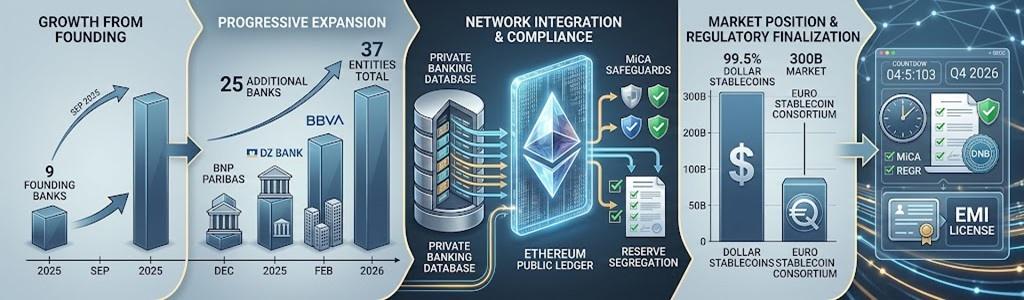
The banking initiative has sustained steady institutional expansion since its founding in September 2025. Initially, the consortium comprised nine founding institutions, including ING, UniCredit, and KBC. Over the following months, the alliance expanded to include BNP Paribas and DZ BANK in December 2025, followed by BBVA in February 2026.
In May 2026, the addition of 25 financial institutions—including ABN AMRO, Rabobank, and Intesa Sanpaolo—brought the total to 37 active entities across 15 European nations. Earlier in April of that year, Spanish lenders including Banco Sabadell, Bankinter, Kutxabank, Abanca, and Cecabank held discussions regarding project integration.
Deploying on a decentralized public network like Ethereum marks a technical departure from standard banking frameworks, which historically rely on permissioned private distributed ledgers. Project documentation notes that a public launch connects the asset directly with global non-custodial wallet infrastructure and existing on-chain protocols.
Nevertheless, industry analysts emphasize that technical integration on an open network requires rigorous compliance safeguards. Under the MiCA framework, issuers of asset-referenced tokens (ARTs) and electronic money tokens (EMTs) must adhere to stringent mandates concerning reserve segregation, asset custody, and governance standards designed to protect end users.
The stablecoin sector remains overwhelmingly dominated by US dollar-pegged assets. Ethereum Institutional estimates place the dollar’s market share at approximately 99.5% within a global stablecoin market evaluated at $300 billion as of September 2026. Against this backdrop, the consortium positions itself as an institutional settlement alternative designed for corporate payments and cross-border interbank clearing denominated in euros.
Asset tracking database Pharos lists Qivalis on its roadmap for a fourth-quarter 2026 debut, contingent upon final regulatory approval from the Dutch central bank.