TL;DR:
- Buterin publicly backed EIP-8141, known as Frame Transactions, for Ethereum’s upcoming Hegota hard fork.
- Frame Transactions removes embedded signature fields and delegates authorization to smart contracts through a new opcode called APPROVE.
- Developers are debating between Frame and Tempo Transactions, two opposing philosophies on how to implement native account abstraction at the protocol level.
The Ethereum developer community is in the midst of one of its most intense technical debates in recent months: how to implement native account abstraction at the protocol level. During the planning of the upcoming hard fork, named Hegota, at least four new Ethereum Improvement Proposals (EIPs) have emerged in recent weeks. Among them, EIP-8141, known as Frame Transactions, received public backing from Vitalik Buterin, co-founder of Ethereum.
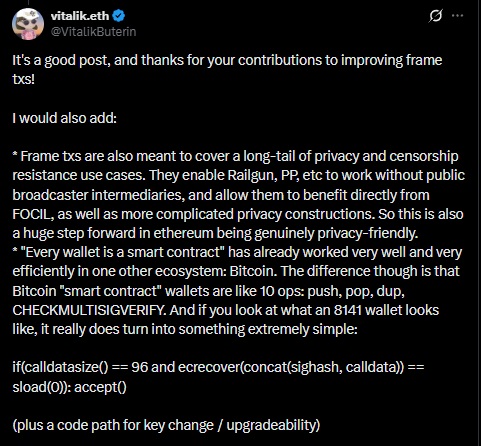
Buterin weighed in in response to a thread posted by Derek Chiang of ZeroDev, where the two competing approaches were compared. In his words, Frame Transactions could cover a wide range of use cases oriented toward privacy and censorship resistance, while also considerably simplifying wallet architecture.
Frame and Tempo Transactions
Frame Transactions proposes a model that removes the signature fields embedded in the traditional transaction format. Instead, authorization logic is delegated to smart contracts through a new opcode called APPROVE. This design allows for multi-signature systems, alternative cryptographic schemes, and conditional gas sponsorship mechanisms, where external contracts cover network fees in exchange for token transfers.
The counterpart in the debate is the Tempo Transactions proposal, which opts to integrate the most common account abstraction features directly into the protocol: atomic batching, transaction scheduling, and sponsored gas fees. Its supporters argue that this architecture is easier to integrate and improves the user experience, although its extensibility is limited because any new functionality would require a protocol upgrade.

Buterin: Simple Wallets Like in Bitcoin
Buterin noted that the model proposed by EIP-8141 would allow protocols such as Railgun to operate without public transaction broadcast intermediaries, interacting directly with mechanisms like FOCIL and preserving censorship resistance.
Vitalik also drew a parallel with Bitcoin: he stated that the “each wallet as a smart contract” scheme had already worked efficiently in that ecosystem, where authorization scripts are reduced to approximately ten operations. According to Buterin, a wallet built under EIP-8141 could reach a comparable level of simplicity, moving functions such as signature hash calculation or transaction batching outside the wallet code.