TL;DR:
- The new open-source DeepSeek V4 model features a 2-bit quantized version capable of running locally using 90 GB of memory.
- Vitalik Buterin formally introduced the CROPS AI concept during his presentation at the ETH Mumbai conference this past March 12, 2026.
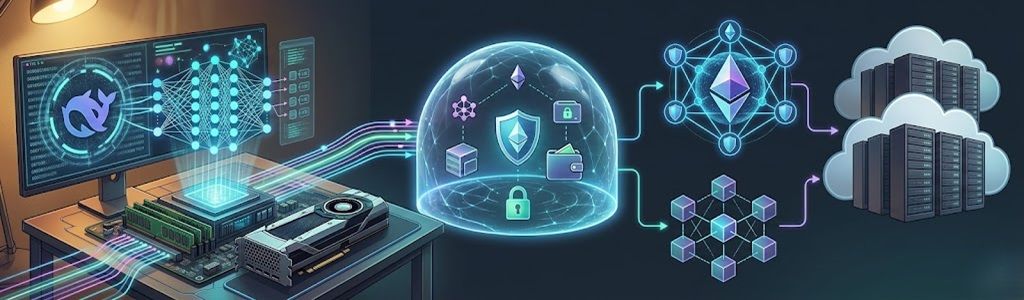
- Running this artificial intelligence model locally on consumer workstations allows Ethereum queries to be processed without exposing IP addresses or metadata.
Ethereum co-founder, Vitalik Buterin, linked the launch of the open-source DeepSeek V4 model with the development of privacy and security in the blockchain network’s access layer.
Updates since then:
* Deepseek v4 is out. There *is* a 2-bit quant that can run within 90 GB ( https://t.co/X3AFAsiH02 ), and it works, however it's only fast on Apple hardware (I've head ~35 tok/s). On AMD, it's ~7 tok/s. IMO actually taking the effort to properly support more… https://t.co/zo04n5Cx0F
— vitalik.eth (@VitalikButerin) May 27, 2026
According to Buterin, the ability to run advanced language models locally stands as a critical component to mitigate centralization risks and the exposure of sensitive data in the crypto ecosystem. The developer argues that the current automated agent infrastructure lacks a design oriented toward user sovereignty.
CROPS AI Infrastructure and Local Execution
The core concept of this technical roadmap is called CROPS AI (Censorship-Resistant, Open-Source, Private, and Secure AI), an initiative originally presented at the ETH Mumbai conference on March 12, 2026. In this regard, Buterin suggests that most current local AI tools, such as the Qwen 3.5 series, do not offer true privacy because they make external calls to the application programming interfaces (APIs) of corporations like OpenAI or Anthropic when encountering complex tasks.
Faced with this limitation, official information shared by the Ethereum co-founder indicates that the 2-bit quantized version of DeepSeek V4, which requires approximately 90 GB of video memory (VRAM) or unified memory, stands as a viable alternative for local processing.
The integration of this language model with the Ethereum access layer could allow users to perform private remote procedure call (RPC) reads. This means that a user could query their wallet balances or the state of smart contracts locally, preventing centralized infrastructure providers from collecting their IP addresses or network metadata.
Upcoming Milestones and Hardware Requirements
According to the technical analysis presented by Buterin, the viability of this privacy ecosystem directly depends on software optimization and the diversity of the hardware used. Shared performance records detail that DeepSeek V4 quantization reaches a processing speed close to 35 tokens per second on Apple architecture components, while on AMD graphics processors, the speed is currently reduced to about 7 tokens per second.
Due to this technical disparity, the network co-founder urged the developer community to closely track the optimization patches called DeepSeek V4 Flash for AMD environments, which are projected as a