TL;DR:
- The Office of Foreign Assets Control (OFAC) sanctioned the BitBank exchange platform on September 17, 2026.
- The U.S. Department of the Treasury linked the exchange’s infrastructure to financier Babak Zanjani and the transfer of hundreds of millions of dollars in Bitcoin to the Islamic Revolutionary Guard Corps (IRGC).
- Punitive measures included software development firm Pishtaz Simorgh Electronic Trade Company and three key associates of the organization.
This Thursday, the United States Department of the Treasury sanctioned Iranian crypto exchange BitBank. The platform was accused of allegedly processing transactions worth hundreds of millions of dollars in digital assets destined for sanctioned state entities and the Islamic Revolutionary Guard Corps (IRGC).
The designation was carried out under the framework of Operation Economic Outcast, a coordinated U.S. administration offensive announced in late August 2026 to dismantle financing channels for the Tehran regime. Official documentation released by the Office of Foreign Assets Control (OFAC) asserts that BitBank operated as a central component within the digital financial network controlled by sanctioned tycoon Babak Zanjani.
The government report details that maritime firm Hormuz Safe Marine Services Authority, previously sanctioned by Washington, used the exchange’s channels since June 2026 to process payments received in Bitcoin. According to federal authorities, this mechanism was used to collect port and escort fees from vessels transiting the Strait of Hormuz, deliberately bypassing the international banking system.
The action blocks all property and interests in property of BitBank subject to U.S. jurisdiction. Any transactions by U.S. persons or within the United States are strictly penalized under federal law.
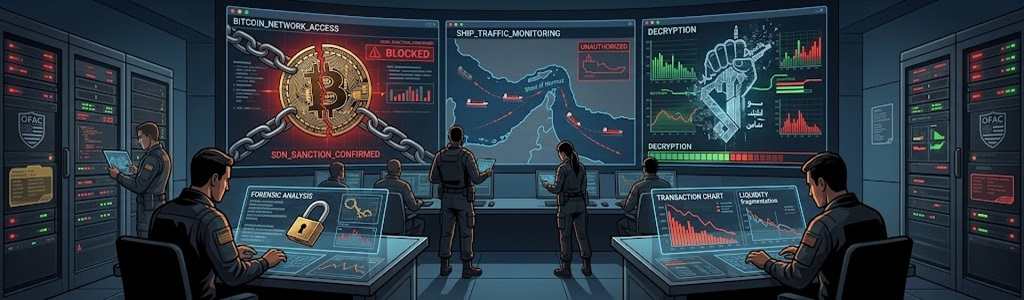
Tech Development Networks Under OFAC Scrutiny
Alongside the exchange’s addition to the Specially Designated Nationals (SDN) list, OFAC expanded its sanctions to its technical support infrastructure. The agency sanctioned software developer Pishtaz Simorgh Electronic Trade Company, responsible for building and maintaining the platform’s codebase.
The legal enforcement also targeted three Zanjani associates: Hossein Ali Zaker Hossein, Mohammad Mahdi Zaker Hossein, and Seyed Adel Heidari. According to legal analysts, blocking the technology development layer indicates that U.S. regulators aim to neutralize not only commercial brand names, but also the engineering teams enabling the operation of alternative exchanges across the region.
U.S. Treasury Secretary Scott Bessent stated that Iran’s attempts to leverage virtual asset technology fall squarely within OFAC’s enforcement reach. Regulatory agency data indicates that while authorities froze Tehran-linked funds in centralized stablecoins like Tether (USDT) in July 2026, the non-custodial and decentralized nature of Bitcoin has compelled regulators to directly target the fiat on-ramps and off-ramps of local exchanges.
The imposed restrictions trigger secondary sanctions warnings for global platforms and liquidity providers maintaining commercial or transactional ties with BitBank. Chainalysis data suggests such blocking measures typically lead to temporary liquidity fragmentation across local over-the-counter (OTC) trading desks, while identified wallets are flagged as high risk across global compliance and regulatory screening tools.
The Department of the Treasury announced it will continue issuing guidance and updated FAQs tailored for virtual asset service providers (VASPs) during upcoming working sessions with Group of Seven (G7) allies and Middle Eastern partners.