TL;DR
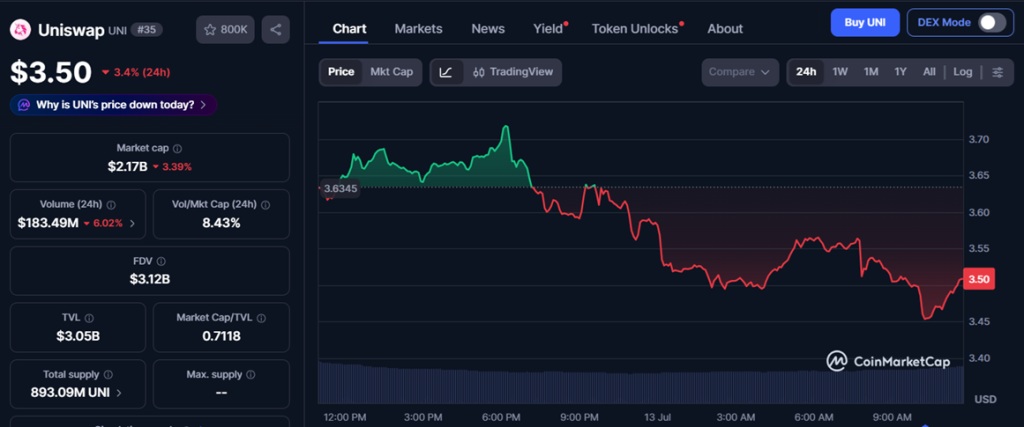
Uniswap activated its fee switch and began generating approximately $5.2 million in daily fees, as confirmed by Hayden Adams, founder of the protocol. With that figure, the decentralized exchange positions itself behind only Tether and Circle in revenue generation, maintaining a considerable lead over the rest of the decentralized exchanges in the market. The UNI token is currently trading near $3.50 after falling 3.5%.
Fees accumulate on-chain and can only be claimed through UNI burns. That means protocol revenue is tied directly to token destruction, without depending on future governance votes. The mechanism is already operational: every high-volume session adds fees to the system and enables new burns automatically.
Wild so many people didn't get the memo: uniswap protocol fees are on + burn UNI
Get constant replies from ppl thinking they're off
Btw 3 gov proposals being voted on now:
1) robinhood chain fees (v2/v3)
2) v4 fees
3) bridge cleanup for fees on xlayer, ava, megaeth, sonium pic.twitter.com/tUUPmHYB0p— Hayden Adams 🦄 (@haydenzadams) July 12, 2026
Uniswap Redefines its Economy
The activation of the fee switch in Uniswap modifies the distribution of rewards between liquidity providers and holders of UNI. Protocol fees now run on v2 pools and selected v3 pools across 11 networks. In enabled pools, liquidity providers receive 0.25% while the protocol retains 0.05%, a fraction that is automatically directed toward buybacks and burns of UNI instead of feeding a treasury.
The UNIFication initiative introduced this model alongside a one-time burn of 100 million UNI from the protocol treasury, with the goal of covering accumulated fees before holders began participating in revenue. The deployment was carried out in stages: it started on Ethereum in late December 2025 and expanded to more networks during March and June 2026. Revenue from the Unichain sequencer also feeds the burn pool after the corresponding deductions.
Projections estimate that the model would have destroyed around $26 million in UNI over 30 days and that cumulative burns over the year could have approached $150 million at similar activity levels. Those figures are based on historical volume data, not optimistic projections.
Volume Will Be Key
The next milestone is extending protocol fees to v4 pools through a governance approval. If trading volume holds, the UNI supply should continue shrinking over time. A lower-activity scenario, on the other hand, would slow down burns. Ethereum remains the primary driver of fee generation on Uniswap, which means its performance will be decisive in sustaining the narrative over the coming months.