The proposal by MSCI to exclude “non-operating companies” from its global indices represents a structural risk of the first order for the ecosystem of corporate Bitcoin treasuries. The August 2026 announcement does not constitute a novelty or a surprise, but the materialization of a threat that the sector already faced in October 2025. On that occasion, the market experienced a violent correction that drove Bitcoin from $122,000 to $105,000 within 48 hours, with leveraged position liquidations exceeding $190 billion.
The return of this catalyst demands a dispassionate analysis of its technical implications, its transmission mechanisms to the asset’s price, and the strategic responses available to sector participants.
The October 2025 Precedent: A Relevant Precedent
On October 10, 2025, MSCI issued an official announcement regarding the potential exclusion of companies with digital asset holdings representing 50% or more of total assets from its global benchmark indices. The original proposal was grounded on a conceptual premise: these companies resembled passive investment vehicles, a category that MSCI does not include in its benchmarks.
The market correctly interpreted that an exclusion of Strategy from the MSCI World and MSCI ACWI IMI indices would trigger forced selling by passive funds tracking those indices. JPMorgan estimates placed the forced outflow volume between $2.8 billion and $8.8 billion, depending on whether other index providers followed the same direction.
The decline in Bitcoin from $122,000 was not a direct consequence of BTC sales by Strategy, but rather of an indirect but equally effective transmission mechanism. The exclusion threat compressed Strategy’s premium over its net asset value (NAV), which in turn affected the company’s ability to access capital markets and continue its acquisition program. The reduction in structural demand for BTC, represented by the largest corporate buyer, generated a downward repricing of the underlying asset.
Strategy filed a formal objection in December 2025, arguing that it operated as a software company with active treasury operations and that the 50% threshold was arbitrary and unfairly discriminated against cryptoasset holders. In January 2026, MSCI announced it would not proceed with the exclusion “at this time,” opting for a broader review of the non-operating company concept.
The August 2026 New Proposal: A Broader Approach
The consultation opened in August 2026 represents a shift in strategy by MSCI. The new methodology does not explicitly target digital assets but establishes a two‑stage filter to identify “non‑operating companies.”
The first stage consists of a primary filter that verifies whether a company’s operating assets represent more than 50% of total assets. If a company surpasses this threshold, no further analysis is performed.
The second stage, for those that do not pass the initial filter, applies five financial exclusion ratios:
-
Operating asset intensity: operating assets below 20% of total assets.
-
Expense intensity: operating expenses below 5% of total assets.
-
Negative operating cash flow.
-
Fair value intensity: changes in non‑operating fair value above 5% of total assets.
-
Capital dependency: external capital dependency above 20%.
A company is deemed ineligible for index inclusion if it fails four out of the five test ratios.
MSCI’s simulation using data from May 2026 shows that Strategy, Metaplanet, and Yellow Cake would be removed from the MSCI ACWI IMI under the new proposal. Strategy, with a free‑float adjusted market capitalization of $23.9 billion, is the largest company that could be excluded.
The Transmission Mechanism to Bitcoin’s Price
The risk to Bitcoin’s price operates through three distinct but interconnected channels.
The first channel is that of forced selling of Strategy shares. Passive funds tracking MSCI indices would be obliged to sell their positions in MSTR, exerting downward pressure on the stock price. While this movement does not imply a direct sale of Bitcoin, the compression of the stock value reduces the NAV premium that the market assigns to Strategy’s BTC holdings.
The second channel is the financing capacity. Strategy has historically financed its Bitcoin acquisitions through debt and equity issuances. An exclusion from MSCI indices would reduce the liquidity and attractiveness of its shares to institutional investors, raising the cost of capital and limiting its ability to continue the accumulation program.
The third channel is the signal effect. MSCI’s decision to classify Strategy as a “non‑operating company” would send a negative signal to other index providers, who would likely follow the same direction. A coordinated exclusion move by multiple index providers would multiply the impact on the ecosystem of corporate Bitcoin treasuries.
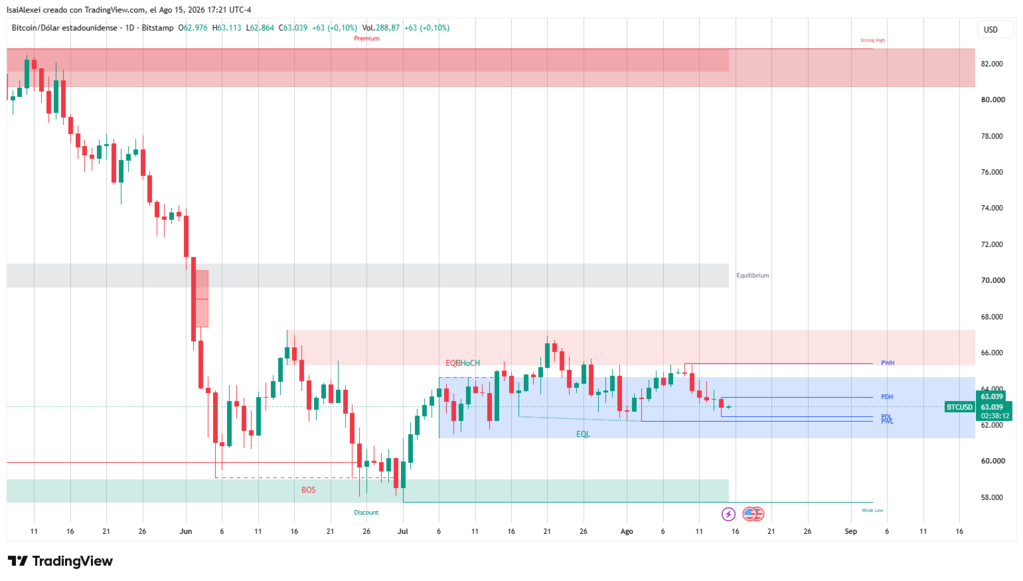
The market is already processing this information. Bitcoin is trading around $62,400–$63,000, with a 1.7% decline over 24 hours and a weekly decline near 4%. The price has lost approximately 50% of its value since the highs of $126,000 recorded in the period following the October 2025 announcement.
Strategy’s Response: A Principled Argument
Strategy has responded to the new proposal with a principled argument. The company contends that “index providers should measure markets, not decide which assets companies can own.” This positioning transcends Strategy’s particular interest and appeals to a fundamental question about the role of index providers in shaping corporate strategies.
Strategy’s argument is that the new MSCI proposal repeats the flaws of the previous proposal and unfairly penalizes companies for holding bitcoin. The company has stated that “Bitcoin does not need MSCI. Neither does Strategy.“
The MSCI consultation period extends until September 30, 2026, with a results announcement scheduled for October 16, 2026. Any changes to index composition would take effect no earlier than the November 2026 rebalance.
Implications for the Crypto Sector
The recurrence of this structural catalyst raises deeper questions for the sector. The dependence of corporate Bitcoin treasuries on global benchmark indices constitutes a vulnerability that the market had not adequately assessed in the previous cycle.
MSCI’s decision, regardless of its final resolution, has introduced an element of regulatory and governance uncertainty that affects the risk premium assigned to companies with large digital asset holdings. Institutional investors considering positions in these companies must now incorporate index exclusion risk as a relevant valuation factor.
The October 2025 precedent demonstrated that the market reacts violently to such announcements, even when the probability of exclusion is not absolute. MSCI’s new proposal, being broader and not explicitly targeting digital assets, presents a regulatory framework more difficult to challenge than the previous proposal.
The sector thus faces an asymmetric risk scenario. A favorable outcome (non‑exclusion) would likely generate temporary price relief, but an unfavorable outcome (exclusion) could trigger a corrective move of significant magnitude in a market already trading at substantial discounts from its all‑time highs.