
TL;DR
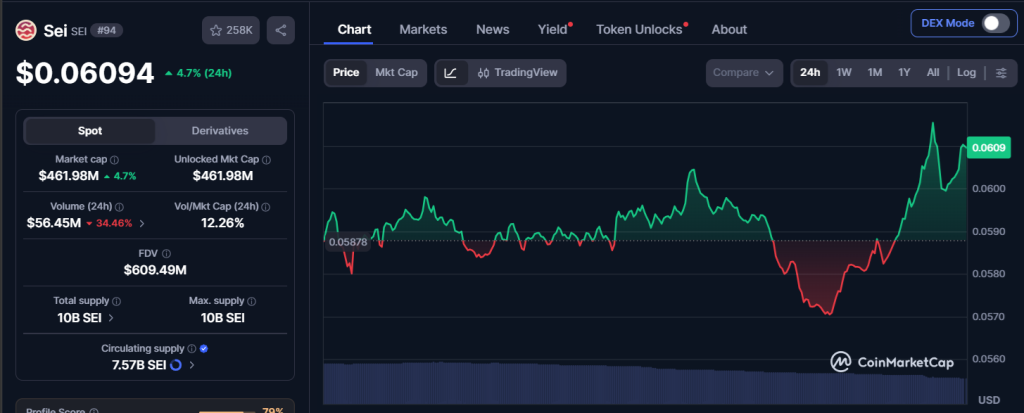
- SEI registers a weekly gain of nearly 50% and trades at $0.0609; its volume fell 35% but hovers around $56 million.
- Sei Labs reached 100,000 TPS with a median finality of 68 ms in controlled tests of the Hermes consensus protocol.
- The benchmark corresponds to the Giga roadmap and does not reflect current mainnet performance, which is still going through development stages.
Sei Labs reported a technical record for its next-generation consensus protocol, Hermes, developed under the Giga roadmap. In laboratory tests, the system processed 100,000 transactions per second with a median finality of 68 ms, a result that positions the network as one of the blockchain projects with the greatest technical ambition among high-frequency financial applications.
At the same time, the native token is growing in the market. It has accumulated a gain of nearly 50% over the past week and trades around $0.0609, with a daily volume of approximately $56 million, although that figure fell 35% compared to the previous session.
Sei Labs has built one of the fastest consensus protocols in existence.
Hermes has achieved 68ms finality in lab conditions.
Hermes will ultimately go live on Sei Giga. https://t.co/JFm3Qtj65T
— Sei (@SeiNetwork) September 23, 2026
Hermes and the Performance SEI Giga Pursues
Hermes is a Byzantine fault-tolerant consensus protocol that Sei Labs built on prior projects such as Autobahn and Ambulance. Its design incorporates the concept of a shared prefix: rather than requiring every vote within the quorum to be identical, the protocol can finalize the heaviest common prefix among comparable votes. This reduces unnecessary view changes and sustains low latency even when network conditions are not optimal.
The test was conducted with 51 validator replicas distributed across four European regions under a stable load of 100,000 TPS. Results showed a 95th-percentile finality of 101 ms and, with three validators stopped, 95% of transactions were finalized within 206 ms. Sei clarified that these metrics correspond to laboratory conditions and that production performance may differ due to factors such as the geographic distribution of validators, adversarial behavior, and hardware variability.
The Gap Between the Laboratory and the Mainnet
The Giga roadmap sets several objectives: exceeding 5 gigagas per second, achieving an ordering finality below 250 ms on a distributed development network, and targeting a public testnet with approximately 200,000 TPS and 400 ms of finality. Hermes is one piece of that package, which also includes improvements in privacy, MEV resistance, execution, and storage.
The effect on the token price is indirect and speculative. A successful deployment of Hermes could strengthen Sei’s technical proposition and attract developers, derivatives platforms, and liquidity providers. However, variables such as validator decentralization, token unlock schedules, and competition from networks like Solana, Sui, and Aptos will shape its future more immediately than an isolated benchmark.