The Russell 2000 closed above 3,000 points for the first time in its history during the session of June 23, 2026. Analyst Ash Crypto published on X that the breakout of the small-cap index represents a relevant macroeconomic signal for Ethereum and altcoin traders, under the hypothesis that small-cap strength anticipates a return of risk appetite that has historically supported altcoin rotation.
BREAKING: 🇺🇸 Russell 2000 just hit a new all-time high of 3,000 for the first time in history.
This clearly shows money is rotating from large cap stocks to small caps.
Russell is the biggest indicator for risk assets like Crypto. Historically ETH and altcoins follows Russell… pic.twitter.com/1mbGnJdXWz
— Ash Crypto (@AshCrypto) June 22, 2026
The relationship between equity market breadth and altcoin rotation has documentable precedents, but it also carries limitations that the original argument does not quantify with statistical rigor.
The Correlation Between Small-Caps and Crypto: Foundation and Limits
Small-cap indices, with the Russell 2000 as the primary reference in the American market, concentrate companies with lower market liquidity, greater dependence on domestic credit, and higher sensitivity to risk-on/risk-off cycles. In behavioral market terms, the Russell 2000 acts as a gauge of speculative appetite within American equities.
When capital rotates away from large-cap technology names in the S&P 500 and into the Russell 2000, institutional operators read the movement as market broadening: the rally moves beyond concentration in four or five names and distributes capital toward assets with lower market capitalization and higher risk profiles.
Altcoins operate under an equivalent logic within the crypto ecosystem
Bitcoin maintains its position as a digital reserve asset and attracts institutional flows in macro uncertainty contexts. Ethereum and mid-to-low cap altcoins require a more generous liquidity backdrop to generate returns above Bitcoin.
In the 2020-2021 cycle and the Q4 2024 rebound, Bitcoin dominance peaks preceded rotations toward the altcoin segment in a consistent pattern. Altcoin season does not trigger from a single catalyst; it requires a confluence of signals: a drop in BTC dominance below critical thresholds — typically between 55% and 60% — expansion of spot volume in mid-cap altcoins, and favorable global liquidity conditions, as reflected in short-term U.S. Treasury yields and the DXY trajectory.
The ETH/BTC Ratio as the Internal Confirmation Signal
In market analysis, the difference between an early warning signal and a confirmation operates across different time frames. The Russell 2000 at historic highs provides macro context; it does not produce altcoin rotation on its own.
The ETH/BTC ratio functions as the most relevant internal indicator for evaluating whether altcoin rotation begins to materialize within the crypto market. When the ETH/BTC ratio rises with volume, capital exits Bitcoin as a relative lower-risk asset and moves into Ethereum, which operates as the entry point into the DeFi ecosystem, Layer 2 infrastructure, and high-beta tokens. From there, liquidity flows progressively into lower market cap tiers across the altcoin ecosystem.
Data from the 2020-2021 cycle support the relationship
The ETH/BTC ratio traded around 0.020 during Q1 2020 and reached a peak near 0.085 in May 2021, a 325% increase in relative terms. The breadth of the altcoin season in the 2020-2021 cycle correlated directly with the magnitude of the ETH/BTC ratio’s rise and with the duration of the period in which the ratio maintained elevated levels.
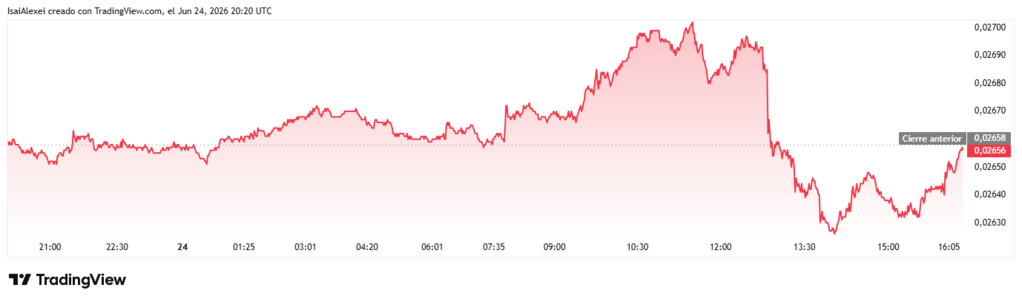
In the 2024 cycle, the ETH/BTC ratio did not sustain levels above the 2021 peaks, which partially explains why the 2024 altcoin season registered lower depth and shorter duration than the prior cycle.
The current debate over the Russell 2000 gains relevance precisely because the ETH/BTC ratio has held at compressed levels for months, trading in ranges comparable to 2022-2023 values. If the macro risk-on signal coincides with a technical breakout of the ETH/BTC ratio above key resistance, the confluence generates a stronger altcoin rotation argument than either signal produces independently.
Rigorous analysis of Ash Crypto’s argument requires articulating the variables that can invalidate it.
Endogenous crypto market leverage
The accumulation of leveraged long positions in altcoins can coexist with a positive equity environment and still produce mass liquidations when perpetual funding rates exceed unsustainable thresholds.
During April and May 2021, while the American equity market operated without material corrections, the crypto market saw Bitcoin drop 50% in price in fewer than five weeks. The Russell 2000 neither anticipated the correction nor provided any structural support.
Token unlocks
The vesting calendars of mid-to-high cap crypto projects generate constant selling pressure independent of external macro conditions. A risk-on environment in equities does not eliminate scheduled dilution across the altcoin market. Projects with large unlocks during rally windows produce technical resistance that limits the extension of any altcoin rotation.
The introduction of institutional Bitcoin ETFs alters the rotation mechanics
In cycles prior to 2024, Bitcoin ETFs in the American market did not exist as regulated investment vehicles at current scale. The availability of regulated products modifies Bitcoin dominance behavior. Institutional investors with a crypto exposure mandate can increase their Bitcoin allocation via ETF without redistributing capital into altcoins. The effect on altcoin rotation constitutes a new structural variable that historical analysis from pre-2024 cycles does not capture fully.

Equity Market Breadth as a Contextual Variable
Market breadth, in its technical definition, measures how many components of an index actively participate in a bullish trend. When market advances concentrate exclusively in the seven largest-cap names of the S&P 500 and the Russell 2000 lags the move, crypto operators read a negative signal: liquidity does not expand; it concentrates in the highest-capitalization assets.
A Russell 2000 at all-time highs, particularly when the movement includes broad sector participation across industrials, financials, and domestic U.S. consumption, changes the structural reading. The move does not produce automatic flows into altcoins. It produces a more favorable backdrop: investors with higher risk tolerance, compression of the liquidity premium on speculative assets, and lower pressure to maintain defensive positions.
When conditions in the crypto market align around internal catalysts — Ethereum ETFs with sustained net inflows, Layer 2 narratives with growing volume, contraction of perpetual funding rates — the macro-crypto confluence can generate an altcoin rotation with greater breadth and duration.
The Correct Reading of Ash Crypto’s Signal
Crypto Economy frames the Russell 2000 movement correctly as an early-warning signal, not a trade instruction. Less experienced participants in cross-asset correlation analysis commit a frequent error: they collapse two distinct time frames.
The structural signal operates over weeks or months; immediate price action operates over hours or days. A positive macro signal does not exclude the possibility of an immediate technical pullback in altcoins; it improves the probabilistic bias of the medium-term environment.
For a professional altcoin trader, the metrics to monitor over the next sessions include:
- ETH/BTC ratio: ability to hold above 0.025 (approximate reference in the June 2026 environment) and, more relevantly, ability to break above the 0.028-0.030 resistance zone with volume.
- Net flows into U.S. Ethereum ETFs: sustained net positive inflows over at least five consecutive sessions.
- Spot volume in mid-cap altcoins: market cap range between $500M and $5B on tier-1 centralized exchanges.
- Perpetual funding rates on altcoins: values below 0.01% per period indicate the market does not carry overloaded long positions, a necessary condition for an organic altcoin rotation.
The Russell 2000’s break above 3,000 points adds favorable macro context to the altcoin rotation thesis, but does not confirm it. Historical crypto market cycles show that altcoin season requires the convergence of macro breadth, generous global liquidity conditions, and internal technical signals, with the ETH/BTC ratio as the most direct reference metric.