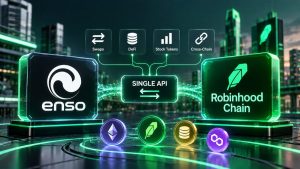
Robinhood Chain introduces a finance‑focused Layer‑2 designed to support regulated digital assets within a fast, Ethereum‑secured environment. Its ecosystem blends tokenized equities, stablecoins, and modern onchain tools into a unified settlement layer. The chain’s structure reflects a shift toward compliant, accessible blockchain markets built for real financial activity.
What is Robinhood Chain?

Overview of Robinhood Chain
Robinhood Chain is a permissionless, Ethereum‑compatible Layer‑2 blockchain built on the Arbitrum stack and focused on modern financial services. It serves as Robinhood’s dedicated settlement network for tokenized stocks, stablecoins, and DeFi protocols, aiming to bring traditional markets and crypto into one shared, always‑on environment. ETH is the native gas token, and the chain targets ultra‑fast block times for trading‑grade responsiveness.
Focus on real‑world assets
The network is purpose‑built for real‑world assets, especially tokenized equities known as Stock Tokens that track listed companies such as NVIDIA, Alphabet, and Apple. These tokens follow an ERC‑20‑compatible interface, making them easy to integrate into wallets, DeFi applications, and risk‑management tools. Native support for regulated exposure, stablecoins, and yield products positions Robinhood Chain as infrastructure for compliant, global, 24/7 markets.
Key features and capabilities
Robinhood Chain combines high throughput, low fees, and predictable transaction ordering to create a reliable environment for both retail and institutional users. The sequencer enforces compliance screening, excluding sanctioned addresses while keeping standard read operations fully accessible. The chain inherits Ethereum security through the Arbitrum framework and offers fast confirmations, making it suitable for active trading, portfolio rebalancing, and complex financial products built on tokenized assets.
Developer and ecosystem advantages
For developers, Robinhood Chain is fully EVM‑compatible, supporting Solidity and Vyper contracts, standard JSON‑RPC, and familiar tooling such as Hardhat, Foundry, ethers.js, and WalletConnect. Larger contract size limits and first‑class account abstraction through ERC‑4337 enable sophisticated applications, programmable wallets, and sponsored gas experiences.
A growing ecosystem of RPC providers, oracles, custody partners, and explorers surrounds the chain, helping teams launch production‑ready financial applications quickly. This foundation gives Robinhood Chain a compelling position within the broader Layer‑2 landscape, attracting builders focused on regulated assets and mainstream user adoption across multiple regions and platforms.
How Does Robinhood Chain Work?

Sequencer and execution flow
Robinhood Chain runs transactions through an Arbitrum Nitro sequencer that receives signed requests directly from wallets and orders them in a strict first‑come, first‑served queue. There is no public mempool, so pending activity is not visible to external bots. Once accepted, transactions execute against the latest state, updating balances, positions, and smart‑contract storage in a single deterministic sequence. This structure turns trading into a latency race to the sequencer rather than a gas‑bidding contest, reshaping how launchpads, token listings, and fast markets behave.
Gas model and Ethereum data posting
Each transaction pays for computation on Robinhood Chain and for compressed data posted to Ethereum. The execution fee reflects local congestion and resource usage, while the data fee covers blob storage on the Layer‑1. Wallets still show a familiar gas interface because the protocol represents the L1 component as additional gas, keeping explorers and tooling compatible. Developers rely on Arbitrum precompiles to inspect gas behavior and must design contracts with different gas estimation and gasleft semantics in mind.
Finality and security guarantees
Robinhood Chain provides rapid “soft” confirmations from the sequencer, giving users near‑instant feedback that their transactions executed. Hard finality is achieved once batched transaction data is posted to Ethereum and confirmed there, securing the resulting state under Ethereum’s consensus. This two‑step model lets the network feel responsive for trading and DeFi while still inheriting Layer‑1 security. Integrators distinguish between local acceptance, potential reorg windows, and finalized status when designing withdrawal, settlement, and risk controls.
Governance and protocol parameters
Governance for Robinhood Chain coordinates Robinhood’s operational control with the Arbitrum Orbit framework. Network settings such as sequencer configuration, compliance screening rules, and upgrade schedules are managed through governance processes that involve Robinhood and ecosystem stakeholders. A portion of fees flows to the Arbitrum treasury, aligning incentives and funding future improvements. Governance can adjust gas policies, evolve precompiles, and refine screening logic as regulatory, performance, and user needs change.
What Makes Robinhood Chain Different from other L2s?

Purpose‑built financial identity
Robinhood Chain stands out because it is engineered specifically for regulated financial assets rather than general‑purpose DeFi experimentation. Its architecture centers on tokenized equities, ETFs, and compliant market instruments, giving traders exposure to traditional financial products in an onchain format. This focus creates a distinct identity compared with L2s optimized for gaming, memecoins, or broad smart‑contract experimentation. The chain’s alignment with Robinhood’s existing user base also introduces a mainstream audience that most L2s do not naturally reach.
Compliance‑driven transaction environment
Most L2s rely on open mempools and competitive gas bidding, but Robinhood Chain uses a sequencer that screens addresses and enforces compliance rules before execution. This approach reduces exposure to malicious actors, improves predictability for financial applications, and supports regulated asset flows. The environment is designed to accommodate institutions that require transparent ordering, restricted access for sanctioned entities, and consistent settlement behavior. These characteristics differentiate the chain from networks that prioritize permissionless experimentation over controlled financial reliability.
Integrated distribution and liquidity pathways
Robinhood Chain benefits from distribution through Robinhood Wallet, giving projects immediate access to millions of users across numerous regions. This built‑in audience accelerates liquidity formation and adoption for applications that launch on the network. Other L2s often depend on fragmented onboarding funnels, whereas Robinhood Chain connects directly to a platform already familiar to retail investors. This integration shortens the path between asset creation, user discovery, and active participation, creating a unique growth dynamic within the Layer‑2 landscape.
Role of USDG within the ecosystem
USDG functions as a yield‑bearing stablecoin that complements Robinhood Chain’s financial orientation. It provides a dollar‑denominated asset designed for predictable returns, making it suitable for portfolios built around tokenized equities and other regulated instruments. Its presence strengthens the chain’s focus on regulated onchain finance.
Conclusion
Robinhood Chain emerges as a distinct Layer‑2 shaped around regulated assets, predictable execution, and integrated distribution through Robinhood Wallet. Its sequencer model, Ethereum‑anchored finality, and compatibility with financial products create a reliable environment for traders and builders. USDG further reinforces its orientation toward structured, dollar‑based onchain portfolios.