TL;DR
- Midnight’s NIGHT token dropped 31% after 290 million tokens were stolen through an exploit on the Wanchain bridge.
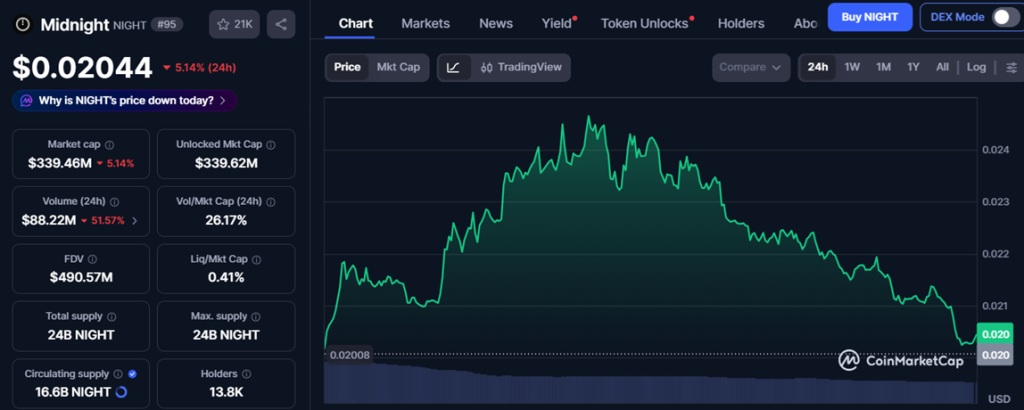
- Although the token bounced back, it is trading 5% lower, at around $0.02044 per unit and with a market cap of nearly $340 million.
- Charles Hoskinson used the incident to advocate for replacing legacy bridge infrastructure with zero-knowledge proof systems.
The NIGHT token staged an abrupt recovery after plunging to an all-time low last Monday. The trigger was an exploit on the Wanchain bridge operating over the Binance-Cardano corridor, through which an attacker stole 290 million tokens and dumped them onto the market immediately, sending the price down nearly 31%. Over the following 24 hours, the token rebounded almost 19% and then gave back 5%, now trading at around $0.02044.
Charles Hoskinson, co-founder of Cardano and the figure behind Midnight, responded quickly to media coverage that focused exclusively on the drop. “Magically, they forget to mention the rebound,” he posted on X. In an interview, Hoskinson described the hack as a “case of the Mondays,” though he acknowledged its significance.
Magically, they forget to mention the rebound. Cryptomedia is scum of the earth. Careful where you get your news and narrative from https://t.co/6i1m26HUQJ pic.twitter.com/jS6gqi9RIU
— Charles Hoskinson (@IOHK_Charles) July 22, 2026
“All software is under enormous assault”, he stated, attributing the rise in vulnerabilities in the Linux kernel to the use of artificial intelligence to discover exploits. He was categorical about the limits of any system, even the best-built ones: “It’s like being 90% resistant to a deadly disease. If you’re exposed enough, you eventually catch it anyway.”
NIGHT Exposes the Problem With Legacy Bridges
Attacks on interoperability bridges have become one of the most costly and persistent vectors in the history of cryptocurrencies. The exploits on Ronin, Wormhole and Nomad collectively resulted in losses of more than $1.5 billion, and all shared a structural vulnerability: they rely on smart contracts or multisig configurations to facilitate cross-chain transfers, failure points that attackers have learned to exploit with near-surgical precision.

Hoskinson argued that zero-knowledge systems, such as the one underpinning Midnight, are designed to eliminate that trust dependency entirely. Instead of bridge operators or multisigs, these systems use cryptographic proofs that validate transfers without exposing centralized control points. The incident, according to the executive, should not be read merely as an isolated crisis but as a signal that the industry needs to abandon legacy bridge infrastructure and move toward architectures that are verifiable from the ground up.