


TL;DR:
- A security incident impacted the Binance platform, resulting in estimated losses of $6.3 billion in late October 2026.
- The cyber group TraderTraitor channeled $242 million through the Tron network during the first 48 hours following the attack.
- Approximately $3.5 billion remains under the attackers’ control after emergency freezes were applied across various protocols.
Alex Shevchenko, director of NEAR Intents, presented technical guidelines aimed at crypto wallet developers. The measure responds to vulnerabilities detected in decentralized exchange infrastructure following the theft from Binance carried out in late October.
To all the wallets: choose your swapping providers wisely. They differ not only by the prices provided.
Uptime, slippage (fill price vs. quote price), ML counteraction, refund rate, etc.NEAR Intents invests way more than others to keep you and your users safe. Do not facilitate… https://t.co/DlGf908a1W
— Alex Shevchenko 🇺🇦 (@AlexAuroraDev) November 2, 2026
Records reveal that the security breach at Binance resulted in the theft of $6.3 billion. Hackers from the TraderTraitor group managed to initially move $242 million via the Tron blockchain. During this process, several decentralized bridges and liquidity aggregators operated as channels for transferring the compromised funds.
Despite coordinated industry interventions to freeze assets, a remainder close to $3.5 billion remains in wallets controlled by the attackers.
Shevchenko stated that focusing custodial application design exclusively on securing the cheapest exchange rate for the end user inadvertently exposes services to acting as intermediaries in laundering illicit capital. According to his technical assessment, a typical transaction passes through multiple independent layers, including routers, bridge smart contracts, and liquidity pools, which fragments immediate technical traceability.
This fragmentation dilutes oversight across every node in the operational chain. If one of these components liquidates assets flagged as stolen property, the wallet interface provider absorbs reputational damage and potential legal liabilities before financial regulators.
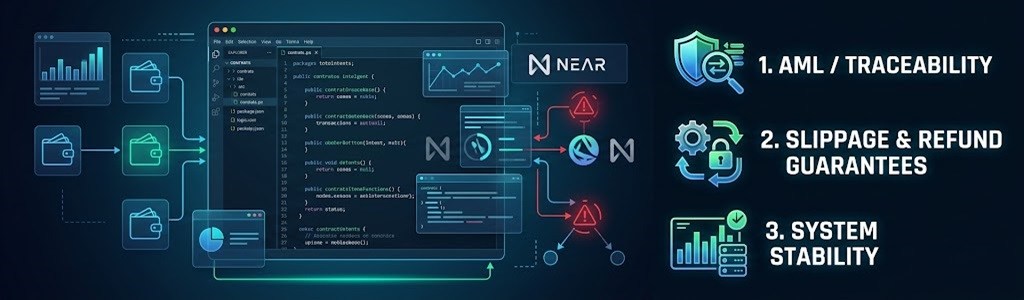
Integration Criteria and Operational Risk Mitigation
To mitigate operational risks, NEAR Intents leadership outlined three mandatory requirements that developers must demand when selecting counterparties and decentralized integrations:
First, anti-money laundering (AML) mechanisms require the integrated protocol’s ability to track and identify illicit assets in real time, immediately blacklisting and isolating flagged addresses to prevent them from entering liquidity pools.
Second, price slippage controls and refund guarantees require verifying that the final execution price strictly matches the quote displayed on the user interface, along with the execution of contracts programmed to return funds should a transaction experience network failures.
Finally, technical infrastructure stability and availability demand continuous responsiveness and guaranteed uptime across automated exchange systems under extreme network congestion or preventive market freezes.
According to an industry source, compliance audits and the rigorous vetting of liquidity partners are shifting from secondary considerations to structural components of the core product. The organization stresses that platforms prioritizing marginal fee reductions over traceability face unsustainable exposure to incoming international regulatory scrutiny targeting the Web3 sector.
The decentralized ecosystem remains under technical observation as programmable blacklist filters are deployed across interoperable cross-chain bridges during the opening weeks of November 2026.