BitcoinNews
Solo Bitcoin Miner Beats the Odds to Win $191,000 Reward
A solo Bitcoin miner with 11.1 TH/s earned $190,764 on block 977,057 using CKpool, according to data from Mempool and Con Kolivas.


Key points
- The miner identified as bc1q~zy9j solved block 977,057 on Sunday, November 22, 2026, via CKpool and collected 3.129 BTC ($190,764 before fees).
- Total revenue consisted of a 3.125 BTC ($190,538) block subsidy and 0.004 BTC ($226) in transaction fees, according to the Mempool explorer.
- Reported hash power was approximately 11.1 TH/s (on a 3.47 TH worker), equivalent to roughly 0.000001% of the Bitcoin network’s estimated 1.07 ZH/s hashrate on November 23, 2026.
Last Sunday, a solo Bitcoin miner solved block 977,057 and earned a total reward of 3.129 BTC, equivalent to $190,764 before fees, using CKpool’s solo mining setup.
Congratulations to miner bc1q~zy9j for solving the 323rd block – yet another lucky one at EU https://t.co/TIIWvCYUk6 with only ~11.1TH of hashrate on a 3.47TH worker! A miner of this size has about a one in 1650 chance of solving a block in a year.https://t.co/eMtGM9CQ3G
— Dr -ck (@ckpooldev) November 22, 2026
According to records from the Mempool block explorer, the payout comprised 3.125 BTC ($190,538) for the block subsidy and 0.004 BTC ($226) in transaction fees. The address linked to the operation, identified as bc1q~zy9j, operated through the European node EU solo.ckpool.org with a reported hashrate of about 11.1 TH/s on a 3.47 TH worker.
Con Kolivas, developer of CKpool, posted on X that the find marked the 323rd block solved on the service. Kolivas noted that a rig of that size has roughly a 1-in-1,650 chance of finding a block over the course of a year.
Price at publication$61,10421:49 UTC
- Past 7 days−6.4%
- All-time high−51.5%$126,080
Hash Power Comparison Against the Network and Public Miners
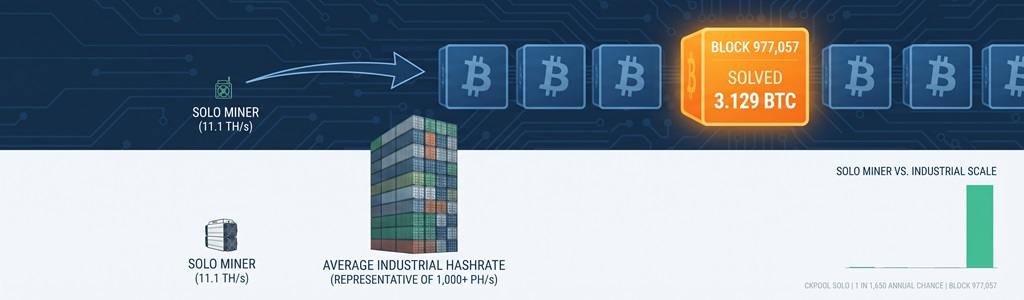
The 11.1 TH/s hashrate represents roughly 0.000001% of the Bitcoin network’s total estimated hashrate, which reached 1.07 ZH/s this Monday, November 23, according to Mempool data. This figure is equivalent to the combined output of just a few home desktop units.
Compared to modern industrial hardware, the reported power falls far below models such as Bitmain’s Antminer U3S23H, which delivers 1,160 TH/s. The gap widens even further when measured against major publicly traded mining companies.
Data from Ziven indicates that Bitdeer (BTDR) manages around 82.3 EH/s, MARA Holdings (MARA) close to 71.2 EH/s, and Riot (RIOT) approximately 37.2 EH/s. Those volumes are roughly equivalent to 7.4 million, 6.4 million, and 3.4 million times the capacity declared by the solo miner.
How Solo Mining Works and Recent Precedents
Smaller-scale miners typically band together in shared pools to receive proportional and more frequent payouts. Conversely, those who opt for solo mining take on the risk of earning zero rewards over extended periods in exchange for keeping the entire block if they manage to validate it.
CKpool’s documentation and operation show that the service acts as a technical intermediary without splitting rewards among multiple participants. Whoever finds a block keeps the full reward minus a 2% fee charged by CKpool, without needing to run a full node or maintain their own pool infrastructure.
The case joins other isolated finds recorded across the ecosystem. In April 2026, another user on a solo CKpool setup earned nearly $210,000 by mining block 943,411, in a scenario where Kolivas noted at the time a daily probability of roughly 1 in 28,000.
In November 2025, another solo miner with just 6 TH/s managed to solve a block valued at roughly $265,000 at the time. These events add to blocks found in recent years by participants running larger managed or rented hash power.
Meanwhile, the price of Bitcoin was trading around $61,221, up 1.2% over the past 24 hours at the time of reporting. Market participants are closely watching the network’s periodic difficulty adjustment and the trajectory of global hashrate over upcoming block cycles.
Notice. For information only; not investment advice.