TL;DR:
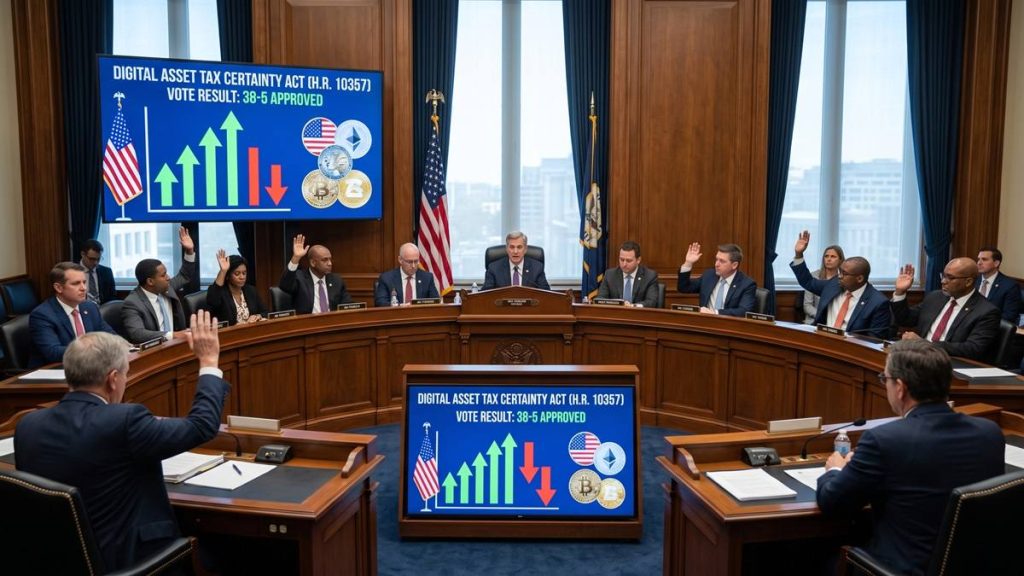
- The House Ways and Means Committee approved the proposal with a bipartisan vote of 38 to 5 on September 16, 2026.
- The legislative initiative establishes a de minimis tax exemption of up to $10 for network fees and everyday transactions with digital assets.
- The advancement comes less than 24 hours after the U.S. Senate blocked the procedural vote on the CLARITY Act.
The U.S. House Ways and Means Committee approved a comprehensive proposal this Wednesday to regulate taxation across the digital sector. Following the deadlock of the Clarity Act in the Senate, this proposal aims to restart the legislative agenda, placing the crypto tax bill at the center of the debate.
The voting session concluded with strong majority backing of 38 lawmakers in favor and 5 against. Sector analysts suggest that this result paves the way toward consensus after the broader, comprehensive structural framework originally pursued in the Upper Chamber stalled.
The legislative text, titled the Digital Asset Tax Certainty Act (H.R. 10357), introduces tax relief for routine operations. The bill establishes an exclusion threshold of up to $10 intended for minor purchases and network fees (gas fees), exempting users from calculating capital gains or losses on small payments.
According to remarks by Committee Chairman Jason Smith, current regulations impose a disproportionate administrative burden that penalizes the use of digital assets in transactions as commonplace as buying a cup of coffee. Committee reports highlight that the absence of a minimum threshold hinders the adoption of dollar-pegged stablecoins for day-to-day payments.
Modifications to Mining, Staking, and Market Rules
The proposal also addresses the accounting treatment for the generation of new assets. The draft outlines that rewards derived from mining and proof-of-stake validation activities would not be taxed immediately upon receipt, but rather when the assets are effectively liquidated or transferred.
Congressional records reveal that this modification would reshape the standard established by the Internal Revenue Service (IRS) in its 2023 ruling, which requires tokens to be included in gross income at the precise moment control is obtained. Legislative analyses from Bloomberg Tax suggest that this deferral would align tax liabilities with the real liquidity capacity of operators.
The regulatory framework similarly extends wash sale rules to the crypto market. This restriction would bar taxpayers from claiming deductions on losses from the sale of an asset if a substantially identical one is acquired within 30 days, aligning digital asset treatment with existing standards for traditional stocks and securities.
The vote also highlighted partisan friction regarding Washington’s legislative priorities. During the hearing, Democratic Representative Lloyd Doggett questioned the urgency granted to the sector and voiced concerns over the industry’s political ties. In contrast, Representative Steven Horsford defended the bill’s momentum, characterizing it as a pragmatic step toward establishing foundational tax certainty.
The crypto tax bill now advances to the full floor of the House of Representatives, where it is anticipated to be scheduled for final debate before the conclusion of the current legislative session.