TL;DR:
- Offshore yuan lending in Hong Kong reached a record 935 billion yuan at the end of 2025.
- The Hong Kong Monetary Authority (HKMA) expanded its RMB liquidity facility to 500 billion yuan and extended credit tenors to three years.
- Of the 36 applications submitted under the Stablecoins Ordinance in force since August 2025, only HSBC and Anchorpoint Financial received issuance licenses on April 10, 2026.
During a Legislative Council briefing this Monday, Christopher Hui, Secretary for Financial Services and the Treasury, unveiled a broad financial policy agenda centered on the offshore yuan, while the development of regulated stablecoins received only a secondary mention on the official docket.
Strategic Shift Toward the Renminbi and Liquidity Framework
The special administrative region’s government detailed a series of technical initiatives designed to solidify banking liquidity in mainland Chinese currency. The Hong Kong Monetary Authority (HKMA) remains in active discussions with the People’s Bank of China (PBOC) to optimize the bilateral currency swap arrangement.
The monetary authority will roll out a seven-day offshore yuan liquidity tendering mechanism. Official documentation indicates that the regulatory agency is reviewing short-term debt instruments aimed at calibrating the renminbi interest rate curve.
Corporate and sovereign debt activity across the financial hub demonstrated sustained momentum. Offshore bond issuance reached 1 trillion yuan for the second consecutive year during 2025.
According to market reporting, these initiatives fall under the directives of the 2026–2030 Five-Year Plan and the 2026 Policy Address, where the traditional banking sector stands as the administration’s primary operational focus.
Regarding currency arrangements, Hui clarified to lawmakers that public spending will continue to be conducted primarily in Hong Kong dollars (HKD). The official dismissed structural changes to the monetary regime, confirming that the HKD will remain pegged to the U.S. dollar rather than shifting toward a peg with the yuan or adopting a floating exchange rate.
Operational Bottlenecks and Restrictions on Stablecoins
The virtual asset segment showed mixed progress compared to initial regulatory targets. The Stablecoins Ordinance took effect on August 1, 2025, attracting 36 formal applications by late September of that same year.
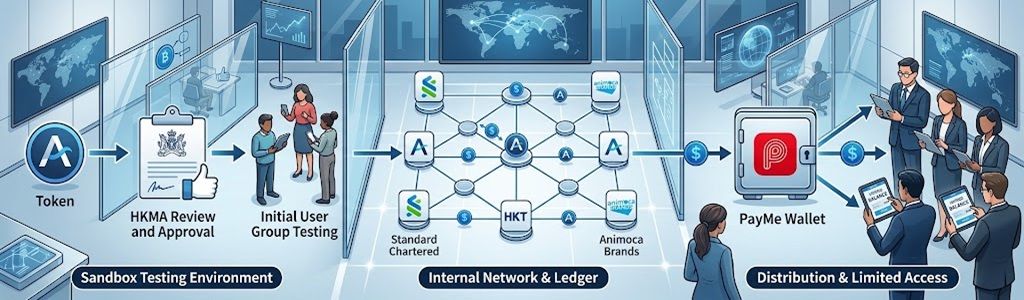
The HKMA granted only two issuer licenses on April 10, 2026, awarded to HSBC and Anchorpoint Financial. Despite holding regulatory approvals, neither firm currently possesses access to active licensed trading venues to facilitate secondary market trading for their tokens.
Licensed issuers have concentrated their product roadmaps exclusively on local currency pegs. HSBC announced on September 30 that it named its upcoming asset “HSBC RedCoin,” with initial rollout restricted to its PayMe wallet app. Anchorpoint Financial, a venture backed by Standard Chartered, HKT, and Animoca Brands, initiated pilot testing in August 2026 for its HKDAP token restricted to professional investors.
A joint circular issued in February by the PBOC and seven regulatory agencies prohibited unauthorized yuan-pegged stablecoins both onshore and offshore. This measure prevents Hong Kong operators from structuring renminbi-referenced tokens without explicit approval from Beijing.
To organize the intermediary landscape, the local government plans to introduce an amendment bill to the Legislative Council before the end of 2026, establishing a comprehensive licensing framework for virtual asset custody, advisory, management, and trading platforms.