TL;DR:
- Kalshi is being analyzed by Federal Reserve researchers as a real-time data source for interpreting economic expectations.
- A paper published on February 12 proposes building probability density functions around FOMC decisions using data from the platform.
- The absence of the Clarity Act leaves prediction markets in a legal vacuum and raises questions about manipulation and transparency.
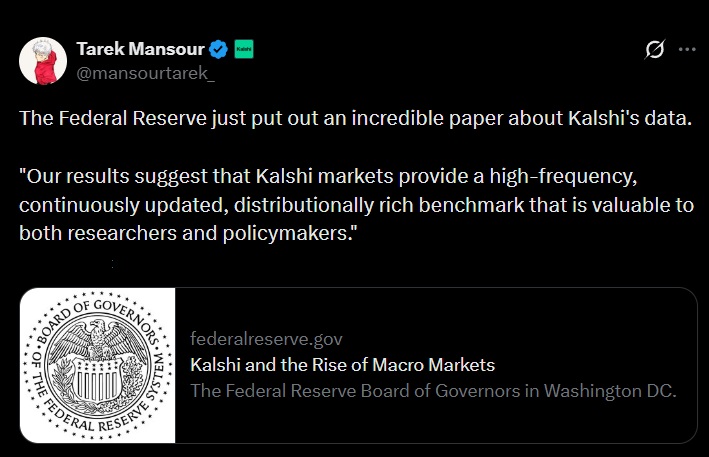
The Federal Reserve has begun exploring data from Kalshi, the event betting platform, as a potential input for interpreting economic expectations in real time. The analysis stems from a paper titled *Kalshi and the Emergence of Macromarkets*, published on February 12, authored by Fed chief economist Anthony Diercks, research assistant Jared Dean Katz, and Johns Hopkins University researcher Jonathan Wright.
The authors’ central argument is that prediction markets update their probabilities continuously and reflect real financial bets, which could make them more sensitive to macroeconomic information than traditional periodic surveys.
The Fed as a Reader of Bets
The study compared Kalshi’s implied probabilities with conventional forecasting tools and found that these markets can adjust quickly in response to monetary policy events. As an example, the implied probability of a rate cut in July climbed to 25% following public statements by Fed governors, only to pull back after a stronger-than-expected employment report. That intraday dynamic is precisely what the authors describe as the instrument’s differential value.
The paper’s technical proposal involves using Kalshi data to build risk-neutral probability density functions around Federal Open Market Committee decisions, mapping the full range of possible outcomes ahead of each monetary policy meeting. The authors acknowledge that the research is preliminary and aims to fuel debate, not to condition decisions.

The Regulatory Void Complicating Kalshi and Other Markets
The regulatory disorder produces constant friction. Monthly volumes in prediction markets exceeded $10 billion over the past year, with platforms like Polymarket competing fiercely in the segment. Yet the absence of the Clarity Act, the proposed federal legislation to regulate these markets, leaves platforms like Kalshi in a legal gray area with no uniform rules on transparency or manipulation.
Adding to that is what the economists themselves call Goodhart’s Law: when an indicator becomes the target of institutional observation, incentives to manipulate it grow. If the market knows the Fed is monitoring those probabilities, the signal could lose the reliability that makes it useful in the first place. The challenge for central banks is to extract information without becoming dependent on an instrument that, under their own scrutiny, could end up distorting itself.