TL;DR:
- DeFi United published a technical plan to restore rsETH backing after the $292 million exploit that affected Kelp DAO on April 18.
- The restoration involves converting committed ETH into rsETH in tranches to transfer it to the affected lockbox contract and resume the bridge.
- The plan also aims to recover around 13,000 ETH on Aave and 16,776 ETH on Compound through controlled liquidations of affected positions.
DeFi United, the decentralized ecosystem coalition led by Aave, published a detailed technical plan to restore the full backing of Kelp DAO‘s rsETH token, which was compromised following the $292 million exploit recorded on April 18.
The attack was attributed to the North Korean group Lazarus. The group used a spoofed message to mint 116,500 unbacked rsETH tokens through Kelp DAO’s bridge. Around 107,000 of those tokens ended up in lending positions within Aave, generating bad debt in the protocol.
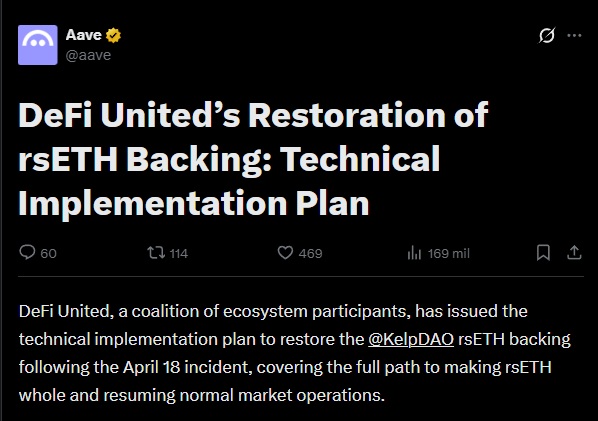
To mitigate the impact on the industry, dozens of DeFi protocols contributed funds to the initiative, pooling more than $300 million in ETH. With sufficient funds in hand, Aave confirmed that the coalition is ready to launch the restoration process.
DeFi United: Step-by-Step Recovery Process
DeFi United’s plan involves converting the committed ETH into rsETH in tranches, which will then be transferred to the affected lockbox contract to allow the bridge to safely resume operations. Execution is subject to obtaining governance approvals and signing of definitive agreements.

In parallel, the plan contemplates liquidating the eight affected positions on Aave Ethereum Core and Arbitrum markets. To that end, the rsETH oracle price will be temporarily adjusted to facilitate efficient liquidations. The liquidated rsETH collateral will be moved to a multisig controlled by DeFi United, redeemed for ETH through Kelp DAO and used to cover the temporary deficits generated in Aave’s markets. This process would allow recovery of approximately 13,000 ETH. Compound, a protocol that was also affected by the exploit, will follow a similar procedure to recover around 16,776 ETH.
The final phase involves reactivating and unfreezing rsETH and ETH across all affected instances, and restoring the loan-to-value ratios that were adjusted during the crisis.

Risks That Remain Latent
Nevertheless, DeFi United’s plan involves some important considerations. Execution depends on governance approvals that have not yet been secured, a period during which the attacker could attempt to interfere.
According to the coalition, deliberate interference could result in an incomplete accumulation of deficits, forcing additional liquidation steps. Furthermore, the new security measures implemented in LayerZero and Kelp DAO following the attack have not yet been put to real-world tests, which prompted the decision to execute conversions and deposits in tranches. The coalition committed to publicly communicating progress as the recovery advances.