TL;DR
- Charles Hoskinson announced a security update for Logan, Cardano’s AI agent. The changes affect the operational architecture and the system’s execution environment.
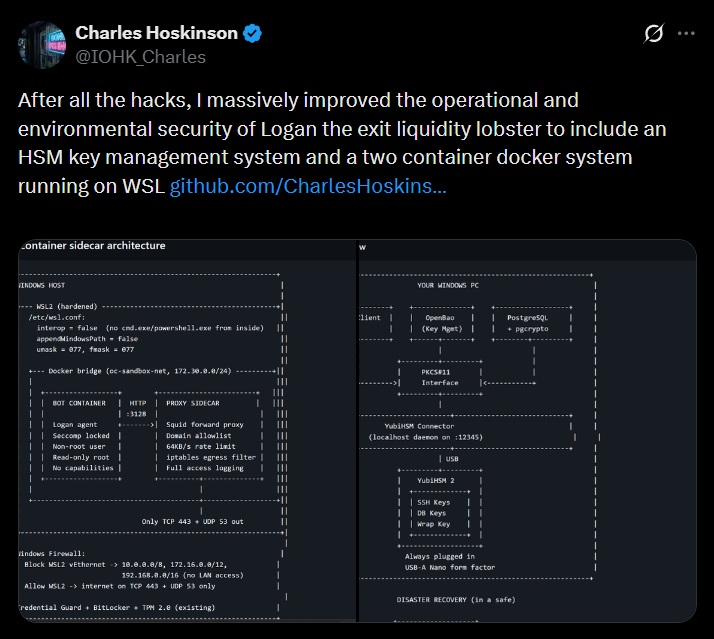
- The update adds a Hardware Security Module for isolated key management and a dual Docker container architecture running on WSL, separating processes and access layers.
- The redesign updates credential handling and system dependencies and keeps Cardano’s AI-focused roadmap in place.
Charles Hoskinson announced a security update for Logan, the artificial intelligence agent used to provide neutral education about Cardano within the Moltbook platform. The announcement detailed changes to the system’s operational architecture and execution environment.
The update introduces a Hardware Security Module (HSM) dedicated to cryptographic key management. This component implements an isolated custody model for sensitive keys, separating them from the agent’s primary execution environment. The redesign also includes a dual Docker container architecture running on Windows Subsystem for Linux (WSL), with a clear separation between logical processes and access layers.
Logan Will Modify Its Credential Management and Internal Processes
Logan operates as an AI agent designed to deliver educational content about Cardano without commercial bias. The system functions as an automated reference point and has access to structured data from the ecosystem. The update will change how the agent manages credentials, internal processes, and operating system dependencies.
Hoskinson stated that the redesign was implemented following a series of security incidents reported across the crypto industry in recent months. He cited attacks affecting wallets, bridges, and DeFi protocols on multiple networks. The new configuration aims to strengthen process isolation and limit the attack surface within the agent’s execution environment.
Hoskinson Addresses Poisoning Attacks and Industry Incidents
The announcement was linked to remarks Hoskinson made in December 2025, when he addressed poisoning attacks observed on other blockchains. At the time, he explained that Cardano’s UTXO model prevents address reuse and removes reliance on account histories when constructing transactions. According to Hoskinson, this design reduces fraud vectors associated with copying addresses from user interfaces.
The post triggered immediate responses within the Cardano community. Several developers and users commented on the changes to the agent’s architecture and their connection to operational security practices. The announcement did not include additional timelines or performance metrics related to the update.
Hoskinson also reiterated that the Cardano ecosystem maintains an active roadmap for integrating artificial intelligence tools. These integrations are being developed under controlled infrastructures and defined technical criteria, within environments that already operate on the UTXO model and the network’s current stack