Michael Saylor’s recent appearance on the Diary of a CEO podcast has generated a debate that extends beyond anecdote. Saylor stated that he utilized ChatGPT to design a financial product—a variable-dividend preferred share backed by Bitcoin—which enabled Strategy to raise approximately $150 billion in financing. The declaration, formulated in categorical terms (“AI helped me create $15 billion”), invites an analysis that disaggregates the financial innovation component from the structural risk component.
The Instrument Design: Genuine Innovation
The context is relevant. By early 2025, Strategy had exhausted traditional financing channels: the capital markets and convertible debt markets had reached their practical limits. Saylor described the problem with precision: he needed a hybrid instrument between debt and equity that did not exist in the market. He turned to ChatGPT to explore structures of preferred shares with a monthly variable dividend, designed to maintain a stable price near 100 dollars.
The result was STRK (and its variant STRC), a convertible preferred share backed by the company’s Bitcoin holdings. The innovation resides in the variable dividend mechanism: the rate adjusts monthly to stabilize the instrument’s price, a feature Saylor claims had no precedent in financial history. Legal and investment banking teams reacted with skepticism: “it had never been done before”. ChatGPT, according to Saylor, validated the legal and structural viability of the design.

The combination of Bitcoin backing, variable dividend, and preferred structure did not constitute a regulatory violation, but rather an absence of precedent. Saylor identified an unoccupied design space and utilized a language model to explore combinations of clauses and parameters that no human advisor had proposed. This constitutes, in essence, an AI application for solution discovery in a domain with complex constraints.
The instrument was placed in the market through an initial public offering of $2.5 billion—described as the largest of the year—followed by additional issuances that raised the total to $150 billion. This figure represents capital raised by the company, not personal gain for Saylor.
The Saylor Thesis on AI and Value Creation
Beyond the specific case, Saylor articulated a wealth-creation philosophy in the AI era that warrants examination. His central premise is that the differentiating factor is not productivity in existing tasks, but the capacity to formulate questions that had never been posed before. In his words:
“you don’t want to learn to do things that AI can already do; you want to learn to ask AI to do something that has never been done before”.
The automation of existing workflows is an efficiency strategy, not a strategy for creating new market value. The exploration of unexplored design spaces—where there are no precedents, no case law, no market convention—is where AI can function as a discovery engine rather than a mere productivity tool.
Saylor complements this vision with a temporal framework: he identifies the convergence of two technologies in early adoption phases—AI and Bitcoin—as the fertile ground for financial innovation. He proposes identifying the inflection point on the adoption S-curve, where growth accelerates. The recommendation for entrepreneurs is, essentially, not to compete in productivity against machines, but in problem-formulation capability.
The Cost of Innovation: Risks and Realized Losses
Saylor’s narrative omits, however, a central component: the performance of the underlying asset and the accounting and market consequences of the strategy. Strategy reported in the second quarter of 2026 a net loss of $8.22 billion, compared to a gain of $10.02 billion in the same period the previous year. The operating loss reached $8.33 billion, of which $8.32 billion corresponds to unrealized losses from the revaluation of Bitcoin holdings. The diluted loss per share was $24.45.
Strategy’s Bitcoin holdings amount to 840,447 BTC, with an average acquisition cost of $75,385 per unit. At the current trading price, the position registers an unrealized loss of approximately $9.9 billion, equivalent to -15.6%. All purchases made in 2024 and 2026 are trading below acquisition cost.
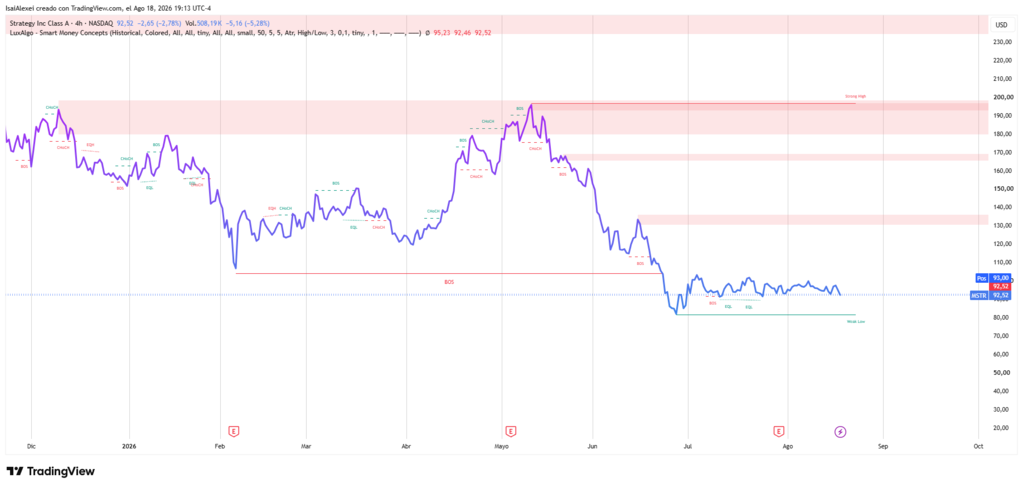
The MSTR stock price has reflected this dynamic. It has accumulated a 38% decline year-to-date in 2026 and a 73% year-over-year decline. Since the launch of STRC in July 2025, the MSTR price has dropped 75%. The stock trades near $95-98, well below the 52-week high of $414.
The company has sold Bitcoin on three occasions to cover dividend obligations on the preferred shares. The most recent sale involved 1,638 BTC at an average price of $63,957, generating approximately $104.7 million. Total accumulated sales amount to 5,226 BTC for roughly $321 million. Saylor has defended these operations, noting that the company “never had a ‘never sell’ policy”.
To meet annual dividend and interest obligations totaling $1.76 billion, Strategy has increased its cash reserve to $4.8 billion, through the issuance of common stock and Bitcoin sales.
Evaluation: AI as Enabler, Not Guarantor
Saylor’s case permits a conclusion that the crypto sector should consider attentively. AI demonstrated itself to be a financial innovation enabler in a domain with complex constraints. The design of STRK/STRC is, from the perspective of financial product engineering, an achievement: it identified a combination of parameters—Bitcoin backing, variable dividend, preferred structure—that no human advisor proposed and which proved legally viable.
However, the creation of the funding vehicle does not resolve the underlying business strategy problem: the dependence on a volatile asset’s performance to generate value. The instrument allowed leveraging exposure to Bitcoin, but did not alter the nature of the underlying asset. The $9.9 billion unrealized loss and the 38% decline in the stock price are direct consequences of that exposure, not failures of the instrument’s design nor of the AI that designed it.
On one hand, AI can accelerate the exploration of financial design spaces that human teams, constrained by convention and precedent, do not consider. On the other, innovation in the instrument does not offset the vulnerability of the underlying asset. ChatGPT’s capacity to structure a novel financial product does not imply capacity to evaluate the market risk of the strategy that product finances.

Saylor has suggested that the convergence of AI and Bitcoin will enable the construction of financial products that do not yet exist. This is true at the level of product engineering. What Strategy’s case demonstrates is that the technical and legal viability of an instrument is a necessary but not sufficient condition for sustained value creation. The question that AI cannot answer—and that the market is already answering—is whether leveraged exposure to a volatile asset through innovative instruments constitutes a value-creation strategy or a risk transfer mechanism toward the holders of those instruments.
The crypto sector, when evaluating Saylor’s statements, should distinguish between AI’s capacity to design solutions in unoccupied spaces and the capacity of those solutions to generate risk-adjusted returns. The former is a statement about computational and exploration capabilities. The latter is a statement about economic and market fundamentals. AI can assist in the former; it cannot substitute for analysis of the latter.