
TL;DR:
- Binance.US dropped maker fees to 0% and set taker fees at 0.02% for all spot pairs, with no volume requirements imposed.
- The new structure replaces the tiered scheme and can reduce trading costs by up to 98% compared to competitors like Coinbase or Kraken.
- The exchange is under legal pressure over an alleged $1.7 billion in transactions linked to Iranian entities.
Binance.US eliminated maker fees and set taker fees at 0.02% across all its spot trading pairs, effective immediately for all users with no volume thresholds, portfolio minimums, or paid subscriptions. The measure replaces the tiered fee structure that had governed the platform until now.
This adjustment can represent a cost reduction of up to 98% compared to direct competitors. Coinbase charges between 0.40% and 0.60% for low-volume traders, while Kraken starts at a range of 0.25% to 0.40%. Charles Schwab, which announced last week the launch of a spot cryptocurrency trading service for retail clients, will charge 75 basis points per transaction.
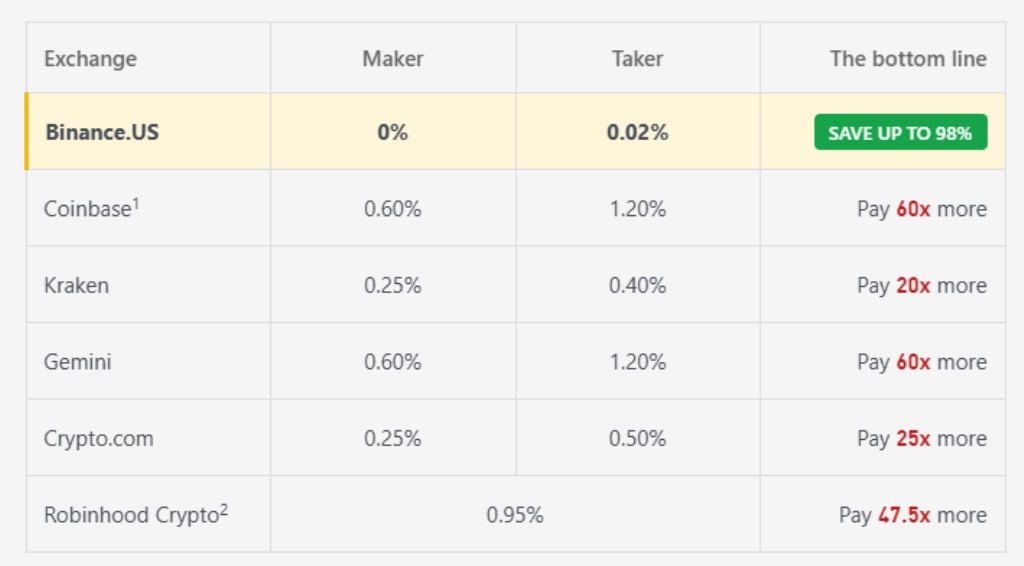
Binance.US introduced its new fee structure as part of a series of updates, including the appointment of Stephen Gregory as chief executive officer and the approval of a SOC 2 Type II audit of its systems and internal controls. The new structure extends to all spot markets the zero-fee policy that had previously applied only to certain Bitcoin pairs.
The Law Closes In on Binance.US
The exchange is navigating a complex moment on the legal front. In February 2026, a group of U.S. senators urged the Department of the Treasury and the Department of Justice to review the exchange’s compliance controls, following reports pointing to more than $1.7 billion in transactions possibly linked to Iranian entities. Binance rejected the allegations in a letter addressed to senators Richard Blumenthal and Ron Johnson, describing the reports as false and unsupported by evidence. The company also filed a defamation lawsuit against The Wall Street Journal.
In 2023, the exchange reached a $4.3 billion settlement with U.S. authorities over violations of anti-money laundering rules and international sanctions. Former chief executive officer Changpeng Zhao pleaded guilty to a criminal charge and served four months in prison, after which he received a presidential pardon. The agreement included a judicial monitoring program that remains in force, and whose compliance is the subject of the new wave of legislative pressure.