BitcoinNews
Bitcoin Hash Rate Sees First Annual Drop Since 2021 China Mining Ban


Key points
- Year-over-year drop: The Bitcoin hash rate sat 8% below the level recorded a year earlier as of November 24, 2026, according to Glassnode.
- Compute revenue: Luxor placed hashprice at $29.36 per petahash per second per day, compared with $30.27 a week earlier.
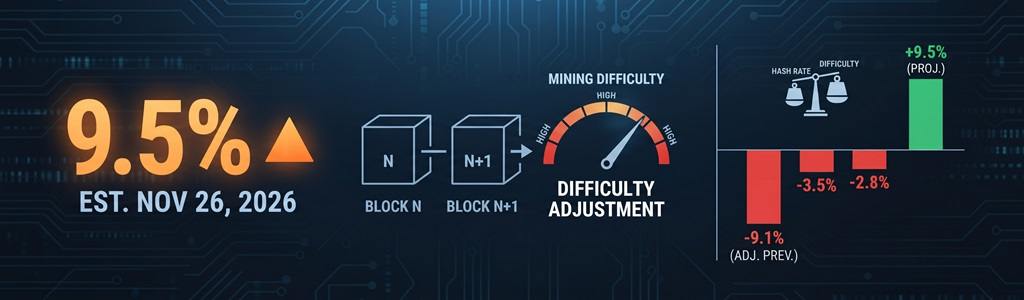
- Difficulty adjustment: Luxor estimated a 9.5% increase in mining difficulty around November 26 following a 7.8% rebound in the seven-day average.
The Bitcoin hash rate recorded an 8% year-over-year decline as of November 24, marking its first annual drop since China‘s mining ban in 2021, according to data from on-chain analytics firm Glassnode. The pullback coincides with Bitcoin trading near $60,000, a level 52.6% below its all-time high of $126,080 reached on October 6, 2025.
bitcoin:native miners are switching machines off.
The hash rate sits 8% below last year's level, the first annual decline since the 2021 China ban.
That drop was forced by policy; this one is price-driven, with hash price at an all-time low. pic.twitter.com/hwFnCUbEkm
— glassnode (@glassnode) November 24, 2026
The contraction in computing power connected to the network stems from market economic factors rather than government restrictions. Market data indicate the network’s computational capacity has remained below its year-ago level since late July 2026.
On November 20, daily hashprice touched a low near $27.70 per petahash, in line with June‘s low. Luxor reports note that a level near $29 already sits at or below the break-even threshold for numerous operators, depending on electricity costs and hardware models.
Price at publication$60,02918:33 UTC
- Past 7 days−6.0%
- All-time high−52.4%$126,080
Miner Response and Difficulty Adjustment
With the block reward halving in April 2024 —which went from 6.25 BTC to 3.125 BTC— and the subsequent price drop from 2025 highs, less efficient machines fell below the profitability point. An industry source indicated that some operators shut down older-generation rigs while others redirected power infrastructure and data centers toward artificial intelligence and high-performance computing workloads.
Industry data cited in sector reports show diverging moves among publicly traded mining companies after September 2026. MARA raised around $1.1 billion through Bitcoin sales after September and allocated $750 million to pay down loans backed by that cryptocurrency, while Riot sold 20,264 BTC through September primarily to fund data center development.
Under the Bitcoin protocol, mining difficulty recalibrates every 2,016 blocks —roughly every two weeks— to maintain an average close to ten minutes per block amid changes in connected computing power.
The previous adjustment cut difficulty by 9.1%, the third reduction exceeding 9% in 2026 according to mempool.space data. Following that cut, the seven-day moving average of the hash rate climbed 7.8% during the week prior to November 24, according to Luxor.
Market data show net outflows from United States spot Bitcoin exchange-traded funds reached $2.37 billion over five days, with an additional $569.7 million on November 23 and $4.91 billion over the past month. Per CoinMarketCap reports at the time of writing, Bitcoin‘s price traded around $60,004.
The network’s next difficulty recalculation is scheduled around November 26, 2026, coinciding with the Thanksgiving holiday in the United States, for which Luxor projects an increase near 9.5% if the current block pace holds.
Notice. For information only; not investment advice.