News
Hacker Steals $12.6M From Chainflip Vaults Through Network Exploit
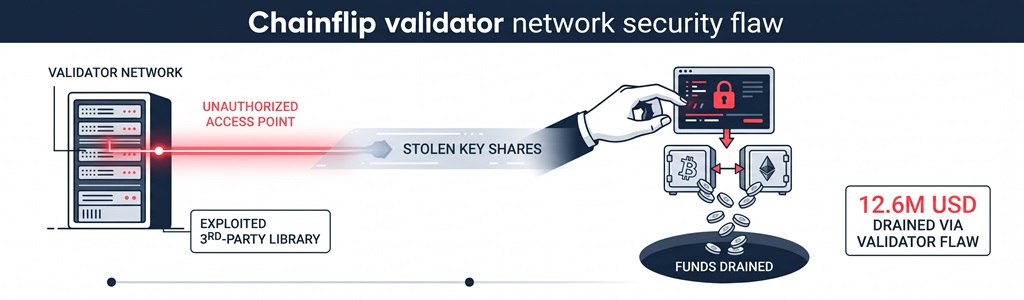
An attacker stole $12.6 million in BTC, ETH, USDC, and USDT from Chainflip vaults after exploiting a validator network flaw on November 21.


In this guide
Key points
- The attacker drained 133.34 BTC from the Bitcoin vault and 520.22 ETH, 3,249,631 USDC, and 758,141 USDT from the Ethereum vault on November 21, 2026, worth roughly $12.6 million based on that morning’s prices.
- An internal monitor detected the first Bitcoin outflow within eight minutes, but the public and Discord alert arrived nearly an hour later at 07:41 UTC, and swaps, deposits, and withdrawals were paused at 08:31 UTC.
- By 11:31 UTC on November 23, 2026, all active validators had installed the patch and completed a second key rotation, while the protocol collaborates with law enforcement and the firm ZeroShadow.
Cross-chain swap protocol Chainflip confirmed that on November 21 a hacker stole approximately $12.6 million from its Bitcoin and Ethereum Chainflip vaults. The incident nearly emptied the available balances in both vaults at the time.
Here is part 1 of our incident report on the 21 November vault exploit.
What happened, a full timeline, and where things stand.
Swaps, deposits and withdrawals remain paused while remediation continues.https://t.co/mkK5wp02fW
— CHAINFLIP (@Chainflip) November 23, 2026
According to the first part of the incident report published on November 23 by Chainflip Labs, the unauthorized withdrawals featured valid vault signatures that the protocol never requested. The attacker generated those signatures off-network using key shares extracted from validator machines.
Stolen$4.86Mper The Crypto GuardianSeverity 3/5
- Rank by size57th largest of 355 in 2026336th of 1,509 on record
- Attack vectorPrivate key compromise
- FundsNo recovery or freeze in the record
Same vector before: LuBian (Dec 28, 2020, $3.5B) · Coincheck (Jan 26, 2018, $534M)
The headline cites $12.6M; the Crypto Guardian record shows $4.86M (+159 %, record updated Nov 23, 2026). Early figures often change.
Mechanics of the Validator Network Flaw
The operation began a day before the main drain. At 11:00 UTC on November 20, 2026, the attacker registered a validator account with the minimum deposit, just 79 seconds after funding it with 20,500 FLIP, under the address identified as cFMH2YX722cFGNemZ5tbZnq7XvYZ3xWyTRdLrW1cLgyrJtEKe.
Although the account never entered the active validator set, registration was enough for existing nodes to accept network connections from it. New validators must communicate with current ones before joining the active set.
Chainflip Labs noted that the attacker leveraged that access to exploit a memory safety flaw in a third-party networking library used by the validator software. The team indicated that the investigation is ongoing, certain aspects of the account remain unconfirmed, and it has not disclosed the name of the affected library.
Through this vulnerability, the attacker executed code on validator machines and extracted key shares stored there. Gathering enough shares allowed them to sign vault transactions without going through standard network coordination.
Alert Delays and Movement of Funds
The Bitcoin vault lost 133.34 BTC across two transactions: a first transfer of 122.86 BTC and a second of 10.48 BTC several hours later. From the Ethereum vault, the outflow occurred in a single transaction for 520.22 ETH, 3,249,631 USDC, and 758,141 USDT.
The first transfer of 122.86 BTC took place at 06:41 UTC on November 21, 2026. Eight minutes later, an automated system posted a warning in an internal channel.
Chainflip Labs explained that the monitor was still in a testing phase and had produced false alarms, so it was not connected to an automated escalation system. At 07:10 UTC, the Ethereum vault was drained, the USDC and USDT funds were swapped into ETH within minutes, and 2,909 ETH were sent to Tornado Cash.
A team member issued an alert in the project’s Discord at 07:41 UTC, nearly an hour after the initial theft. The first protocol responder came online at 07:52 UTC, governance forced a key rotation at 08:14 UTC, and swaps, deposits, and withdrawals were suspended at 08:31 UTC.
Despite the initial rotation, the attacker withdrew the remaining 10.48 BTC from the Bitcoin vault at 11:24 UTC because the stolen key still granted access to those funds. The attacker’s account was removed from the validator peer list at 12:37 UTC.
As of 16:18 UTC on November 23, 2026, the stolen Bitcoin remained in two addresses: bc1qm777twlzmelyutungyfw65ykn2l5kn68e6v4g6 holding 122.86136932 BTC and bc1qp5r8aemhg8pxytlhcn43k8ptc6l6y03vxud5pr holding 10.48283731 BTC, according to the Chainflip Labs report. The team added that the attacker left metadata that could help authorities identify them and that it will continue tracking the Ethereum funds if they exit Tornado Cash.
Impact on Liquidity Providers and the FLIP Token
The losses fall primarily on liquidity providers and FLIP holders. Chainflip Labs stated in its report that the impact is substantial for those affected and announced it has begun returning free provider balances on unaffected chains to refund addresses on Solana, Arbitrum, Tron, BNB Chain, and Polkadot Assethub.
The team clarified that users with open lending, strategy, or range order positions may still hold assets on those chains inside their Chainflip accounts. The FLIP token recorded a 29% drop after a potential vault exploit was initially reported, when early estimates placed Ethereum losses at $4.86 million before the Bitcoin drain was confirmed.
This incident marks the protocol’s second exploit in under two months, following the September 2026 network pause when an attacker drained 736,442 USDT via the Tron integration. Chainflip Labs stated it is working with law enforcement and blockchain investigation firm ZeroShadow, while also offering a bounty to the attacker for returning the assets.
Next Steps in the Recovery Plan
Chainflip Labs released a patched build for validator operators on the afternoon of November 21, 2026, completed a second key rotation on November 22, 2026, and confirmed that all active validators were running the fix by 11:31 UTC on November 23, 2026. According to the Chainflip Labs report, the protocol plans to recapitalize its most active liquidity providers through incentives and funding, add new defensive layers, and resume service.
The team has not yet detailed the compensation mechanism or the exact amounts lost per user. Chainflip Labs announced that those details, alongside the recovery plan and the continuation of the incident report, will be shared in a subsequent update.
Notice. For information only; not investment advice.