The convergence between traditional finance and cryptocurrencies is entering a new phase. In his recent analysis, content creator CryptoSensei examines how financial institutions are beginning to incorporate blockchain into their operations, while programmable payments and real-world asset (RWA) tokenization expand the possibilities of the digital ecosystem. Developments involving Canton Network, DTCC infrastructure, and XRP Ledger demonstrate how this technology aims to move beyond speculation and become a practical financial tool. However, its long-term success will depend on proven efficiency, regulatory clarity, and user security.
Wall Street Takes Financial Markets On-Chain
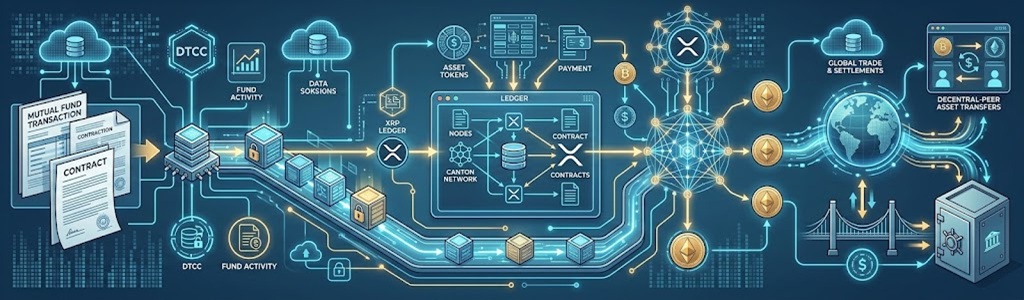
On October 13, 2026, S&P Dow Jones Indices announced a milestone for institutional finance: the execution of a total return swap over-the-counter on Canton Network. The transaction involved DRW and Marex through Derivnex, with Kaiko providing the infrastructure to tokenize the underlying benchmark. According to S&P Dow Jones Indices’ official announcement, the derivative referenced the iBoxx USD Liquid Investment Grade Index, which tracks the corporate credit market.
The significance of this development lies in the fact that the underlying bonds did not need to be individually tokenized to represent the transaction. Index data, contractual terms, and valuation information could be integrated into a shared digital ledger. Canton is also designed to preserve the confidentiality of institutional transactions, an important feature for firms seeking blockchain’s advantages without publicly exposing their trading positions.
Adoption is also reaching traditional investment distribution systems. On September 16, the Depository Trust & Clearing Corporation (DTCC) announced that Ondo Finance, through its subsidiary Oasis Pro Markets, had become the first tokenization platform to join Fund/SERV. According to DTCC’s official announcement, this infrastructure processes more than 85% of U.S. mutual fund transaction activity.
These developments support a decisive trend: blockchain can integrate with existing financial markets without immediately replacing them. The potential to reduce manual reconciliation, connect systems, and automate processes makes the technology attractive to institutions. Nevertheless, adoption must still demonstrate sustainable benefits in costs, liquidity, and operational efficiency.
XRP Ledger and the Economy of AI Agents
Another area highlighted by CryptoSensei is the development of automated commerce powered by artificial intelligence agents. On October 13, Privy announced a collaboration with Ripple to bring its programmable wallet infrastructure to XRP Ledger (XRPL). The goal is to help developers build applications capable of managing digital assets and executing payments automatically.
According to Privy’s official announcement, the integration will enable developers to create and manage wallets programmatically, sign transactions, and build services using XRP, RLUSD, and other digital assets. It also includes compatibility with x402, a protocol that enables payments for digital services through HTTP requests.
In practice, an AI agent could pay to access an API, retrieve information, or use computing resources without requiring human intervention for every transaction. This capability creates opportunities for new business models, ranging from on-demand digital services to autonomous systems that manage their own budgets.
The potential is significant, although technical capabilities must be distinguished from actual adoption. Claims that autonomous agents account for more than 25% of XRPL’s daily transactions require a verifiable methodological source before being presented as confirmed data. The growth of agentic commerce will depend on real-world utility, authorization controls, and the ability to prevent unwanted transactions.
Security and Custody: The Risks That Remain
As institutional infrastructure advances, security remains essential for individual cryptocurrency users. Hardware wallets protect private keys against certain threats, but they do not eliminate risks associated with counterfeit products, tampered devices, or exposed recovery phrases.
In his original analysis, CryptoSensei raises concerns about alleged incidents involving Ledger’s distribution chain. However, claims involving malicious microchips, losses approaching $93 million, and allegedly affected distributors require verifiable technical reports before they can be treated as confirmed facts.
As a precaution, users should purchase hardware wallets through official channels and carefully follow the manufacturer’s authentication procedures. Recovery phrases should never be shared with third parties or entered on unfamiliar websites. Self-custody provides financial independence, but it also requires personal responsibility and a clear understanding of potential threats.
Final Reflection: A Transformation That Requires Evidence
Developments involving Canton Network, DTCC, and XRP Ledger reflect an important evolution: blockchain is pursuing practical applications in derivatives, investment distribution, and automated payments. For the crypto industry, this integration represents an opportunity to expand beyond speculative trading and establish a stronger role in the financial system.
CryptoSensei’s perspective encourages investors to pay attention to this structural shift without confusing technological progress with guaranteed returns. Institutional adoption can strengthen the ecosystem’s infrastructure, but it does not guarantee that every related token will appreciate in value. Ultimately, progress will depend on verifiable results, operational security, and trust. For investors, understanding which technology is being used and what problem it solves will be just as important as following price movements.
Disclaimer: This article has been written for informational purposes only. It should not be taken as investment advice under any circumstances. Before making any investment in the crypto market, do your own research.