TL;DR
- Ethereum recorded a new all-time high in staking with approximately 43 million ETH deposited, close to 35% of the total circulating supply.
- BlackRock filed a request for an ETF that could allocate up to 95% of its ETH holdings to staking, intensifying pressure on the liquid supply.
- Ethereum’s price hovers around $2,512.62, registering a 0.9% weekly gain as available supply continues to contract.
Ethereum has just surpassed its own all-time staking record: approximately staking: approximately 43 million ETH are deposited in the network’s staking contract, representing close to 35% of the total circulating supply.
Both metrics continue to climb and there are no signs of an eventual slowdown, according to data in real time from ValidatorQueue published on September 14.
Ethereum’s Record and the Contraction of Liquid Supply
The ValidatorQueue chart shows that the staked supply and its percentage of the total have moved in sync since 2020. The line crossed 40 million ETH earlier this year and climbed to 43 million in recent weeks, recording a notable acceleration over the past few months.
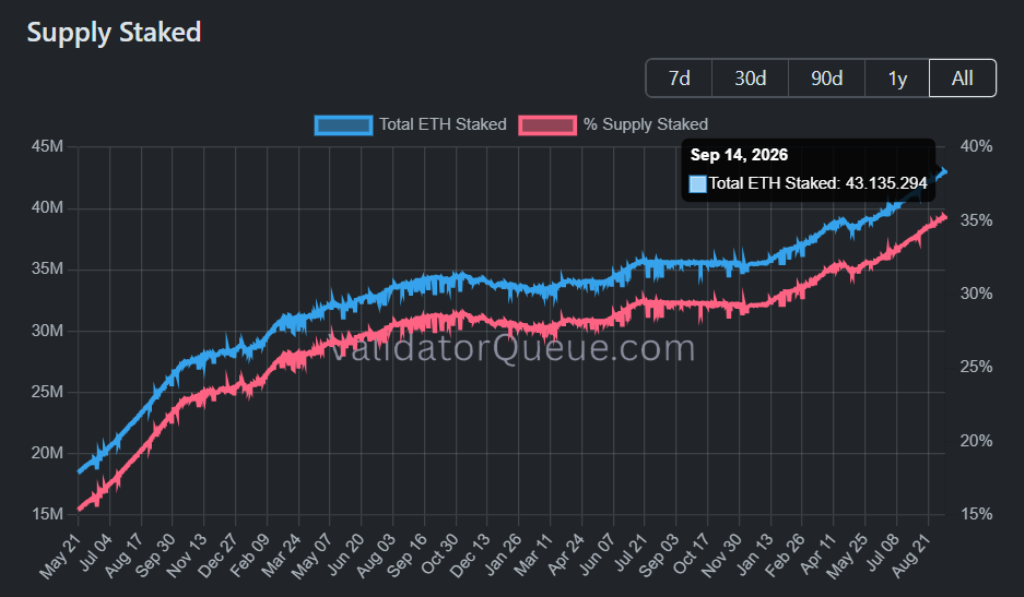
The direct effect is a reduction in the ETH available to trade on secondary markets. A similar dynamic had already appeared in the validator queue at the end of last year, when staking inflows doubled outflows, a signal that long-term conviction had been building ahead of this new all-time high.
The Price Waits as the Market Tightens
Ethereum is currently trading at $2,512.62, with a weekly gain of 0.9% according to CoinGecko. The weekly chart shows a peak above $2,600 on September 12, followed by a rapid correction toward the $2,450 to $2,550 range, where the price has remained stable. That price stability coexists with a structural tightening of supply, a combination that throughout the network’s history has preceded moves of greater magnitude.

Institutions Are Betting on ETH
This trend is not just a retail phenomenon. BlackRock filed a request to launch an ETF that would allocate up to 95% of its ETH holdings to staking, rather than simply replicating the spot price. If the product is approved, it would withdraw an additional portion of ETH from the liquid market, deepening the contraction that on-chain data already reflects. Institutional demand and retail staking are now pulling in the same direction.
With fewer coins available for sale, selling pressure tends to diminish when demand picks up. If staking continues to grow and institutional products strengthen their position, Ethereum’s liquid float will keep shrinking through the rest of the year, setting up conditions in which modest increases in demand could have a more pronounced price impact than in recent periods.