Time measurement in centralized computer systems presents a level of complexity, yet it is resolved through synchronization with atomic time servers and trust in a central authority. The Bitcoin network, operating under a decentralized paradigm, confronts this problem from a different perspective. The difficulty in establishing a precise chronology in Bitcoin does not constitute an implementation flaw subject to correction through patches, but rather an inherent consequence of its distributed consensus architecture.
The nature of the timestamp in the Bitcoin protocol
The nTime field included in the block header constitutes the fundamental mechanism for temporal fixation. This 4-byte field stores a Unix timestamp value that the miner sets at the moment of hash resolution. The original protocol specification establishes restrictions for this value: the timestamp must be greater than the median of the timestamps of the previous 11 blocks (MTP, Median Time Past) and cannot exceed the receiving node’s adjusted network time by more than 7200 seconds (2 hours).
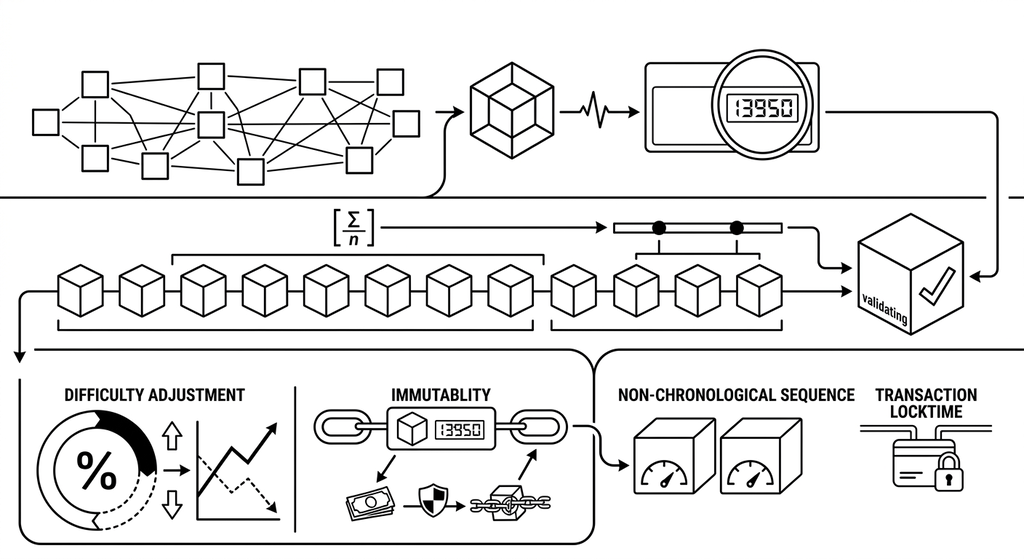
This two-hour flexibility does not represent a minor concession. A financial system that admits a margin of error of 120 minutes in the temporal certification of its transactions could be considered imprecise. However, this characteristic responds to the need for tolerance against network asynchrony. Globally distributed nodes cannot share a reliably synchronized clock without depending on third-party services like NTP, which introduce variable latencies and are susceptible to man-in-the-middle attacks.
The miner, possessing the ability to choose the timestamp within a defined range, introduces a variable that eliminates the possibility of establishing an absolute time of block emission. The network does not verify the truthfulness of the timestamp in relation to the actual moment of hash resolution, but rather limits itself to validating its compliance with the median and future restrictions. This mechanism converts the timestamp into consensual data, not an empirical measurement of physical time.
The problem of global synchronization and its impact on transaction confirmation
The perception of time in Bitcoin presents a fundamental divergence between the time of block emission and the time of propagation. The block propagation time on the network, ranging between 2 and 10 seconds under normal conditions, though it can extend to 30 seconds or more during congestion, introduces a lag between the moment a mining node solves the block and the moment other nodes receive and validate it. This interval, although brief in human terms, becomes significant in the context of competition for transaction confirmation.
A transaction included in a block with a timestamp that, according to the receiving node’s clock, lies in the future will be accepted as long as it does not exceed the two-hour difference. This scenario generates a situation in which transaction prioritization based on emission time loses all objective meaning. The order of transactions is not defined by the instant the sender signed them, but by the moment the miner decided to include them in the block and the timestamp assigned to that block.
For the end user, confirmation of a transaction with six blocks does not guarantee that exactly 60 minutes have elapsed since its emission. The variance in block finding time, described by a Poisson distribution, implies that the interval between blocks can be seconds or hours. The network difficulty, adjusted every 2016 blocks, attempts to maintain an average of 10 minutes, but does not ensure regularity in short periods.
Attacks based on temporal manipulation
The flexibility of the nTime field enables specific attack vectors. The block time attack allows a dishonest miner to manipulate the timestamp to influence the network difficulty calculation. By presenting artificially delayed timestamps, a miner could attempt to cause the difficulty to decrease more than expected in the next adjustment. Although the MTP protection limits the ability to move timestamps backward, the possibility of strategically advancing timestamps has not been completely eliminated.
The attack known as the “time warp” represents the most critical materialization of this vulnerability. An attacker with the capacity to mine 50% of the network can systematically manipulate timestamps to alter the difficulty calculation, reducing it and allowing block generation at an accelerated rate.
The correction implemented in Bitcoin Core in version 0.8.2, which introduced MTP as a lower bound, mitigated this attack but did not completely eliminate it in all its variants. The academic discussion regarding the completeness of the patch against variations of the original attack remains open in development forums.
In the second-layer ecosystem, such as the Lightning Network, temporal precision acquires critical operational relevance. Payment channels use timelocks (OP_CHECKLOCKTIMEVERIFY and OP_CHECKSEQUENCEVERIFY) to manage dispute resolution and contract expiration. The distinction between block time (BLOCKTIME) and sequence time (SEQUENCE) introduces a complexity that requires a deep understanding of consensus rules.
A smart contract that depends on the expiration of a block at a specific moment faces the uncertainty of network variance. A block expected at 14:00 UTC could arrive at 13:45 or 14:20 without this constituting an anomaly. This unpredictability forces contract developers to implement safety margins that can extend from several hours to even days, depending on the application’s risk tolerance level.
Lightning payment channels handle this uncertainty by implementing expiration times based on blocks, not calendar time. The payment sender establishes an expiration deadline in number of blocks, assuming an average generation rate. When variance deviates significantly from the mean, dispute resolution mechanisms may execute before the commitment transaction has reached the required maturity, generating risks of forced channel closures or liquidations not executed on time.
Time perception in exchanges and its operational implications
Cryptocurrency exchanges face the temporal problem from the perspective of credit allocation and deposit resolution. When crediting a deposit when the transaction reaches a certain number of confirmations, the exchange cannot rely on the block timestamp to determine the transaction’s age. The entry date into the mempool and the moment of inclusion in the block constitute two variables that can present a considerable difference, especially during periods of high network congestion.
An exchange that uses the block timestamp to calculate the deadline for order resolution with time limits exposes itself to undesired executions. For example, a buy order expiring in 30 minutes based on the platform’s time will not correspond to the block-based expiration that the liquidation transaction might require. This asynchrony has led operators to implement synchronization mechanisms based on their own server clock, ignoring the block timestamp for operational purposes, and using the latter exclusively for consensus validations.
Bitcoin network nodes implement their own timestamp verification
The adjusted network time is calculated as the median of timestamps reported by connected peers, with a tolerance margin of 70 minutes to consider a timestamp valid. A node will not accept a block whose timestamp exceeds this adjusted time by more than 2 hours, establishing a limit that protects against desynchronization induced by future timestamps.
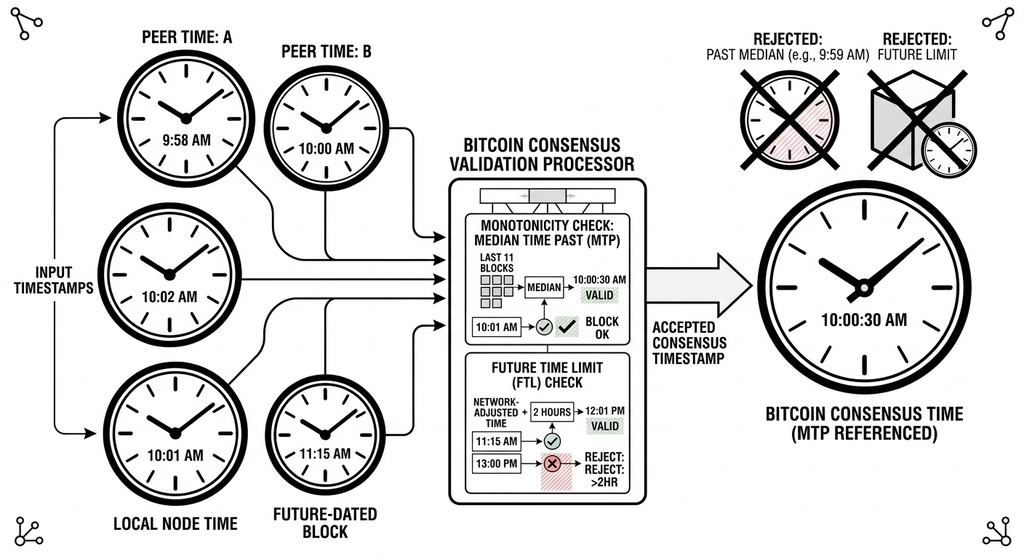
This validation introduces an additional layer of complexity: the node does not verify the timestamp against real time, but against the temporal consensus of its peers. An isolated node or one with a reduced set of peers could develop a temporal deviation that affects its ability to correctly validate blocks. The timestamp propagation mechanism in the P2P layer does not guarantee convergence toward a global time, but rather establishes a tolerance threshold within which the network can operate without interruptions.
Protocol evolution toward greater relative precision
Bitcoin Improvement Proposals (BIPs) have addressed the temporal problem without attempting to solve the issue of absolute precision. The implementation of 32-bit timestamps in the original protocol, which will expire in the year 2106, constitutes an architectural limitation that will require a consensus solution for overflow handling. The current discussion among developers is oriented toward solutions that preserve backward compatibility.
The replacement of the 32-bit timestamp with a 64-bit one is not contemplated in the short-term roadmap, as it would require a hard fork and modification of the block format. The proposal to use UNIX time in milliseconds as a standard for future extensions has been discussed but not implemented, due to the complexity of synchronizing said standard with existing consensus mechanisms.