The Bitcoin move from $64,000 to above $79,000 across four trading sessions constitutes one of the most pronounced rallies for the asset in 2026. The immediate catalyst was the U.S. Treasury Department announcement on August 19, which doubled the limit for its long-term bond buyback operations from $2 billion to $4 billion per operation, effective from September 9 through November 4. The cryptocurrency market interpreted this measure as an expansionary signal, triggering the liquidation of approximately $4 billion in short positions and elevating Bitcoin’s price by 25%.
This article examines the transmission mechanisms that connected a Treasury liability management decision to a price movement of this magnitude and evaluates the sustainability of said movement against the underlying macroeconomic fundamentals.
The Mechanics of the Buyback: What Actually Occurred
The Treasury, under Secretary Scott Bessent, announced it would increase the size of its buybacks of longer-duration Treasury bonds. Bessent subsequently stated that the $4 billion constituted a “floor, not a ceiling”, suggesting the figure could increase further. The announcement occurred one day after the 30-year bond yield reached 5.34%, its highest level since 2007.
A critical understanding requires distinguishing this operation from quantitative easing (QE) mechanically. A Treasury buyback involves the government purchasing existing bonds by issuing new short-term debt to fund the operation. It does not expand the monetary base, unlike Federal Reserve QE, which creates new bank reserves. As an analyst from CoinEx noted, “mechanically, a buyback is not QE, but primarily a tool for managing liquidity and the composition of Treasury liabilities.”
However, the market operates on expectations, not mechanics. The expectation generated was that this measure represented an initial step toward looser policy, an interpretation some analysts have labeled “not-QE”. This discrepancy between operational reality and market perception constitutes the central axis for understanding the price movement.

The impact on Bitcoin channeled through three interrelated pathways.
First, yield suppression. The announcement achieved its immediate objective: the 30-year bond yield fell from 5.34% to approximately 5.19%, and the 10-year yield declined about 6 basis points to 4.66%. The decline in yields reduces the attractiveness of government debt as a yield-paying safe-haven asset, directing capital toward higher-risk assets. Gold rose 2.7% to $4,528 per ounce, and Bitcoin followed a similar trajectory.
Second, dollar weakening. The Treasury intervention exerted downward pressure on the U.S. dollar, which propelled traditional and alternative safe-haven assets. The 90-day correlation between Bitcoin and gold reached its highest level since the pandemic, reinforcing the Bitcoin case as a hedge against currency devaluation.
Third, and most relevant in terms of immediate price impact, the short squeeze. The cryptocurrency market had accumulated record short positions. When yields fell and Bitcoin began to rise, traders positioned to the downside were forced to cover, purchasing Bitcoin to close their shorts. This mechanism amplified the upward movement exponentially. Liquidations were substantial: approximately $3.3 billion on Wednesday and $1.25 billion additional across Thursday and Friday, totaling between $3.5 and $4 billion in short positions liquidated. The key driver of the rally was not the buyback itself but the excessive concentration of short positions in the market.
Signal versus Fundamentals
The fundamental distinction market participants must consider is the following: the Treasury is not injecting new liquidity into the system; it is buying long-dated debt and issuing short-dated debt. This is a refinancing operation, not a monetary creation event. As Dan Gottlander, global head of USD and CAD trading at Citi, warned, the Treasury “will still need to issue in other parts to cover the deficit.”
Nevertheless, the market interpreted the measure as a signal that the Treasury and the Fed are aligned in an expansionary direction. Beimnet Abebe of Galaxy Digital argued that the Fed was “actively doing QE” because its balance sheet was expanding while the Treasury bought long-dated paper and re-issued at the short end. This interpretation, though debatable from a strictly mechanical perspective, holds validity in terms of policy perception.
The issue resides in the fact that the effect on bond markets proved ephemeral. The Treasury intervention had a direct effect for less than one day. Long-term yields declined briefly but subsequently came under pressure again and ended the week approximately flat. By August 20, the 30-year bond yield had already rebounded to 5.24%, recovering approximately half of the prior day’s decline. Bessent stated to CNBC that the market “overreacted a little.”
Technical Levels and Rally Sustainability
Bitcoin surpassed several significant technical levels during the rally: the short-term holder cost basis at $67,138, the 200-day moving average at $68,969, and the realized market average at $75,689, which filters out lost coins and measures the active investor cost basis. However, the asset now faces a resistance zone between $80,000 and $83,000.
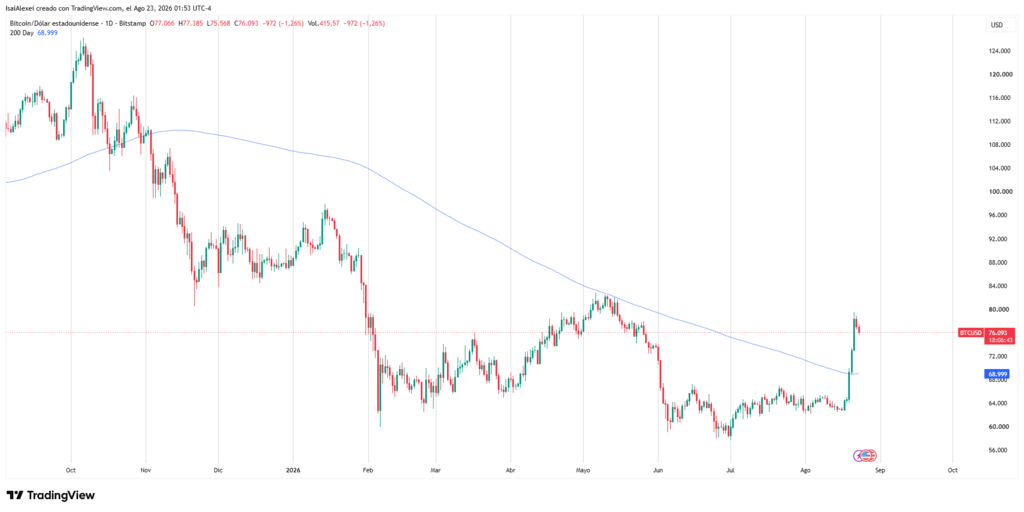
Technical analysis suggests the movement was driven primarily by short covering rather than organic accumulation. As a PrimeXBT report noted, “liquidation short covering can push Bitcoin above $80,000 in the short term, but buying pressure from short covering is difficult to sustain long-term.” The RSI(14) reached 94.63, indicating overbought conditions that have historically preceded corrections.
The critical question is whether Bitcoin can hold the $69,000 level (its 200-day moving average) and transform it from resistance into support. If the 10-year bond yield surpasses 4.7% again or the 30-year approaches 5.3%, the current Bitcoin breakout could face renewed pressure.
Implications for the Bitcoin Investment Thesis
From an investment perspective, the event raises several considerations.
- First, Bitcoin’s reaction to this measure confirms its sensitivity to monetary policy signals, even when these signals do not constitute a structural change. Bitcoin operates as a liquidity asset, and any indication of monetary expansion tends to be positive for its price.
- Second, the magnitude of the short squeeze reveals a significant positional imbalance in the market. The concentration of short positions creates asymmetric risk: any positive news can trigger disproportionate price movements. This suggests the market was structurally over-leveraged to the downside, and the correction was a matter of timing rather than catalyst.
- Third, the sustainability of the rally will depend on whether macroeconomic fundamentals align with the currency devaluation narrative. The U.S. fiscal deficit approaches $2 trillion, and concern regarding the direction of U.S. economic policy is real. Ray Dalio, founder of Bridgewater, issued a warning on Friday, advising investors to reduce bond exposure and hold gold and some Bitcoin to hedge against a potential U.S. debt crisis.
However, Manulife Investment Management cautioned that the Treasury “can influence liquidity and sentiment, but cannot persistently suppress the fundamentals of growth, inflation, deficits, and supply.” Corporate bond issuance, particularly from technology companies financing AI investments, is adding pressure on long-term yields.
Price projections vary widely. Investment strategist Mark Connors projects that Bitcoin could reach $180,000 as routine Treasury buybacks improve liquidity. Standard Chartered analyst Geoff Kendrick suggests Bitcoin could reach $100,000 by year-end. Other analysts have proposed ranges of $180,000 to $360,000 in the longer term.
The 25% move occurred in a market with reduced weekend liquidity and extremely concentrated short positions. The question traders must formulate is not whether Bitcoin can attain these levels, but under which conditions and with what fundamental underpinning.
The buyback period extends from September 9 through November 4. During this window, the Treasury will execute operations of $4 billion (or more) per session. The market will observe whether this liquidity without QE manages to maintain suppressed yields and a weakened dollar, or whether fiscal and growth fundamentals regain prominence.