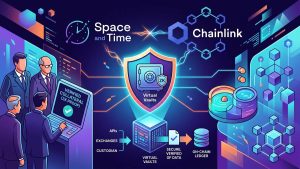
The tokenization of real-world assets (RWAs) — from Treasury bills and private credit to real estate and commodities — is shaping up to be crypto’s next multi-trillion-dollar narrative. BlackRock’s BUIDL fund, Franklin Templeton’s on-chain money market, and a wave of institutional pilots are moving the conversation from “if” to “how fast.” At the center of this infrastructure sits Chainlink, whose decentralized oracle networks supply the critical off-chain data, proof-of-reserves, and cross-chain connectivity that tokenized assets require.
The question for LINK holders and protocol watchers is no longer whether Chainlink will be integral to RWA adoption, but whether the economic model can convert that adoption into sustainable, scalable oracle fees. Can Chainlink’s fee streams grow fast enough to keep pace with — or even outstrip — the tokenization boom, or will the protocol remain a public good with underwhelming unit economics?
The RWA Oracle Stack: Why Chainlink Wins
Chainlink’s RWA advantage isn’t accidental. Three product pillars align almost perfectly with what tokenized assets need:
-
Proof of Reserve (PoR): For any tokenized fund or stablecoin, real-time, automated verification that off-chain collateral matches on-chain tokens is non-negotiable. Traditional audits are point-in-time; PoR feeds deliver continuous assurance. Chainlink already provides this for stablecoins (TrueUSD, Paxos) and is expanding to tokenized Treasuries.
-
Cross-Chain Interoperability (CCIP): Tokenized assets will not live on a single chain. An institutional fund on Ethereum might want to interact with DeFi on Avalanche or a private bank chain. CCIP, built on the same decentralized oracle network, acts as a secure transport layer, generating fees for every cross-chain message.
-
Market Data Feeds: Pricing for tokenized RWAs (real-time NAVs, interest rates, FX rates) requires enterprise-grade accuracy and manipulation resistance. Chainlink’s proven Data Feeds already power much of DeFi; they’re the natural choice when TradFi moves on-chain.
These are not speculative use cases. SWIFT, DTCC, and ANZ have all conducted successful pilots using Chainlink’s infrastructure to bridge traditional systems with tokenized assets. When a central bank explores settlement on a permissioned chain, it finds that Chainlink’s CCIP offers a common standard to connect to public networks without sacrificing security.
The moat is deep: the technical risk in serving large financial institutions is so high that only a thoroughly battle-tested, highly decentralised oracle network will pass their due diligence. Newer, leaner oracles may compete on speed or cost, but they struggle to match Chainlink’s 4+ year record of uptime and Sybil resistance.
How Oracle Fees Flow Today
Understanding whether fees can “keep up” requires a clear picture of how value flows through Chainlink’s ecosystem:
-
Node operators stake LINK as collateral and are paid in LINK (or sometimes the native gas token of the requesting chain) for fulfilling data requests. They earn fees from user contracts that consume Data Feeds, VRF, Automation, and CCIP.
-
CCIP fees are paid by developers and end-users for each cross-chain transaction. A typical token transfer fee can range from a few cents to several dollars in LINK terms, depending on destination chain gas costs and a premium for security.
-
Stakers (in the Chainlink Staking v0.2 pool) currently earn a yield in LINK that is partly subsidized by the protocol’s early incentive pool, not solely from organic user fees. The goal, articulated in the Economics 2.0 roadmap, is to transition to a system where stakers are rewarded entirely from real fee revenue.
To date, total fee generation has been modest relative to Chainlink’s market capitalization. On-chain data from Dune shows that CCIP fees in the first several months after mainnet launch were in the low hundreds of thousands of dollars. Public Data Feed fees are notoriously hard to isolate because many are sponsored or bundled, but the aggregate fee pool remains small — likely under $10 million annually across all services.
That’s a long way from supporting a network that secures trillions in tokenized value.
Sizing the Revenue Opportunity
The bull case for fees rests on the sheer scale of the RWA market. Consider some napkin math:
-
By 2030, tokenized asset estimates range from $4 trillion (Bernstein) to $16 trillion (BCG/Citi). Even a conservative $2 trillion in tokenized Treasury and money market funds alone looks plausible.
-
If Chainlink captures an oracle and interoperability fee of just 1-2 basis points annually on the assets it secures (a fraction of what custodians or transfer agents charge), $2 trillion in secured value would yield $200–$400 million in annualized fees.
-
Add transactional CCIP fees: if tokenized assets move cross-chain at a velocity comparable to stablecoins, message volume could reach hundreds of millions of transactions per year. At an average fee of $0.50–$2.00, that’s an additional $50 million to $1 billion in fee revenue.
In the best case, a mature RWA ecosystem could funnel $500 million to over $1 billion per year to Chainlink node operators and stakers. That would fundamentally transform the token’s economic profile, making staking yields self-sustaining and supporting a cash-flow-based valuation rather than mere speculative premium.
There’s precedent: SWIFT processes over $150 trillion in messages annually, earning fees that underpin its cooperative model. If Chainlink’s CCIP becomes the “SWIFT for blockchains,” a slice of that messaging pie becomes attainable.
The Gap Problem: Will Fees Scale Fast Enough?
While the TAM is enormous, three headwinds could keep realized fees well below ambition.
Subsidy Dependence and Timeline Risk
Chainlink still relies heavily on bootstrap incentives. Staking rewards from the v0.2 pool currently far exceed the organic fee base. If fee growth lags, the community will face a choice: taper rewards and risk node operator churn, or continue emissions that dilute LINK’s value. The transition to a fully sustainable model has to occur while the RWA market is still taking off — a delicate synchronization.
Competitive Pressure on Fees
Institutional clients buying Proof of Reserve or custom data feeds have significant bargaining power. They may demand fixed annual service contracts rather than per-call pricing, compressing margins. Meanwhile, alternative oracle networks like Pyth (pull-based, low-latency) and API3 (first-party data) are pushing fee models that are either close to zero or embedded in data provider economics. If a consortium of banks builds a private oracle network using Chainlink’s own open-source technology (via the Chainlink Platform), fees captured by the public LINK network could be limited.
Transactional Velocity Might Not Favor Oracles
Much of the early RWA activity is in “static” tokenization — buy and hold wrapped bonds or funds that seldom require on-chain price updates or cross-chain transfers. If a BUIDL token sits in a wallet earning yield via rebasing without constant oracle calls, the recurring data feed revenue is negligible. The highest-value oracle calls occur around trading, lending, and rebalancing — use cases that may take years to dominate the RWA space.
The Infrastructure Paradox
Chainlink’s greatest success — being embedded as a standard plumbing layer — carries a risk of commoditization. If every blockchain and institution integrates Chainlink as a default, the pricing pressure becomes enormous. The protocol would then need to monetize through volume alone, similar to an internet backbone provider, where margins are razor-thin despite massive throughput.

The Verdict: More Than Fees — The Moat Is Data as Infrastructure
The question “can oracle fees keep up with the tokenization boom” might slightly miss the point. Chainlink’s long-term value capture likely isn’t as a per-call tollbooth but as an infrastructure layer that accrues value through multiple reinforcing mechanisms:
-
LINK as collateral and staking asset: As RWA value flows through the network, the economic security requirement grows, driving demand for LINK to stake. Even if fee rates compress, the total value staked must scale with the value secured, creating structural buying pressure.
-
Vertical integration: Chainlink is moving into services like DECO (zero-knowledge data verification for institutions) and Functions (serverless compute for oracles), which command higher margins than vanilla data feeds.
-
Network effects: Every new institution that joins strengthens the argument that Chainlink is the industry standard, making it harder for competitors to dislodge and allowing for premium pricing on security-critical services like CCIP.
-
“Settlement token” for a new financial rail: In a future where CCIP settles cross-chain transactions for central bank digital currencies and bank-issued stablecoins, LINK could become the gas or collateral token for an entirely new global messaging layer — a role with immense value even if explicit user-facing fees appear modest.
The most realistic near-term outcome is a dual-speed market: retail DeFi data feeds face fee compression from competition, while enterprise RWA products (bespoke PoR, private CCIP lanes, DECO) generate high-margin, recurring contract revenue. Chainlink’s fee growth will likely trail the parabolic asset-curve of tokenization for a few years, then inflect sharply if institutional adoption reaches critical mass.