On July 18, 2025, President Donald Trump signed the Guiding and Establishing National Innovation for U.S. Stablecoins Act (GENIUS Act), establishing the first comprehensive federal regulatory framework for stablecoins in the United States.
One year later, the balance is mixed: none of the ten proposed rules (Notices of Proposed Rulemaking) have been finalized, and the statutory deadline established in Section 13 for the promulgation of implementing regulations expired on July 18, 2026, without the regulators meeting it. However, the stablecoin market grew by 18.6% during that same period, reaching $308.1 billion.
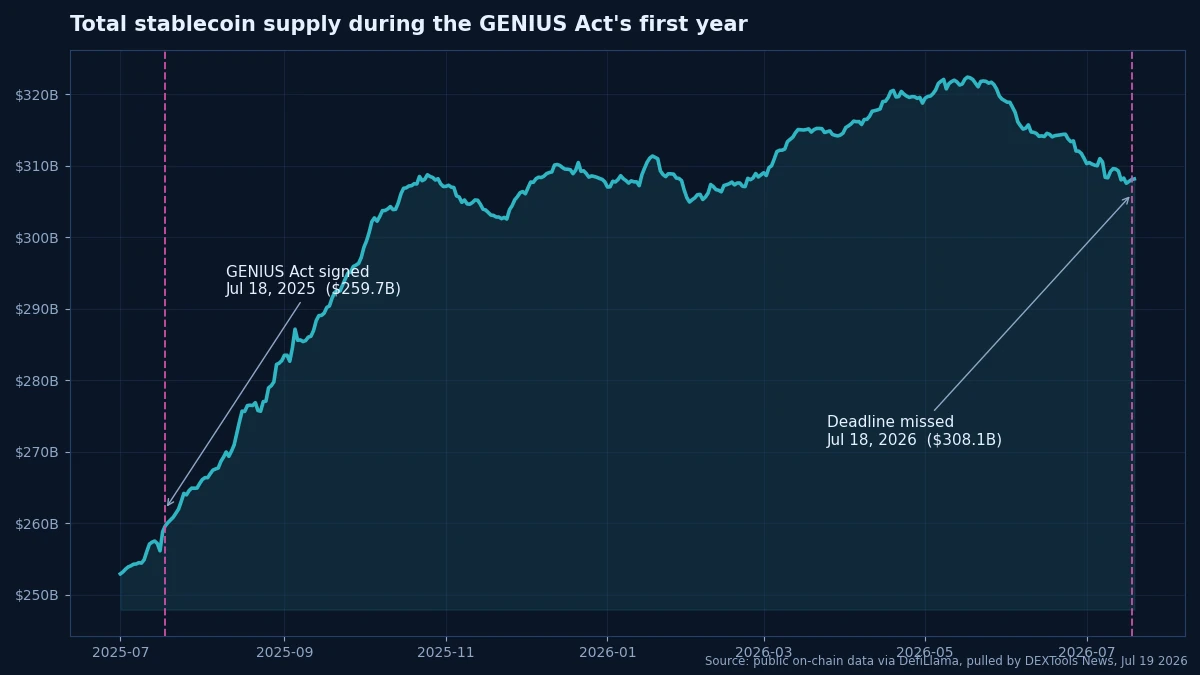
This gap between regulatory progress and market expansion defines the current state of the GENIUS Act. For issuers, institutional investors, and crypto ecosystem traders, the operational question is not whether the law exists, but when and how the final rules will transform market conditions.
The Missed Deadline: Operational Implications
Section 13 of the GENIUS Act granted primary federal regulators exactly one year from enactment to issue implementing regulations. That deadline expired without a single final rule being published.
This failure does not invalidate the law. Section 20 establishes that the law will take effect on the earliest date between January 18, 2027 (18 months after enactment) or 120 days after regulators issue the final rules. Given that no final rule published after September 20, 2026, can advance that date, January 18, 2027, is emerging as the effective implementation date.
Entities planning to operate under the GENIUS Act regime must prepare for an environment where the draft proposals—which include one-to-one reserve requirements in cash and short-term Treasury bonds, redemptions within two business days, and a capital floor of five million dollars—will likely materialize with minor modifications.
The Regulatory Proposals: Clear Direction, Pending Details
During the first year of the GENIUS Act, federal agencies issued ten NPRMs covering different aspects of implementation. The U.S. Treasury published four proposals on eligibility, registrations for foreign issuers, and AML (Anti-Money Laundering) compliance.
The OCC (Office of the Comptroller of the Currency) issued two NPRMs covering approval requirements and supervisory standards for stablecoin issuers of national banks.
The FDIC (Federal Deposit Insurance Corporation) published a proposal in April 2026 that implements custody and safeguard requirements for FDIC-supervised issuers, establishing that deposits held as reserves to back a stablecoin would not be insured for stablecoin holders on a pass-through basis. In December 2025, the FDIC had already proposed application procedures for subsidiaries of insured institutions seeking approval to issue stablecoins.
The OCC proposed in February 2026 a comprehensive framework for licensing, supervision, and enforcement for PPSIs (Permitted Payment Stablecoin Issuers). A critical element of this proposal requires stablecoin issuers with $10 billion or more in circulation that are state-chartered to transition to federal prudential supervision within prescribed timelines.
In June 2026, federal regulators—including the OCC, the Federal Reserve, the FDIC, and the NCUA—published a joint proposal requiring PPSIs to establish Customer Identification Programs (CIP) as part of their AML/CFT programs. This proposal treats stablecoin issuers as financial institutions for purposes of the Bank Secrecy Act (BSA). The comment period for this rule extends until August 21, 2026.
Stablecoin issuers will be treated as financial institutions with all the compliance obligations that entails, including KYC (Know Your Customer), suspicious transaction reporting, and sanctions standards.
Regulation as Catalyst, Not Barrier
Despite regulatory uncertainty, the stablecoin market experienced significant expansion. Total stablecoin supply grew from $259.7 billion in July 2025 to $308.1 billion one year later. The market reached a peak of $320 billion in May 2026. Federal Reserve data show that stablecoin capitalization reached $317 billion on April 6, 2026, more than 50% above early 2025 levels. Ethereum stablecoin transaction volume increased by 50% since the law’s enactment.
USDT (Tether) and USDC (Circle) jointly control approximately 83% of the stablecoin market. USDT has a market capitalization of roughly $184 billion, while USDC reaches $73 billion. The entry of traditional institutional actors has been notable. SoFi launched SoFiUSD in May 2026, accessible to nearly 15 million clients. MoneyGram and other payment companies have deployed stablecoin products.
PayPal expanded PYUSD, BlackRock grew BUIDL, and Ripple increased RLUSD, all under a regulatory framework still in draft form. Visa reached an annualized settlement rate of $7 billion in its stablecoin settlement pilot, a 50% increase over the previous quarter.
This growth suggests that the GENIUS Act provided sufficient directional clarity for financial institutions to begin building on blockchain. As Visa CEO Ryan McInerney noted: “This shift opens the door for banks, networks, and platforms to participate with confidence.” Kyle Sonlin, president of Global Settlement Network, observed that their conversations with governments and institutions now start from the acceptance of stablecoins as financial infrastructure.
Tether and the Compliance Challenge
The case of Tether illustrates the divergence between compliance rhetoric and operational reality. CEO Paolo Ardoino stated at the law’s signing: “Tether will comply with the GENIUS Act.” However, Tether’s most recent disclosures indicate that approximately 25% of USDT reserves remain allocated to assets not permitted under the GENIUS Act, including precious metals, loans, and Bitcoin holdings. The law requires issuers to maintain full reserves in highly liquid assets—essentially cash and U.S. Treasury bonds.
Tether faces a two-year compliance deadline through July 2028. After that period, stablecoins that do not meet the requirements will not be able to operate on U.S. crypto platforms. There is ongoing legal debate regarding whether the grace period applies to non-U.S. issuers such as Tether.
If USDT fails to meet GENIUS Act standards by 2028, a proportion of market liquidity could be affected. Circle, based in the U.S., has made a more visible effort to pre-comply with regulatory requirements.
The CLARITY Act: The Next Legislative Front
The regulatory framework for the broader digital asset market remains pending through the Digital Asset Market Clarity Act (CLARITY Act). The House of Representatives passed the CLARITY Act in July 2025 with 294 votes in favor and 134 against. The Senate Banking Committee passed an amended version in May 2026.
The combined text of the CLARITY Act drafts is not yet public. Senators Cynthia Lummis and Bernie Moreno were scheduled to brief President Trump on the bill the Thursday prior to the publication of the Crypto Economy article, but no public summary of that meeting was released. Anchorage Digital used the first anniversary of the GENIUS Act to renew calls for Congress to pass the CLARITY Act.

The CLARITY Act would classify digital assets into three categories and establish exclusive CFTC jurisdiction over digital commodities. The law would also apply BSA regulations to digital asset market participants. Polymarket data indicates a 40% probability of enactment in 2026.
The first year of the GENIUS Act yields three operational conclusions for the crypto sector:
First, the regulatory direction is irreversible. The GENIUS Act establishes a framework that treats stablecoin issuers as financial institutions with capital, reserve, KYC, AML, and reporting obligations. The agencies are coordinating implementation across multiple NPRMs that, while not finalized, define the parameters of the regime.
Second, the market does not wait for final rules. The 18.6% growth in stablecoin supply and the entry of banks, payment networks, and payment processors demonstrate that directional clarity—even without final rules—is sufficient for institutional investment. Transaction volume and market capitalization have consistently increased during the period of regulatory uncertainty.
Third, compliance risk is asymmetric. Issuers with reserves in non-conforming assets (such as Tether) face a two-year adjustment timeline. U.S.-based issuers with reserve structures aligned with GENIUS Act requirements (such as Circle) are better positioned for the post-January 2027 environment. The transition of issuers with over $10 billion to federal prudential supervision will directly affect the largest market actors.
Outlook for the Second Year
The second year of the GENIUS Act will be defined by the finalization of rules and the transition to the compliance regime. Comment periods for current proposals close between July and August 2026. The OCC has indicated it will finalize its interpretive rule on stablecoins issued by banks by the end of 2026, although the timeline has already been delayed twice.
January 18, 2027, remains the effective date of the law, regardless of progress in finalizing rules. By that date, stablecoin issuers operating in the U.S. must be prepared to comply with the standards established in the NPRMs, even if final rules have not been published.
The CLARITY Act remains the linchpin of the legislative agenda for the broader crypto market. Its passage in the Senate and subsequent enactment would provide the complete framework for exchanges, token issuers, and digital asset market participants.