TL;DR:
- Stolen amount: A case recorded in Hong Kong using AI video conferences resulted in the theft of approximately 40 billion won ($29 million).
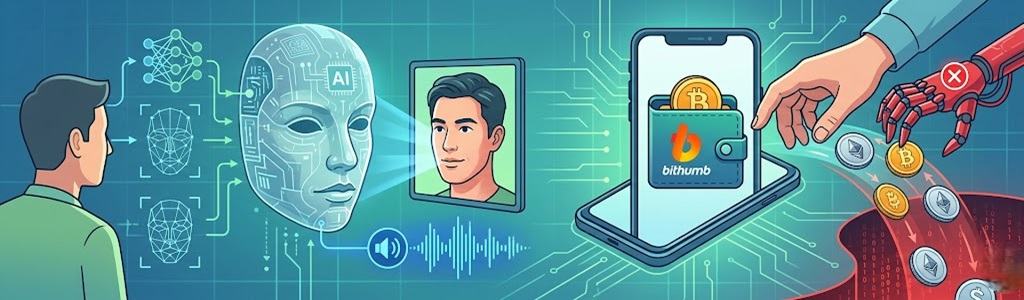
- Fraud typology: Attackers use deepfake and deepvoice technologies to impersonate family members, exchange employees, or government officials.
- Security measures: The official guide recommends activating two-factor authentication (2FA), blocking foreign IPs, and never sharing OTP codes.
The South Korean exchange Bithumb presented a comprehensive anti-phishing guide this Thursday, created to protect digital asset users. The campaign, titled “Voice Phishing Complete Guide,” was launched due to the surge in the use of artificial intelligence to execute financial fraud.
보이스피싱 완전정복🧐
지난 캠페인에서는 "오류를 해결하세요"라며 명령어 실행을 유도하는 ClickFix 공격을 소개해 드렸는데요.
이번 달 주제는 보이스피싱(Voice Phishing) 입니다.
보이스피싱은 수년째 가장 큰 피해액을 기록하고 있는 대표적 금융사기이며,
최근에는 여기에 AI 기술을 악용한… pic.twitter.com/LfVDCCGyD0— Bithumb (@BithumbOfficial) May 13, 2026
The Impact of Artificial Intelligence on Crypto Fraud
During the past year, the sophistication of these scams has intensified. According to market data, criminals employ AI to replicate faces and voices with high precision during live calls.
These data indicate that one of the largest scams occurred in Hong Kong, where a victim transferred the equivalent of $29 million after participating in an artificially generated video meeting. Bithumb reports that the primary objective is to pressure victims into installing remote access applications or revealing their passwords.
The scammers’ MO involves impersonating exchange customer support agents or bank employees. According to current trends, these interactions aim to get the user to move funds to external wallets under the attackers’ control.
Defense Strategies and Technical Prevention
To try and reduce these risks, the platform established three mandatory security rules in its manual. These include an absolute ban on sharing OTP codes, the rejection of links from unverified sources, and the refusal to send assets to unknown addresses.
The use of AI-based phishing detection services, offered by telecommunications operators, is presented as an additional layer of protection for mobile devices. A company spokesperson noted that because AI financial crimes are increasingly difficult to identify, awareness campaigns will be permanent.
This phenomenon is not exclusive to the Korean market. Recently, in Canada, combined losses of $2.3 million were recorded linked to deepfakes that used the image of public figures to promote fraudulent investments.
Regulatory Environment and Technical Incidents in 2026
The issuance of this security guide coincides with a period of scrutiny for the exchange in the first half of 2026. At the beginning of the year, a technical error incorrectly credited 620,000 BTC units to various accounts, an incident the platform had to correct following unauthorized sales by some users.
Additionally, the Seoul Administrative Court suspended the execution of a six-month business ban that had been placed on the firm. The Korea Financial Intelligence Unit had previously imposed a fine of 36.8 billion won, citing alleged regulatory violations.
Moving forward, new regulations in South Korea require companies managing international digital asset transfers to complete their registration with the Ministry of Economy and Finance to operate legally.